

Why getting dressed can trigger daily meltdowns for some children
People with sensory processing differences say what to wear can be a daily struggle.
Why getting dressed can spark daily meltdowns for some children
Naomi Potter launched her own clothing company after becoming overwhelmed by how certain clothes felt
Every morning, Zara is confronted with the same problem.
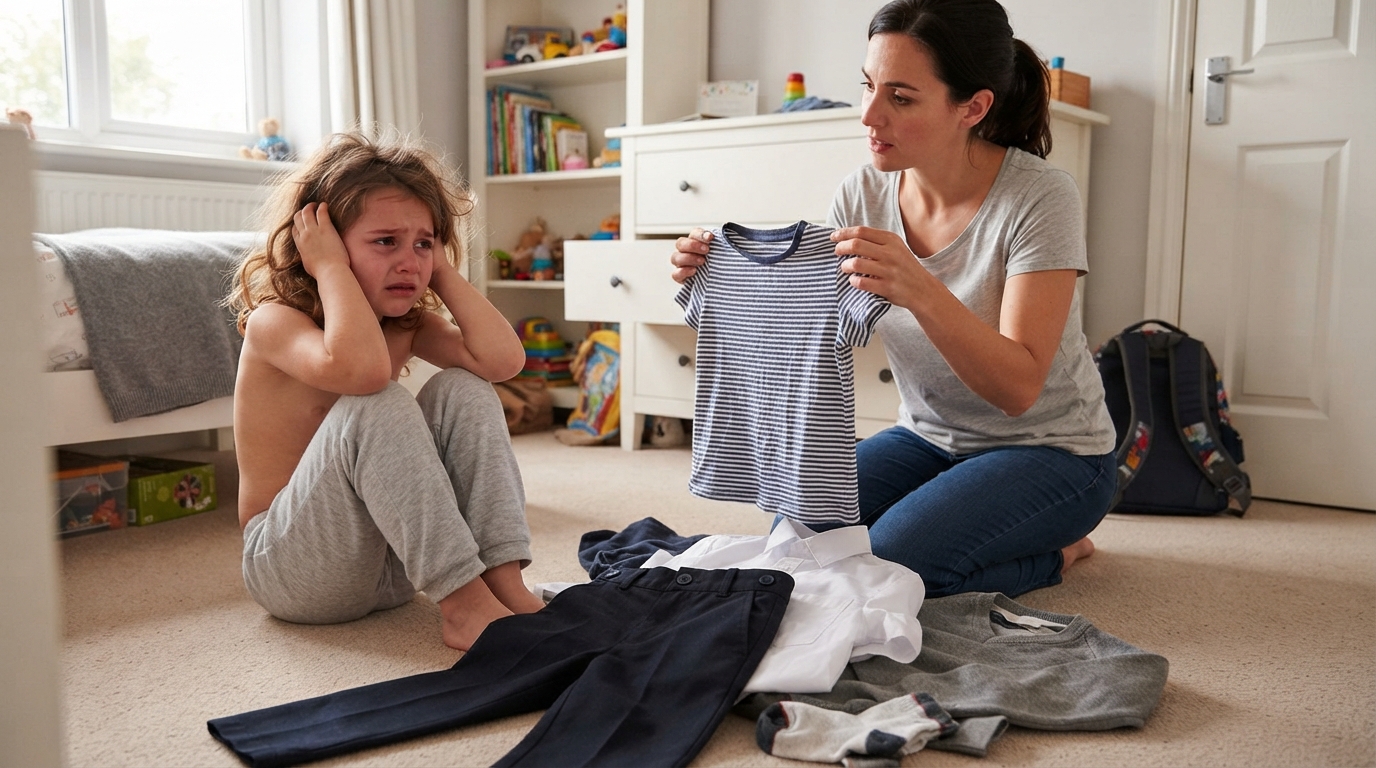
Her seven-year-old daughter Valentina refuses to wear anything that feels tight, has rough fabric or includes buttons. Labels are removed from everything she owns. Finding clothes she can stand to wear can be draining.
"I'm always trying to avoid the distress, the exhaustion, the meltdowns, the difficulties in leaving the house," Zara said.
For Valentina, the wrong piece of clothing can feel overwhelming.
"When I put some stuff that I don't like on, I start screaming and crying and like, no, no, no, I don't want to wear this," she said.
Zara says finding clothes Valentina can tolerate is often a daily challenge
Stories like hers are familiar to many families dealing with sensory processing differences, which experts say can be common among people with autism and ADHD.
"It's maybe best thought of as this sort of continuum," explained Dr Cathy Manning, associate professor in psychology at the University of Birmingham.
"Some people are more reactive to sensory input, some people are less, and it's just more likely that those who are more reactive also have a developmental condition."
Sensory processing differences can affect touch, as well as sensitivity to light, sound, smell and temperature.
For Bridget, from Wellesbourne in Warwickshire, wearing the wrong clothes can bring back memories from childhood.
The 40-year-old, who has ADHD, said many people underestimate the effect unsuitable clothing can have.
"For me, if something feels wrong, it feels noisy," she said.
"I can remember as a child being made to wear clothes that felt wrong. And it's as if there was a very loud, aggressive white noise in the back of my brain all day that wouldn't go away."
Her experiences have made her more understanding of her own children's sensory needs.
Childhood struggles with clothing have helped Bridget understand her own children's sensory needs
Parents told the BBC that problems often become most visible during busy mornings, when children are under pressure to get dressed and get to school.
For Angela, whose 13-year-old daughter has dyslexia, autism and ADHD, school uniforms have been a particular challenge.
"Her sensory problems are more obvious when she's worried about something or anxious about something," she said.
"Socks are a problem, labels in the backs of clothes, especially at the neck, she doesn't like things being too tight under her arms."
Angela believes stricter uniform requirements can make matters worse.
"Uniforms have got so much more strict," she said. "It makes the anxiety more which makes the sensory issues more."
Anais Lombard spent years researching fabrics after her daughter struggled with certain clothes
For some people, the difficulties continue well into adulthood.
Naomi Potter, a nurse from Nuneaton, was diagnosed with ADHD almost a year ago. After the birth of her second child and a diagnosis of postnatal depression, she found even getting dressed had become part of the issue.
"I'd never struggled with it myself until I got to a point where I couldn't cope," she said.
"Everything was becoming overwhelming so that even my clothes were annoying me and I didn't want to get dressed."
Looking for a solution, she began designing clothes that felt comfortable for her to wear. The project eventually became her own clothing company, CalmHaus.
Potter is not alone in trying to create alternatives.
London mother Anais Lombard spent years researching fabrics after noticing her daughter struggled with certain materials. The search eventually led her to launch Morning Marvels, which produces sensory-friendly children's pyjamas.
"From quite a young age we noticed there was certain fabrics she didn't like," she said.
For Zara, raising awareness remains just as important as finding practical solutions.
She hopes greater understanding will prevent other families feeling isolated by experiences that are often hidden behind closed doors.
"It's really sad as you do feel like your child is the only one who has these battles," she said.
"There's not enough education on this."