

"Whose pain?" is it actually? About the podcast without journalists
A society that does not read books, parents who are afraid of vaccines, artificial intelligence that is studying humans, and roads that still cannot break free from old standards... This time, the opinions, objections, and suggestions of viewers from the previous four episodes of "Nima dard?" ("What is the pain?") were analyzed.
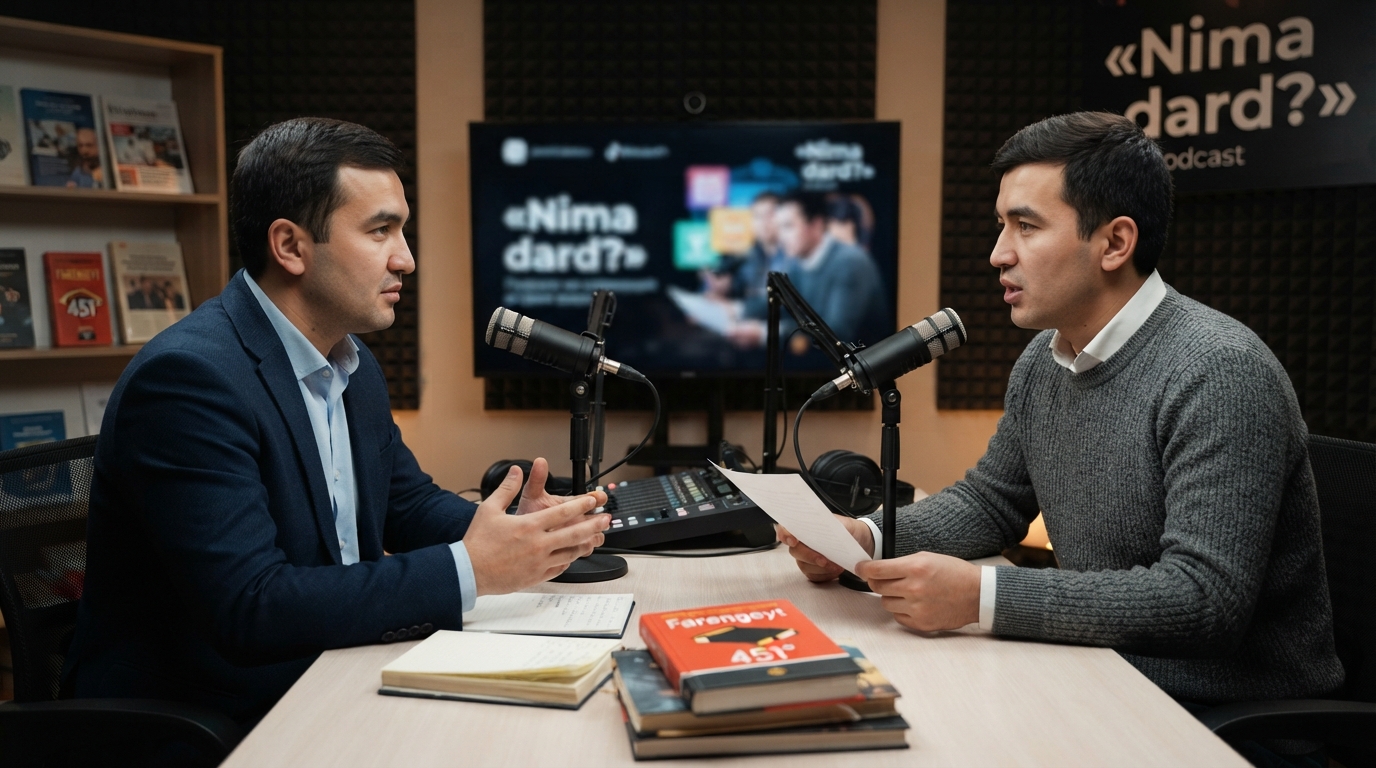
Whose pain is "Nima dard?" (What is the pain?) in reality? About a podcast without journalists
In the first four episodes of the "Nima dard?" podcast, various topics were discussed. This time, however, no guest was invited: Jamshid Muslimov and Odilxon Alixonov, in a conversation with each other, looked back at the previous programs, discussing the conclusions they drew from them, the viewers' objections, and why the podcast was created in this exact format.
The fifth episode of "Nima dard?" began differently than usual. This time, no specialist was invited to the studio. The hosts, Jamshid Muslimov and Odilxon Alixonov, took center stage in the conversation themselves.
There is a reason for this. After the initial episodes, objections were received from viewers along the lines of "it shows that you are not journalists," "speak in the literary language," and "do not mix in Russian words."
The hosts, however, state that they have never claimed to be journalists. Odilxon Alixonov is a doctor, and Jamshid Muslimov is a representative of the finance and economics sector. They emphasize that the podcast's task is not to replicate a professional journalistic interview.
The goal is to find intellectuals and specialists who perceive societal problems as their own personal pain, to hear their opinions, discuss the problem, and look toward a solution as much as possible.
The hosts returned to the first conversation — a dialogue about books and reading with Xurshid Yoʻldoshev, the editor of the "Farengeyt" publishing house.
One incident from it particularly stuck in Jamshid Muslimov's mind. At a book fair, a boy takes a liking to a popular science physics book translated into the Uzbek language. However, his father buys him a cheaper fairy tale book instead. It was mentioned that Russian-speaking parents were purchasing the Russian-language, even more expensive copies of the exact same book.
This raises a question larger than simple book sales: why is the demand for quality popular science literature in the Uzbek language not at the expected level?
During the conversation, opinions were expressed that the roots of this could trace back to education, reading culture, and views passed down from generation to generation. The hosts specifically emphasized that this is a debatable opinion and invited the viewers to join the discussion as well.