

Who, what for, and why?
Kazakhstan: detained terrorists and uncomfortable questions that the NSC leaves unanswered
Who, What for, and Why?
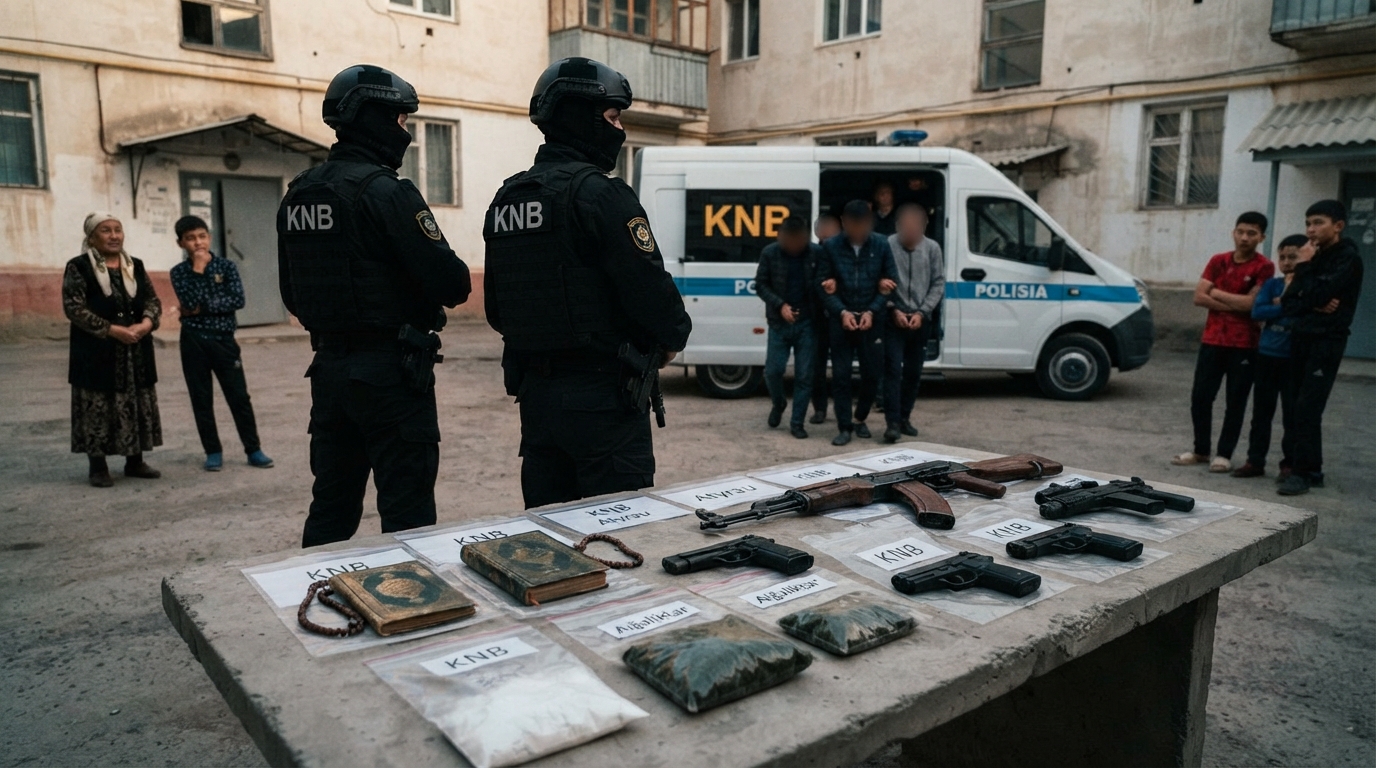
On October 30 in Atyrau, officers of the National Security Committee (NSC) of Kazakhstan, coordinated by the prosecutor's office, detained ten people at once. The official report is extremely dry: an extremist group aiming to forcibly change the constitutional order in the western region; weapons, drugs, and religious paraphernalia seized; three underground educational centers for children and teenagers liquidated; some of the detainees have prior convictions for terrorism and common crimes. And that is all. That is where the official information ends. Beyond that is Article 201 of the Criminal Procedure Code, "not subject to disclosure." And beyond that arise questions that naturally suggest themselves if one reads this report not as a press release, but as an attempt to understand what actually happened and is happening.
What is wrong with this "sensation"
Formally, the news looks serious: ten people, weapons, drugs, children's centers. But the more carefully you read, the more details remain unanswered.
Who are these people? Citizens of Kazakhstan or foreigners? Which religious or ideological group do they identify with? Where did the money for weapons, drugs, and the maintenance of three underground centers come from? Who financed them? Who was the ideologist? Who recruited the children? There are no answers to any of these questions. There are only general formulations that could be applied to any group in any country.
The combination of "weapons, drugs, and religious paraphernalia" looks particularly strange. This is a set of different criminal categories. Religious extremists do not usually deal drugs — these are different types of crime; they have different logic, different channels, and different motivations. If this is a mixture, then the question arises: is this really a religiously motivated group, or are they criminals hiding behind religion? Or, on the contrary, are they religious fanatics who have devolved into ordinary crime? A lot depends on the answer, but there is no answer.
Three underground educational centers for children — this is perhaps the most disturbing line. If three schools, where children were taught something illegal, really operated somewhere for years, the question arises: how did this remain unnoticed? Who attended these schools? How many children passed through them? Where are their parents? Why did no one notice anything? If they did notice, why were they silent? If they did not notice, what does this say about the work with the local community?
Where does the money come from and go, and why are they caught in "small batches"?
A question floats in society: why do the security services catch extremists in small groups instead of busting the entire network at once? It sounds like conspiracy theory, but behind it lies a real problem — a lack of transparency.
After the January 2022 events, the official position changed. While previously the talk was mainly about external funding, now Kazakhstani experts and religious scholars admit: most external channels are blocked, and the main portion of the money now comes from within the country. Radical groups have been marginalized, gone into the shadows, and collect funds through charitable foundations and donations that are almost impossible to track.
This is an important shift. Public discussion covers not only "foreign sponsors," but also internal schemes. However, there is no such context in the official reports about the arrests. The NSC does not state where the detainees in Atyrau got their money. It does not state whether they are connected to any foundations. It does not state whether the investigation is following financial chains.
The systemic problem is that society does not see the big picture. It sees individual arrests, individual press releases, individual trials. And it does not see how these dots connect. Is there an overall strategy? Is there a map of the network? Is there an understanding of who stands behind whom? Without this, every new arrest looks like an episode, not a part of a system.
The President "knows," but does not name
After January 2022, President Kassym-Jomart Tokayev stated that he knew where the riots were financed from, but he did not name a single country. This creates a strange situation: the existence of a foreign trace is acknowledged at the highest level, but it is not specified publicly.
Meanwhile, different conversations are taking place in parliament. Deputies from the People's Party of Kazakhstan raised the issue of foreign funding in June 2026 — not of extremist groups, but of NGOs and media. According to their data, Kazakhstan received over 12 billion tenge (more than $26.5 million) in foreign funding in the second half of 2025. A significant portion went to structures that position themselves as human rights and expert organizations. The deputies named specific foundations — Open Society Foundations, National Endowment for Democracy*, European Endowment for Democracy — and demanded the disclosure of final beneficiaries and projects.
And then this party was simply dumped. Today, it is not present in the new Kazakhstani parliament, the "Kurultai." A coincidence? Doubtful.
This is a separate storyline, not necessarily connected to Atyrau. But it shows: in Kazakhstan, there is a public discussion about the transparency of foreign funding. And there are official figures regarding the amounts. But there is no answer to the main question: how do these funds relate to actual extremist groups? Is there a connection between "foreign agent" funding and those detained by the NSC? Or are these two different streams that simply exist in parallel?
For now, these questions are answered with silence. And silence on such topics always works against the authorities. It breeds rumors, conspiracy theories, and a feeling that something is being withheld from society.
What should have been in a normal report
If the NSC really wanted not just to report an arrest, but to explain to society what happened, the message could have looked different. It would have contained: the citizenship and age of the detainees (at least in general terms); the regions they came from, if they are not local; the approximate period during which the group operated; at least a general characteristic of the ideology — without propaganda, but with an understanding of what we are dealing with; information on whether an investigation into the finances is underway and whether there are suspects outside of Atyrau.
None of this is present. There is only "ten people, weapons, drugs, three centers." Moreover, drugs figure in every such case as an integral part of the "gentleman's set," as if all extremists without exception are drug addicts. This is not an explanation; this is a headline. And behind the headline is an emptiness that everyone fills themselves: some with fear, some with distrust, some with conspiracy theories.
The question that worries society is: why can't they be finished off once and for all? In fact, the question is not for the NSC, but for the system of communication between the authorities, security services, and society. As long as society does not understand what the authorities want and who the security services are fighting, it can neither trust them nor help them. And without trust and help, any fight against extremism turns into a one-sided game: catch them, report it, get a checkmark, seal the information, go catch the next ones.
Ten people in Atyrau is not a sensation. It is another episode in a long story that is told to people in parts and with major omissions. And until the story becomes complete, questions will remain.