

What we didn't notice as a child: hidden hints in favorite cartoons
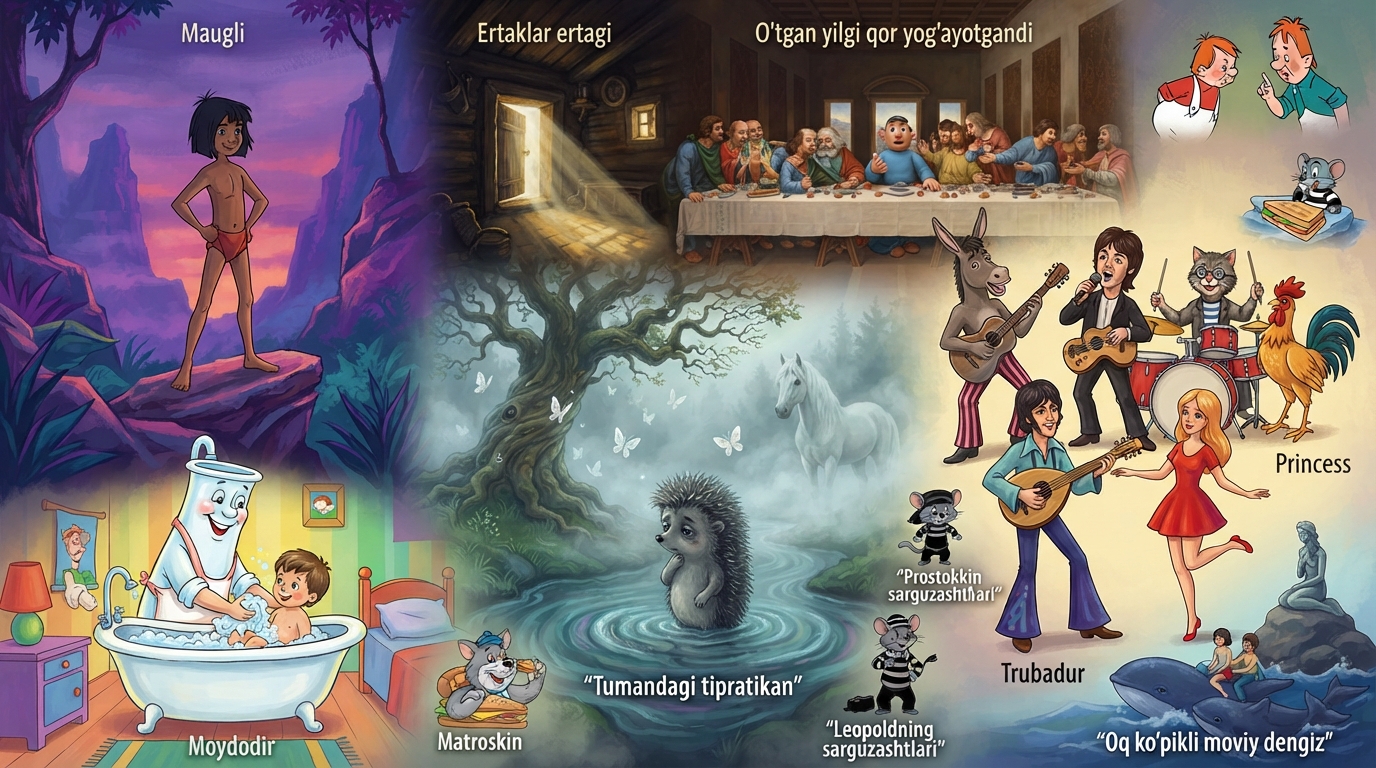
Even though we didn't notice it as children, there are many hidden meanings and allusions in our favorite cartoons. When we watch them again as adults, details that previously seemed like ordinary backgrounds suddenly take on a new meaning.
**"Mowgli"**
When Korney Chukovsky wrote "Mowgli" in 1921, bathrooms were rare in homes, and washbasins were often located in bedrooms. Chukovsky did not attach any hidden meaning to the image of Mowgli, but rather created a vivid and everyday image that was understandable to children.
**"Mowgli"**
The artistic style of the cartoon "Mowgli" was inspired by the works of Nicholas Roerich. The artist's style of depicting nature - soft but saturated colors, inky sunsets, sharp cliffs and endless stone valleys - creates a unique jungle atmosphere, both fairy-tale and realistic at the same time. It is this style that gives the cartoon a unique aesthetic that distinguishes it from other Kipling adaptations.
**"The Tale of Fairy Tales"**
The famous animator Yuri Norstein effectively used classical painting techniques in his work. In his work "The Tale of Fairy Tales", the light falls on the scene with the door open, just like in Rembrandt's painting "The Return of the Prodigal Son". And the scene of the bald man returning to his home is in harmony with the biblical plot of the return. This style gives the cartoon depth, turning it from a simple children's story into a philosophical observation about memory and homeland.
**"Last Year's Snow Was Falling"**
This seemingly simple cartoon is actually rich in references to masterpieces of world culture. In one of the scenes, when the hero says "I will throw parties!", the composition refers to Leonardo da Vinci's "The Last Supper": the characters line up around the table in a pose similar to that in the famous fresco.
"Carriage to me, do you understand! Carriage!" is a line taken and modified from Alexander Griboyedov's play "Madness". The phrase "Oh, these storytellers" is an epigraph to Dostoevsky's first novel "Poor Things", which in turn is a quote from Prince Odoevsky's story "The Living Corpse".
**"Mittivoy and Carlson"**
The character of Freken Bock was inspired by Faina Ranevskaya. Initially, the actress was supposed to voice the character herself, but she was horrified when she saw the sketches and said that "this ugly old woman" could not be her. After much persuasion, she agreed, but then she became very capricious: she kicked the director out of the studio, led the process herself, and constantly improvised.
Many of the phrases that have become popular among the people are the result of her own creativity. The phrase "I'm crazy! Is it possible..." is a reference to the film "Spring". The actress categorically refused to say the last phrase "My soul, my soul" due to personal memories, and this phrase was voiced instead by the cartoon editor Raisa Frichinskaya.
**"The Three from Prostokvashino"**
Matroskin's phrase "Uncle Fyodor, you're eating your sandwich wrong" has become very popular. There is also a humorous theory that the cat advised to eat the sandwich upside down, so that the sausage would fall to the ground and you could eat it separately. However, this clip is a reference to Vladimir Gilyarovsky's book "My Wanderings", which is not about sausage, but about liver. Matroskin simply modernized the old joke and made it even funnier.
**"The Blue Sea with White Foam"**
The cartoon is full of allusions to myths and classical art. For example, the scene where the boy and the sea king stand on three whales refers to ancient ideas about the structure of the universe. The princess sitting on the rock is reminiscent of the famous "Little Mermaid" statue, while the chests pouring out of the shell are a sign of a cornucopia.
**"The Adventures of Leopold"**
In the cartoon, the mischievous mice seem to parody the heroes of "The Lucky Gentlemen" and "Operation I", while some scenes with their participation refer to the films "The White Sun of the Desert" and "The Prisoner of the Caucasus".
**"The Hedgehog in the Fog"**
This cartoon is often interpreted as a philosophical parable. In it, the Hedgehog passes through symbols associated with death and rebirth: white butterflies (a symbol of resurrection), oak (the world tree - Yggdrasil), and a horse (among the Slavs - a guide to the afterlife). The hero's thoughtful emergence from the river is reminiscent of Dante's return from the Divine Comedy.
**The Bremen Town Musicians**
The most obvious reference in the cartoon is a parody of the famous trio from the film "Operation I": Coward, Dovdir and Barzangi. However, the characters of the main characters are also inspired by famous figures - Western rock musicians. For example, the gloomy Dog is reminiscent of Paul McCartney from The Beatles, while the sideburns and round glasses of the Rooster are apparently a reference to Ringo Starr. The film's composer Gennady Gladkov was a fan of The Beatles. The wide striped trousers and energetic movements of the guitarist Donkey make him look like Mick Jagger from The Rolling Stones.
For the troubadour's hairstyle and flared trousers, director Inessa Kovalevskaya was inspired by "some foreign magazine." The princess's short red dress was the wedding dress worn by the wife of the cartoonist Yuri Entin. All of this was completely in keeping with the style of the hippie movement.