

What the defendants said at the third hearing in the Uzbekneftegaz case. Report
In the trial of the former Uzbekneftegaz management and contractor representatives, the former deputy chairman, the head of the procurement department, and the former head of Enter Engineering testified. All denied the charges and stated that the decisions were made outside their authority. Sidikova's pretrial detention was requested to be changed.
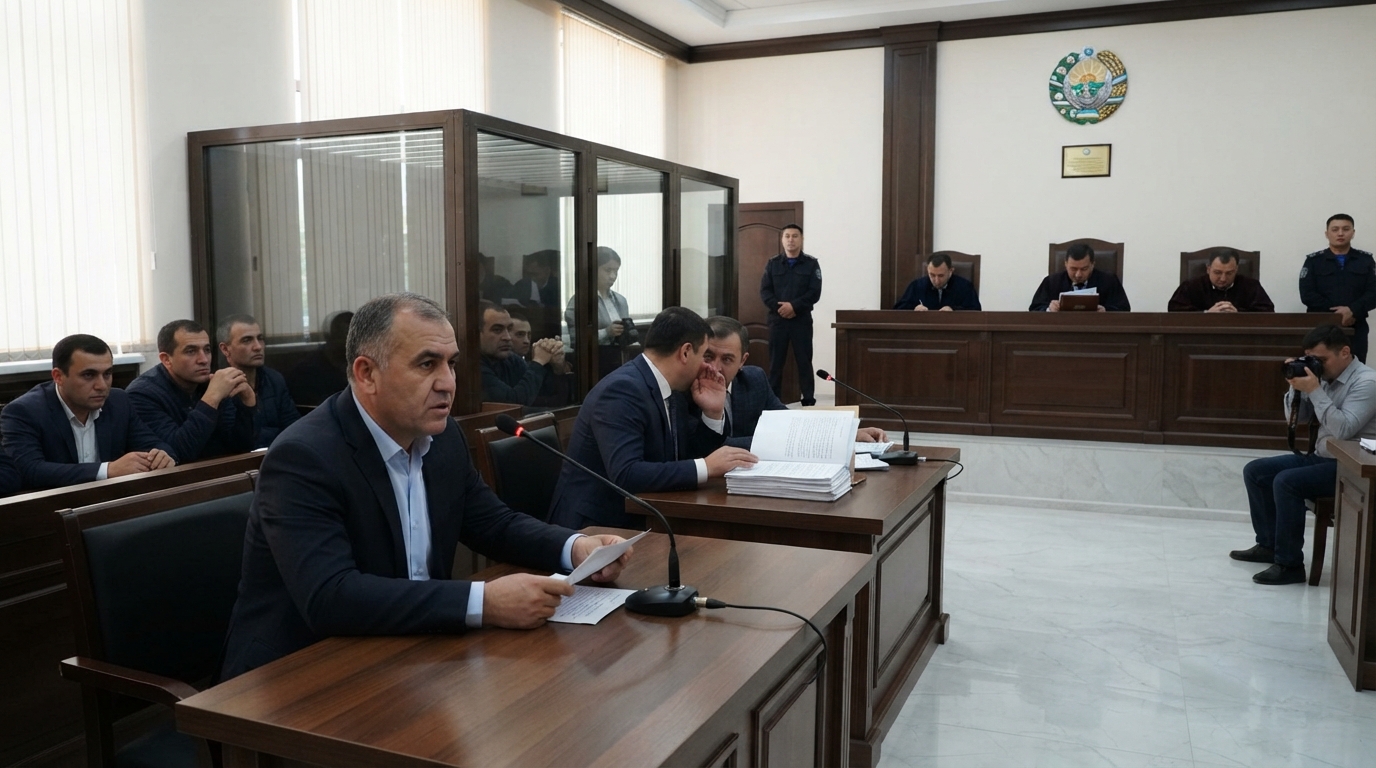
**What the defendants said at the third hearing in the Uzbekneftegaz case. Report**
On August 7, the Yashnabad District Criminal Court in Tashkent continued its consideration of the case against the former management of Uzbekneftegaz and representatives of contractor companies. Gazeta correspondent Shukhrat Latipov attended the hearing and prepared a report covering the main points.
The third hearing concluded the questioning of the former chairman of the company's board, Bakhodirjon Sidikov. Following this, former deputy chairman Bakhtiyar Anarkulov, head of the procurement department Dilmurod Burkhanov, and Enter Engineering representative Ulugbek Usmonov testified.
All defendants pleaded not guilty. In their testimony, they disputed both the damages alleged against them and the prosecution's allegations regarding their role in decision-making.
The trial continues. The statements presented in this report represent the positions of the defendants and their defense. The court has not yet assessed them or rendered a verdict.
In accordance with the principle of the presumption of innocence, defendants are presumed innocent until proven guilty by a final court verdict.
**Report from the previous hearing**
Bakhodirjon Sidikov completed his main testimony at the previous hearing. On August 7, the lawyers for the other defendants continued to question him.
Lawyer Rakhmatov, representing Dilmurod Burkhanov, asked the former head of Uzbekneftegaz about the company's management structure and whether the supervisory board's decisions were binding on the executive body.
Sidikov confirmed that the supervisory board's decisions and instructions were subject to execution.
Masudjon Khoshimov's lawyer asked whether a face-to-face confrontation had been held between him and Sidikov during the investigation. Sidikov replied that no such confrontation had taken place.
Separate questions related to the compressor station construction project with Maxsusenergogaz. Sidikov explained that the original decision was revised to reduce costs. He added that after analyzing the project, the option to continue construction in its original form was abandoned.
Sidikov noted that Uzbekneftegaz owned a 41% stake in Maxsusenergogaz, describing it as a specialized company with which Uzbekneftegaz collaborated in several areas and had mutual settlements. Therefore, he said, the funds could have been offset or used in other relationships between the companies.
Questions also related to the Tuti-Maidan gas field development project in Afghanistan, in which Eriell was involved. According to Sidikov, Uzbekneftegaz was expected to become a shareholder in the project with a 60% stake.
He stated that the supervisory board's decision to allocate funds was based on decisions by the Cabinet of Ministers and approvals from the Presidential Administration. Information about the project was also sent there.
After questioning Sidikov, the court moved on to the testimony of Bakhtiyar Anarkulov, former deputy chairman of the board of Uzbekneftegaz.
Bakhtiyar Anarkulov, former deputy chairman of Uzbekneftegaz, confirmed his testimony during the preliminary investigation and declared his innocence.
He emphasized that some of the transactions imputed to him were concluded before his appointment. Some projects were implemented while he held the position of deputy chairman for economic affairs, but, according to him, he was not a party to the relevant contracts.
Anarkulov claims that another deputy and the company's treasury were responsible for the payments. He compared Uzbekneftegaz's treasury system to that of the Ministry of Economy and Finance.
A significant number of decisions, he claimed, were made based on decrees of the Cabinet of Ministers, the president, and decisions of the supervisory board, while the value of assets was determined by independent appraisers.
"Recovering funds and preparing documents were not within my authority," he stated.
First, Anarkulov discussed in detail the sale of 49% of Jizzakh Petroleum, a company that later became part of Sanoat Energetika Guruhi (SANEG).
According to him, the supervisory board minutes on the sale of the stake are dated May 26, 2021, while he himself began serving as deputy chairman much later.
Anarkulov reiterated that the supervisory board's decisions were binding on the executive body.
According to him, the supervisory board's decision already specified a specific price—$10 million—and did not require an additional valuation first.
However, the valuations of the stake varied significantly.
The main point of contention, the defendant claims, was the price of the stake. KPMG (one of the "Big Four" global audit and consulting firms) valued it at approximately $87 million, Deloitte (another of the "Big Four") at 1 soum, and PwC, later hired, at $15.1 million.
Neither party, Anarkulov claimed, agreed with the valuations.
Anarkulov specifically emphasized that he himself was not a member of Uzbekneftegaz's supervisory board. According to him, it was chaired by former Energy Minister Alisher Sultanov, and included, among others, Deputy Ministers of Economy and Finance Akhadbek Khaidarov, Botir Khodjaev, and Bobur Abdinazarov, as well as Sunatilla Bekenov and others.
After the valuations of the 49% stake in Jizzakh Petroleum diverged significantly, Akhadbek Khaidarov proposed a revaluation, but the other members of the supervisory board did not support him, the defendant said.
According to Anarkulov, given such disagreements, the supervisory board should have reconvened, invited the buyer, and re-discussed the valuation results and the terms of the deal. However, the new meeting did not take place.
"The difference between 1 soum and $87 million is very large," he noted.
For this reason, Anarkulov stated that he considers the deal essentially unfinished.
The next incident concerns the transfer of 106 deposits and a discrepancy in value of approximately 90 billion soums (Gazeta reported on the deal in detail).
Anarkulov claims that the list of deposits was included in a draft government resolution, which underwent several months of approval.
According to him, the assets were transferred at book value, and the discrepancy was technical in nature. He described the amount of the alleged damages as artificially inflated.
The process, he said, was overseen by the company's legal department.
Another incident concerns land tax on properties that were supposed to be transferred to the new owner.
According to Anarkulov, the transfer dragged on for several years, and during this time, Uzbekneftegaz continued to pay land taxes. He estimated the total amount of these payments at approximately 10.4 billion soums.
Anarkulov stated that he did not oversee the cadastral service.
He described the preparation of cadastral documents as a complex issue not only for Uzbekneftegaz but also for the country as a whole.
He believes it is necessary to request documents from both parties and determine why the transfer of the property to the balance sheet was delayed. If it is determined that the new owner was indeed liable for the taxes, the funds, he said, can be recovered.
Anarkulov then moved on to the Shurtan Gas Chemical Complex expansion project, the history of which, according to him, began back in 2018. (Gazeta has written about the project in detail.)
The project was initially considered for a different location, but it was later decided to locate production in the Karakul Free Economic Zone in the Bukhara Region and establish a joint venture, Ark Chemical.
According to Anarkulov, Uzbekneftegaz transferred $416 million as its share in the Ark Chemical joint venture, receiving a 40% stake.
He described the deal as very complex.
He stated that the remaining 60% contribution of the second participant (approximately $660 million) was to be paid as the project progressed until construction was completed. Anarkulov stated that he did not oversee the investment process and cannot be held responsible for the actions of the second participant in the joint venture.
He also cited legislation on limited liability companies, stating that he considers the prosecution's approach to this matter unfounded.
A separate section of testimony concerned Uzbekistan GTL.
Anarkulov recalled that the plant was intended to produce environmentally friendly synthetic liquid fuels, including diesel fuel, jet fuel, and liquefied gas.
The project's deadlines, he said, were delayed first due to the COVID-19 pandemic, then due to the effects of Russia's war against Ukraine and external restrictions.
After the launch, he claims, defects were discovered at the facility. Enter Engineering was required to fix them at its own expense.
The American company Air Products participated in the negotiations. According to Anarkulov, the company agreed to finance the necessary work with approximately $56 million over three years.
He rejected the theory that the debt was artificially created for the purpose of writing it off.
Uzbekneftegaz, he noted, regularly underwent audits by the Big Four international companies, which also confirmed its accounts receivable and payable.
Regarding the disputed $21.4 million payment (repayment of a debt owed by contractor Enter Engineering to Air Products by Uzbekneftegaz), Anarkulov stated that the decision was agreed upon at the "highest level" and the Presidential Administration was informed.
Therefore, he noted, he had no grounds to stop payments on his own.
Describing his own responsibilities, Anarkulov repeatedly emphasized that he was responsible for the company's economics and financial stability.
According to him, Uzbekneftegaz employed approximately 13,000 people, with personnel costs alone amounting to approximately 100 billion soums. Another 500-600 billion soums per month were required for taxes, excise duties, and other payments to the state.
He estimated daily revenue from the sale of gas and petroleum products at approximately 23 billion soums.
At the same time, the company had to service a significant volume of loans.
According to Anarkulov, Uzbekneftegaz has repaid approximately $1.1 billion in loan debt since 2024.
He stated that during his tenure, there was not a single day of salary arrears: employees regularly received advances and basic salaries twice a month.
"My job was to find the money," he described his role.
According to him, the main goal was to prevent the company from defaulting.
Anarkulov was also asked about the Surgil project, where a compressor station was planned to be built with the participation of Enter Engineering.
Specifically, the discussion concerned the installation of a large gas turbine engine.
Anarkulov stated that he did not directly supervise the construction, but he visited the site and personally witnessed the delivery of the engine and the work involved in installing it on the foundation. He said he did not understand why he was specifically assigned to this project.
Regarding the Kultak and South Kemachi incidents with Maxsusenergogaz, Anarkulov recalled that Uzbekneftegaz developed its production program annually with the involvement of Schlumberger.
The company, he said, prepared forecasts for where new wells needed to be drilled and where compressor stations needed to be built to maintain gas production.
A large number of questions concerned the project to develop the Tuti-Maidan gas field in Afghanistan.
Anarkulov explained that Uzbekistan is expanding cooperation with Afghanistan in transport, energy, and other areas. Gas fields in the neighboring country, he noted, had been known since the Soviet era.
To prepare the project, Uzbek delegations traveled to Afghanistan to negotiate with the local side. Anarkulov emphasized that following these visits, reports were prepared and sent to the Cabinet of Ministers. Therefore, in his view, the project was not the initiative of individual company managers but was discussed at the government level.
The project ultimately received the necessary approvals, he claimed.
Anarkulov emphasized that the disputed funds were not transferred outside the country, but rather were transferred to a company account in Uzbekistan, from which they were then transferred to a bank account in Afghanistan.
The prosecutor later cited the Afghan project as one of the main charges against Anarkulov.
According to the defendant, Uzbekneftegaz provided Eriell, a company involved in the project, with a loan of approximately 332 billion soums, or approximately $24 million, for several years and with interest. He described these funds as collateral for Uzbekneftegaz's participation in the project.
Anarkulov claimed that Turkish and Chinese investors had also expressed interest in the field, but the Afghan side was interested in collaborating with Uzbekistan.
The implementation mechanism, he claimed, was determined by a closed government decision.
When asked by the prosecutor whether the project had already begun, Anarkulov replied that in 2025, organizational preparations were primarily underway—geological work, equipment delivery, and team formation. Exploration was planned to intensify in 2026.
He added that Uzbekneftegaz had long been considering the possibility of operating abroad and earning money not only from domestic gas sales but also from geological exploration, drilling, and production services.
According to him, it was planned to appoint specialists from Uzbekistan to key positions in the Afghan project.
When asked why he had no doubts about the need to finance the project, Anarkulov cited the fact that the field itself had long been known and that Soviet-era materials—maps, geological data, and other documents—were available. Furthermore, he said, the project had been approved at the government level, with the Presidential Administration informed.
When asked whether Uzbekneftegaz had previously issued comparable loans of $24 million, Anarkulov said he couldn't immediately recall and would perhaps clarify later.
Another incident concerned Dzharkurganneft.
Anarkulov cited Cabinet of Ministers Resolution No. 66 of February 2020, which concerned a company in the Surkhandarya region that produced a specialized bitumen oil.
According to him, the government resolution required an international company to appraise the asset.
He stated that he didn't understand why the indictment included different valuations for a local company.
The buyer, according to Anarkulov, defaulted on the payment schedule, after which the dispute raged for approximately four years. Uzbekneftegaz, he claimed, filed lawsuits two to three times a year to collect the debt.
The company later declared bankruptcy.
Anarkulov used this episode as yet another example of how Uzbekneftegaz didn't always independently select its contractors: some companies were directly mentioned in government decisions. "We were forced to work with them," he said.
Another episode concerns the Russian company ENGS (at the time a wholly owned subsidiary of Eriell) and drilling at the Sharkiy Berdakh field.
According to Anarkulov, the procurement committee made the corresponding decision on July 23, 2023.
He explained that at that time, Uzbekneftegaz owed approximately 500 billion soums to its own drilling company, Uzneftegaz Burgilash Ishlari, and its technical infrastructure remained weak.
Subsequently, a large quantity of new equipment was purchased for service companies.
Anarkulov reported that a presentation was held for the ministry and the Presidential Administration explaining the need to drill a well within approximately 150-180 days to halt the decline in gas production.
The group's own capacity, he claimed, was insufficient for this, so a foreign company had to be hired.
Moreover, according to Anarkulov, the contract with ENGS was signed before he assumed responsibility for the relevant area.
During questioning, Anarkulov's lawyer, Davron Akhmatov, asked him to explain the structure of Uzbekneftegaz's governance system and the role of the company's board within it.
Anarkulov stated that virtually the entire stake in Uzbekneftegaz—99.99%—is owned by the state, represented by the Ministry of Economy and Finance. A small portion of the shares are traded on the Tashkent Stock Exchange.
According to him, the supreme governing body is the general meeting of shareholders. The next level is the supervisory board, which is a permanent body and acts in the interests of the majority shareholder. Below that is the executive body—the management board, headed by the chairman and his deputies. Next come the departments, structural divisions, regional offices, and subsidiaries.
The lawyer asked Anarkulov whether the executive body has the right to disregard the supervisory board's decision, revise it at its own discretion, or act contrary to it.
Anarkulov responded that the management board does not have such a right.
According to him, the executive body is obligated to implement the instructions contained in the supervisory board's decisions as adopted. The management board cannot independently change the content of a decision or choose a different procedure for its implementation.
Anarkulov noted that this procedure is enshrined in Uzbekneftegaz's charter and the company's internal regulations.
Anarkulov also discussed Uzbekneftegaz's financial transformation and explained why international audit firms from the Big Four were engaged for the assessment.
He explained that the company was transitioning to international financial reporting standards (IFRS), with Ernst & Young performing the necessary work.
In 2021-2022, the company also received international credit ratings. Anarkulov cited leading agencies Fitch, S&P, and Moody's.
This, he said, was necessary to directly attract international financing.
Previously, Uzbekneftegaz received a significant portion of its funding through the Uzbekistan Fund for Reconstruction and Development (UFRD), Russia's Gazprombank, and local banks, particularly Uzpromstroibank.
However, banks have regulations on the maximum loan concentration per major borrower ($75 million, in some cases $100 million), whereas Uzbekneftegaz's financing needs could have reached $800 million.
Anarkulov explained that by borrowing through a local bank, the company effectively paid both the cost of the foreign resource raised by the bank itself and its additional margin. Therefore, direct access to international markets was cheaper.
After receiving the rating, one of the first major financings was arranged by Deutsche Bank together with other banks, including Chinese ones. Anarkulov estimated the total loan amount at approximately $250 million.
He also reported that Uzbekneftegaz's profit increased from 623 billion soums in 2023 to approximately 5.2 trillion soums in two years.
He cited the increase in Uzbekistan GTL production, the expansion of the Bukhara Oil Refinery, the production of AI-92 gasoline, dividends from joint ventures, the placement of Eurobonds, and increased gas tariffs as reasons for this.
According to Anarkulov, the company repeatedly proposed raising domestic gas prices more quickly: at the time, Uzbekneftegaz was selling gas for approximately 600 soums, while some foreign producers were charging approximately 2.5 times higher.
Anarkulov was asked who directly determined the prices during procurement.
He replied that the procurement department did not set them independently.
Commercial proposals were collected, government procurement, an online store, and auctions were used. In certain cases, closed government decisions were issued, allowing for direct procurement under special conditions.
When asked about the alleged criminal conspiracy, Anarkulov stated that he believed the investigation had not provided him with evidence of connections to most of the other defendants.
Anarkulov said he had not even known some of the defendants before the criminal case.
**Photo: Gazeta.**
After Anarkulov, Dilmurod Burkhanov, head of the procurement department at Uzbekneftegaz, testified.
He also denied guilt.
At one point, he explained his position on the limits of his official authority figuratively:
"I have the physical ability to jump one meter, but the investigation wants me to jump three meters."
He claimed he did everything he could within the scope of his position: sending letters, memos, and appeals to suppliers, and forwarding materials to the legal department if contracts were not fulfilled.
The first incident concerns the purchase of two engines from Enter Engineering for approximately $5 million, or 64.7 billion soums.
According to Burkhanov's account of the prosecution, the company allegedly needed one engine, but ultimately purchased two.
Burkhanov stated that the procurement department could not independently decide to purchase this or that equipment.
According to the defendant, his unit's work began following management's instructions.
Burkhanov also disputed the assertion that he and others "succeeded" in concluding the agreement.
He cited, among other things, the Prime Minister's order of January 20, 2025, and a subsequent order from the Chairman of the Board as the basis for purchasing the engines.
"If the order had said to buy 10 engines, I would have bought 10 engines," he explained.
According to him, inspecting the technical condition of the equipment was not his responsibility.
When problems were later discovered, Burkhanov, he claims, sent inquiries to the supplier. Unable to resolve the issue, he prepared a memo to the legal department, after which the dispute was transferred to the economic court.
The mere presence of defects, he noted, does not necessarily constitute theft: such issues can be resolved through claims processing, mutual agreement, or through the courts.
The next episode concerns the Russian drilling company ENGS and the Sharkiy Berdakh field.
Burkhanov is accused of falsifying the minutes of the procurement commission.
Specifically, according to the prosecution's version of events, requests to SOCAR, the Chinese, and Kazakh companies were either not sent, or no responses were actually received.
Burkhanov denied this.
He stated that the minutes were signed by 11 commission members, and approximately 30 more specialists were present at the meeting.
"To falsify the minutes, it would be necessary to forge the signatures of all 11 commission members," the defendant said.
He claims that requests to foreign companies were sent via Uzbekneftegaz's corporate email account, and that responses were also received by mail. This information, he said, can be verified with the company.
Burkhanov also disputed the claim of manipulation of the cost of drilling a 4.5-kilometer-deep well.
In his opinion, if the goal was truly to artificially change the price, the calculations for other depths—for example, 2 km or 5 km—would have to be similarly adjusted.
The investigation, according to Burkhanov's testimony, also attributes the estimated damages of approximately 59.8 billion soums to the fact that Uzbekneftegaz's own drilling company, Uzneftegaz Burgilash Ishlari, was not awarded work.
Burkhanov stated that its capabilities were studied for approximately three months before the procurement committee's minutes were drawn up.
The analysis concluded that the existing capacity was insufficient.
The procurement department itself, he emphasized, did not make this decision, but recorded in the minutes what the procurement committee had decided.
Another incident concerns the supply of Oil Ravon Servis pipes worth 37.1 billion soums.
Burkhanov called the accusation unfounded.
He stated that the contract was executed through an exchange mechanism at the direction of the former head of Uzbekneftegaz, Mehriddin Abdullaev, in January 2023.
His department's function was to monitor the delivery until the pipes arrived at the Mubarek Oil and Gas Department warehouse.
Payments, invoices, and transfers, according to Burkhanov, were handled by the Accounting and Corporate Reporting Department.
"Anything related to payments does not pertain to me," he stated.
Later, according to Burkhanov, Uzbekneftegaz's new management, represented by Abdugani Sanginov, conducted an audit of the delivery after receiving a request. Following the corresponding instruction, a special compliance group, comprised of company specialists, was created in June of this year.
They visited the site and examined the documents and the actual movement of the pipes: where exactly the products were delivered, whether they were accepted into the Mubarek Oil and Gas Department warehouse, and where they were subsequently used.
Burkhanov cited this as evidence against claims that the supplied pipes were missing or that funds were transferred without the goods actually being delivered. He argued that the pipes "couldn't have simply disappeared": their arrival should have been reflected in warehouse records, and their subsequent use should have been tracked through the company's internal accounting.
The fourth section of Burkhanov's testimony concerned work worth approximately 30 billion soums (including VAT) on repairs and upgrades to turbine equipment.
Initially, the necessary work was unable to be completed for a long time with Siemens. Subsequently, a German company was found that promised to complete it more quickly—in 90 days. Its representative was the local company Oilgasservisinvest (whose representative is also a defendant in this case).
This company failed to meet the deadline. Burkhanov stated that complaints were sent, followed by an internal letter to the legal department, after which Uzbekneftegaz filed a lawsuit in the economic court demanding the return of the 10 billion advance payment and a penalty of 4 billion soums.
According to him, Oilgasservisinvest has already paid this amount.
The last defendant to testify on August 7 was Ulugbek Usmonov, former CEO of Enter Engineering from 2020 to 2025.
He also completely denied any wrongdoing.
Usmonov stated that when he held a management position at the company, he was primarily responsible for construction.
Financial matters, banking, fund management, signing financial documents, and the use of the seal, he claimed, were entrusted to Alfonso Tengco, acting under a power of attorney from Enter Engineering's Singaporean subsidiary.
In January 2025, entrepreneur Bakhtiyor Fazylov became the company's CEO, and Usmonov continued to serve as his advisor.
In this role, according to Usmonov, his responsibilities included relaying management instructions, collecting information on project progress, and reporting to Fazylov.
Usmonov specifically addressed the prosecution's theory of criminal conspiracy.
He stated that he personally knows only a few of the individuals named in the case, including Shahzod Alirizayev (who is not listed as a defendant). He claimed he either only knew a number of the other defendants in absentia or first met them during the criminal case.
Therefore, he considers the allegation of a joint criminal conspiracy unfounded.
Usmonov stated that key negotiations between Uzbekneftegaz and Enter Engineering were conducted directly by Bakhtiyor Fazylov and Bakhodirjon Sidikov.
**Uzbekistan GTL. Photo: Presidential Press Service.**
One of the incidents concerns Enter Engineering's debt to Air Products and a payment of approximately $21.4 million as part of the Uzbekistan GTL project (a guarantee and subsequent repayment of Enter Engineering's contractor debt to Air Products by Uzbekneftegaz).
Usmanov stated that he was not involved in the conclusion of the relevant agreement and was not involved in the financial arrangements related to this matter. He stated that Bakhtiyor Fazylov was directly involved in all matters related to Uzbekistan GTL and negotiations and agreements with Air Products.
Usmanov himself, according to him, learned about the contents of some documents and the debt repayment mechanism only during the preliminary investigation.
Usmanov reiterated that he had no authority to approve or reject payments.
He reiterated that during his time at Enter Engineering, he was primarily responsible for construction and did not have the authority to independently approve, reject, or process payments. According to him, financial matters, banking, and the management of funds were overseen by other company officials.
Later, while working as Fazylov's advisor, Usmonov learned that Enter Engineering needed to repay a debt to Air Products. He said he advised management to avoid default and allocate the necessary funds, as he considered it important to fulfill its obligations to the foreign partner.
However, Usmonov claims, he was told not to interfere in the matter. He explained that as an advisor, he could only convey information and make recommendations, but had no authority to manage the company's funds or make payment decisions.
The next episode involved the construction of a compressor station in the Southern Tandyrcha.
Usmonov estimated the total cost of the contract at approximately $77 million. Most of the work, he said, had been completed.
He described the remaining 8.8 billion soums not as stolen funds, but as outstanding debt reflected in the accounting records.
According to him, work continued, the station was built, but Uzbekneftegaz rejected part of the completed work due to deficiencies at the construction site.
After the deficiencies are corrected and the relevant documents are signed, the debt, Usmonov asserted, should be settled.
He emphasized that all amounts are reflected in the accounting entries and can be collected.
In this regard, Usmonov asked the court to acquit him under Article 83 of the Criminal Procedure Code.
Regarding the Surgil project, Usmonov also denied the charges.
He stated that the contract was worth approximately $78 million, while the disputed amount was approximately $8.5 million, or 119 billion soums.
He stated that some of the work stipulated in the contract was not completed due to embezzlement, but rather due to insufficient project funding.
Usmonov elaborated on how, according to him, funds received from the client were approved within Enter Engineering. After receiving the funds, special registers were created listing the required payments—specifically, for the purchase of equipment, materials, and financing of construction work. These registers were sent to Bakhtiyor Fazylov for approval.
According to Usmonov, only after Fazylov's approval could the corresponding funds be allocated to a specific project. If the register wasn't approved or funding wasn't allocated, the project team was unable to purchase equipment in a timely manner and continue work to the planned extent.
This, the defendant claims, explained the delay at Surgil. He stated that the receipt of funds from Uzbekneftegaz did not in itself mean that the entire amount was automatically allocated directly to this project: the subsequent distribution of funds occurred within Enter Engineering and depended on the decisions of the company's management.
Usmonov emphasized that he did not personally manage these funds or determine which projects they would be allocated to.
"I don't know where the money went or how it was distributed," he stated.
The defendant insisted that the disputed amount had not vanished without a trace and that the movement of funds could be verified using Enter Engineering's accounting records and postings. He argued that payment registers, receipts, and subsequent distributions should be reflected in the company's books.
Usmonov also asserted that unfulfilled project obligations remained on the balance sheet and could have been settled by completing the work, offsetting the obligations, or recovering the corresponding amounts. Therefore, he disagreed with the classification of the entire 119 billion soum sum as damages.
A separate incident involved large Baker Hughes gas turbine equipment valued at approximately 111.7 billion soum sum.
Usmonov stated that the equipment had indeed arrived in Uzbekistan, as confirmed by customs documents.
In the fall of 2024, the engine was installed on the foundation of a compressor station at the Surgil field.
He described its dimensions, comparing the unit's height to approximately two rooms in the courtroom where the hearing was held. A separate building was constructed for the engine, and a ventilation system was installed.
After the launch, an accident occurred.
According to Usmonov, a foreign specialist made an error during the installation or startup of the equipment, related to plastic process plugs. This resulted in problems with the oil, the temperature rose to approximately 210 degrees Celsius, and the engine failed.
In November 2025, it was sent to Florence for repairs.
According to Usmonov, according to a letter from the repair company, the equipment should be returned to Uzbekistan after repairs in December 2026.
He believes this incident cannot be considered theft: the engine exists, was imported into the country, installed, and then failed during operation.
Another incident concerns two AI engines (used for pumping gas at compressor stations), the cost of which, according to Usmonov, was included in the damages in the investigation. These are two new engines that Enter Engineering sold to Uzbekneftegaz. He claims that by the time the relevant agreement was concluded, he was no longer involved in the company's operational management and was unaware of the details of the transaction.
According to Usmonov, one of the engines was actually operational, while the other was in storage. Therefore, he doesn't understand why the value of both engines is considered damages. "The investigation is trying to inflate the damage amount," he suggested.
Usmonov said he learned about the failure of one of the units later.
The malfunction occurred during the warranty period. According to the information he received, a foreign object had entered the engine.
The repairs were to be performed by Ukraine's Motor Sich.
The company insisted on sending the unit to Ukraine for inspection, as, in its opinion, the necessary conditions for such an inspection were not available in Uzbekistan. The Uzbek side wanted to conduct the inspection domestically.
The dispute, according to Usmonov, is currently being heard in court.
He also requested acquittal in this regard.
Another issue concerned diesel fuel valued at approximately 3.8 billion soums.
Usmonov reiterated that at the time the relevant agreements were concluded, Fazylov was effectively in charge of the company, while Tengco handled financial matters.
He was an advisor and was unaware of the contract.
Usmonov, however, characterized the provision of fuel to Enter Engineering as a normal business relationship between the companies.
According to him, Enter Engineering later fully repaid the fuel debt.
Usmonov separately contested the results of the property inventory, which the investigation linked to him.
He stated that the inventory included the properties of his younger and two older brothers, including property they inherited.
One of the brothers is involved in construction, Usmonov said. Some apartments are still registered in his name, as the buyers purchased them on an installment plan. After full payment, the properties should be re-registered to the buyers.
According to Usmonov, the car and property registered to his wife were also not purchased by him. Specifically, one of the cars was purchased by his father and registered in his wife's name.
The defendant denied that all the property listed by the investigation belonged to him personally or was acquired with proceeds from the alleged crimes.
At the end of the hearing, lawyer Khusanov, representing the interests of former head of Uzbekneftegaz, Bakhodirjon Sidikov, petitioned the court to change the preventive measure against his client.
One of the defense's arguments was the defendant's health. The lawyer pointed out that Sidikov's continued detention, according to the defense, creates additional risks for him.
Furthermore, the defense specifically questioned the legality of Sidikov's detention itself. He recalled that at the time of his arrest in January of this year, the defendant was a member of the Jokargy Kenes of Karakalpakstan and enjoyed parliamentary immunity.
According to the lawyer, the procedure prescribed for a deputy before Sidikov's arrest was not followed. The defense considers this a violation of his parliamentary immunity and an additional argument in favor of changing his pretrial detention.
The lawyer asked the court to consider both circumstances—Sidikov's health and the arguments regarding the violation of the arrest procedure—and release him from custody, replacing the current pretrial detention measure with a more lenient one (bail, house arrest, or another).
The court did not rule on the motion directly during the hearing and stated that a decision on it would be made at the next hearing.