

What is anime, how did it come about, and where to start your acquaintance?
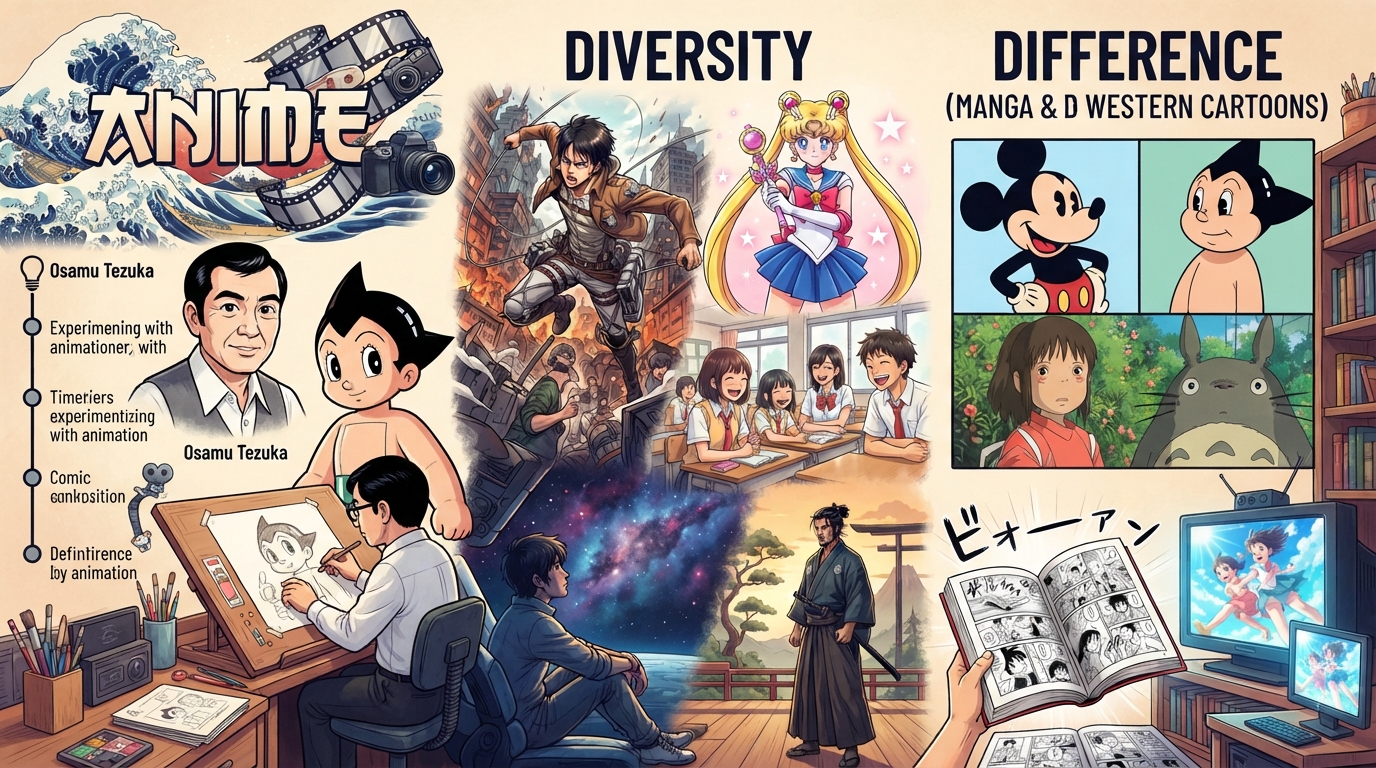
What is anime, how did it come about, and where to start watching it? This article will discuss where anime came from, how it differs from manga and Western cartoons, and how to choose your first work.
**What is anime?**
It is appropriate to start getting acquainted with Japanese animation with its definition. The important point is that anime is not a separate genre, but a type of animated film that was formed in Japan.
The term "anime" is usually used to refer to Japanese animated films and TV series. This word is an abbreviation of the English word "animation".
Therefore, the phrase "I don't like anime" has a broad meaning, like "I don't like cinema". Because one work may be a cheerful school comedy, another a brutal crime thriller, a third a romantic story, and a fourth a complex science fiction.
Anime does have its own, recognizable visual styles: expressive eyes, conditional expression of emotions, a unique work with color and facial expressions. But there is no single "anime style". Some directors work with detailed, realistic images, while others use deliberately grotesque, minimalist or fantastic forms.
Another feature is a serious approach to the viewer. Anime contains stories intended for children, teenagers and adults, where the age category is determined not only by the complexity of the plot, but also by the theme. More serious works may raise issues such as the meaning of life, morality, loneliness, religion and human choice.
In other words, anime is not a plot formula or a specific genre, but a way of telling a story through animation.
**What is the difference between anime and cartoons and manga?**
At first glance, the difference seems obvious, but it is easy to confuse the terms here. The main thing is not to confuse the form, origin and method of creation of the work.
Cartoon is a general concept for an animated work. Anime is also a type of animation, so it is wrong to contrast these words. The difference lies, first of all, in the cultural and production tradition: usually anime refers to Japanese animation or works created in this tradition.
Anime can exist in various formats. The most common of them is television series. A typical episode lasts about 23–25 minutes, and the model of regular television shows was formed in the 1960s, mainly thanks to Osamu Tezuka.
There are also full-length films, short films, OVAs and other formats. Full-length animation is usually produced under stricter quality control and with more flexible deadlines than television series.
Manga is a completely different form. This is a Japanese comic book, that is, a sequence of images and text on the pages. Anime is a moving image with sound, music, voice actors and editing.
At the same time, the connection between them is very strong. Most anime is based on popular manga, but the screen adaptation does not have to repeat the original frame by frame. The authors can change the plot, add new characters or even come up with a different ending.
As a result, a simple conclusion follows: manga is read, anime is watched, and cartoons are a broader concept that includes various national animation schools.
**How did anime appear and why did it become so popular?**
The history of Japanese animation began long before the word "anime" meant a huge industry. At the beginning of the 20th century, the first Japanese directors experimented with the methods of animation available in the West. Among the earliest surviving Japanese animated works is a short film called "Katsudo Shashin", which lasts only three seconds.
The real turning point came after World War II. Manga artist and author Osamu Tezuka, who made a huge contribution to the development of modern Japanese animation, became one of the main figures in this field. In his work, he used, among other things, the technique of drawing characters with large eyes to more clearly express emotions. His manga "The Mighty Atom" brought the author great fame.
By the 1970s, the popularity of manga had increased significantly, and at the same time the number of animated films based on it had increased. Gradually, the plots became more diverse and complex: the fact that the works were originally intended only for a children's audience was no longer decisive.
Then anime spread far beyond the borders of Japan. While television introduced it to audiences in different countries, the development of the Internet has made Japanese animation even more popular. In Russia, television shows have played an important role: for example, in the 1990s, Sailor Moon became one of the main means of introducing an entire generation to the world of anime. At the same time, Japanese animation fan clubs began to appear, and the widespread use of the Internet further accelerated the formation of the anime community.
The popularity of anime is not explained by one reason. It is a combination of a variety of plots, a unique visual culture, strong characters and the ability to talk to the viewer on a variety of topics. Anime can present large-scale adventures, and after a few scenes, switch to a conversation about the fear of death or the value of human choice. It is this freedom of the genre that has become one of the reasons for its international success.
**Where to start with anime?**
The main mistake of beginners is to look for the "right" anime that everyone should start watching. There is no universal starting point: it is better to make a choice based on personal interests, not on the popularity of the work.
If you like fantasy and serious stories, you can pay attention to "Attack on Titan", "Evangelion" or "Psychopassport". And for lovers of adventures and large-scale worlds, "One Piece" is suitable, although it is a rather long story, or you can choose "Fullmetal Alchemist: Brotherhood".
For those who like romance and drama, "Your April Fool's Day", "The Shape of Voice" or "Your Name" are also suitable. If you want something lighter and funnier, watch the anime "The Lady Kaguya: In Love as in War".
For those who want to get acquainted with full-length anime, rather than multi-episode stories, it is convenient to start with films such as Studio Ghibli's Spirited Away, My Neighbor Totoro, Princess Mononoke or Howl's Moving Castle.
Another good rule of thumb is to start with a work that you are already familiar with through recommendations, memes or a film adaptation. If you like a certain genre in cinema, you don't have to immediately dive into a shounen of several hundred episodes.
Another tip is to not judge all anime by one series. Even within one direction, the pace, visual style, dramaturgy and tone can vary dramatically. Anime does not have a single "character", so an unsuccessful first acquaintance will tell more about the work itself than about the industry as a whole.