

What does takeover by sportswear firm mean for traditional shoemaker?
Grenson, which has been making shoes for 160 years, is entering a new era under Castore's ownership.
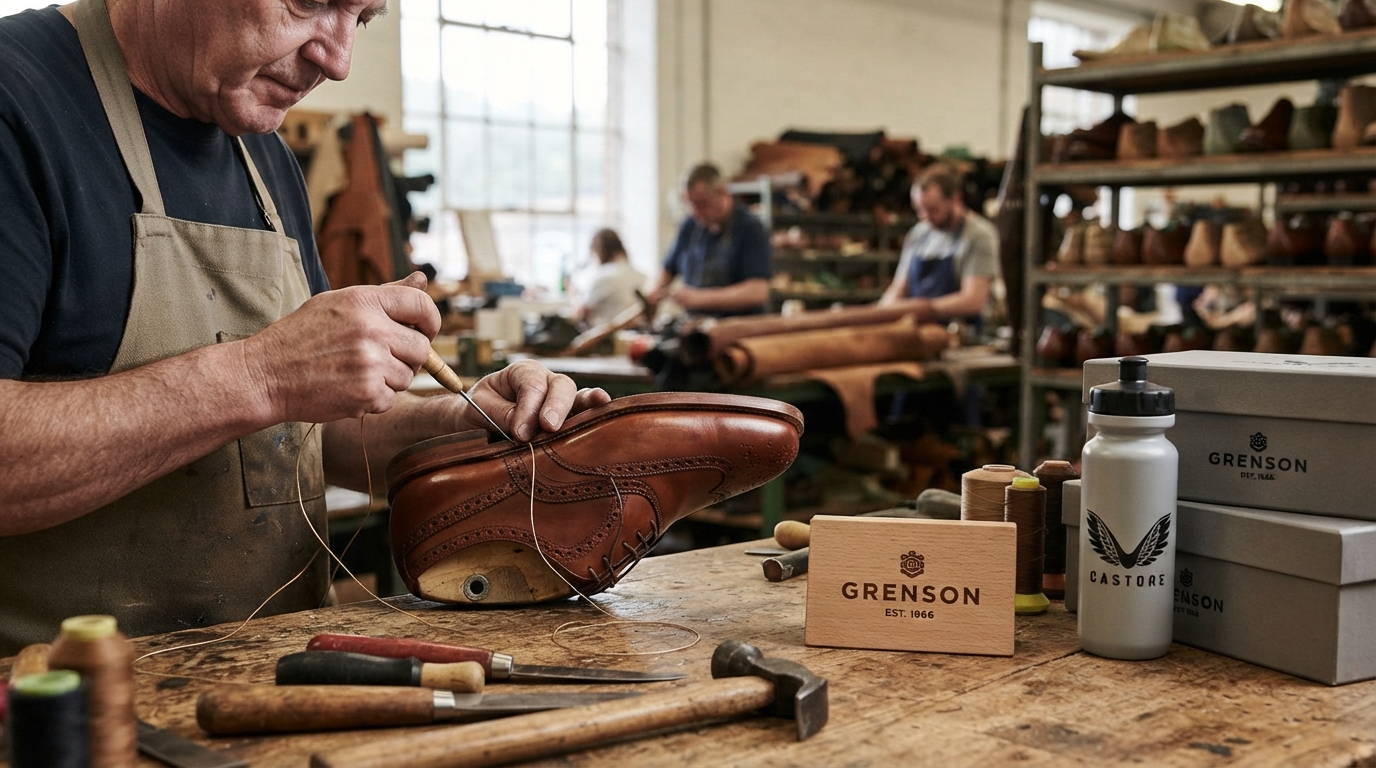
What does takeover by sportswear firm mean for traditional shoemaker?
Grenson has been making shoes in Northamptonshire for 160 years
Traditional shoemaker Grenson has been acquired by international sportswear company Castore. But what does that mean for one of the best-known names in a county celebrated for its footwear heritage?
For 160 years, it has produced shoes and boots worn by soldiers in both world wars, celebrities – and even Doctor Who.
The company that became Grenson was founded in 1866, when William Green began making shoes in a loft above a corn merchant in Rushden, Northamptonshire.
It has now been bought by Castore, which makes kits for teams including Everton FC and England Rugby.
Grenson built its first factory in Rushden, a town that was once packed with shoe factories and businesses connected to the leather trade.
Castore says the deal is "a significant opportunity to support" the company going forward "while protecting the qualities that make it so special".
Former owner Tim Little says he sold the business so a "new chapter" could begin.
"I feel I'm passing on this amazing old brand and company to somebody who can really take it on and build it and grow it for the future," says Little, who will stay on as Grenson's chief operating officer.
Little, who owned the company from 2010, says that although Castore is known for sportswear and Grenson for handmade footwear, no immediate changes are planned.
"It's about growing it and Castore being able to help us grow as a business in ways that we couldn't do ourselves as a small independent company," he says.
Ncuti Gatwa wore Grenson Sneaker 51 shoes in the Christmas 2023 episode of Doctor Who, and its sneakers and boots have continued to appear in the series
Northamptonshire has a long bootmaking and shoemaking history, dating back to the mid-19th Century.
Nearby cattle markets supplied leather, and the county's central location made it ideal for trade.
Grenson moved into its first "state-of-the art factory" in 1895, on the corner of Queen Street and Cromwell Road, and remained there for 118 years before moving in 2013 to what it described as a more modern and efficient site.
Castore makes kit for sports teams including Everton, whose midfielder Kiernan Dewsbury-Hall is pictured
Known for its Goodyear-welted, external footwear, the company introduced the first machine-welted shoes to Great Britain in 1895 and has since moved beyond traditional brogues, boots and loafers, adding trainers and collaborations with leading designers and celebrities.
Little says smart shoes remain "the core of the brand" and make up most sales.
"But now we also make other styles such as sneakers and sandals, as the trends have moved more towards casual dressing," he saiys
It sells worldwide, but its biggest markets are the UK and the USA, followed by Germany, France and Japan.
Tim Little says his favourite shoe is "Archie", a traditional brogue "but blown up and a bit more modern" and its biggest-selling men's shoe
Grenson has worked with designers and celebrities including Holly Willoughby
Generations of local people have worked for Grenson.
Sarah Tully joined the company at 17. Now 53, she is still there.
"I finished school, then I carried on in the sixth form to do a business studies course and the UK sales job in Grenson came up through the school, so I applied for it, got the job, loved it," she says.
After leaving to have a child, she returned in 2011 and now works in the closing room, where the uppers of the shoes are finished.
"It's hard work but enjoyable," she says.
"It's such a reward when you see the result on the final shoe."
Sarah Tully has worked for Grenson over several decades and moved to the factory floor after the birth of her son
The child she left to have, Tom Norton, 31, is now the company's warehouse manager.
"It's a bit of a family affair," he says.
"My great-grandmother worked here, my nan worked here and now my mum works here.
"No matter what position you are, whether it be the CEO down to the cleaners, it feels like no one's just a number, everyone is somebody."
Tom Norton has worked at Grenson since he was 16
So what does the future hold for Tully, Norton and the firm's 30 other employees?
"Since 2020 there have been seismic changes to the world of fashion retailing and manufacturing," says Little, citing Covid-19 and the wars in Ukraine and Iran, which affected energy costs, plus tariffs and Brexit.
He says the sale was to "keep it alive, grow it for the future, for the next 160 years".
"The [retail] world is changing enormously," he says, and believes the larger group can "navigate those kinds of waters much better than us" because it has teams handling shipping, logistics and warehousing, plus overseas distribution centres and legal departments.
The company was founded by William Green and Heyden Green was the last family member to run the business until the 1980s
He says a bigger company being able to handle global markets is the "kind of winning formula" a small company needs to move forward.
Co-founder and chief executive of Castore, Tom Beahon, says Grenson is an "iconic British brand with extraordinary heritage, craftsmanship and authenticity".
"This investment is a commitment to long-term stewardship, investing behind strong fundamentals and helping distinctive British brands reach more customers around the world," he adds.
In 1895, Grenson built a factory on the corner of Queen Street and Cromwell Road, Rushden, where it stayed for 118 years
Ian Cartwright, chief executive officer of the British Footwear Association, calls the deal "a massive vote of confidence in the UK footwear industry".
He says the Northamptonshire shoe industry is "revered around the world" with its "amazing heritage", skills and craftsmanship passed down from generation to generation.
"I think that UK footwear manufacturing is the envy of the world and has got international prestige," he says.
"For a very fast-growing British success story like Castore to buy a 160-year-old brand like Grenson, and to invest in the heritage, the craftsmanship and the international potential of that brand I see as something good for the industry."
He thinks Castore can bring international reach, digital skills and e-commerce experience.
"UK manufacturers want to reach a wider audience and someone with Castore's background and their international reach will give Grenson that ability," he says.
"For me, it's about what this deal enables next, and you would hope that there's investment in skills and talent, which is the lifeblood of those manufacturers."
The main techniques of making traditional shoes have not changed much over the years
He says one of the biggest concerns of UK footwear manufacturers is where future skills and talent will come from, and they want government investment in vocational training.
The Department for Business, Innovation, Science and Trade says the UK is "lucky to have a long-standing global heritage when it comes to footwear".
"We engage closely with the sector to understand any challenges they face and to explore potential solutions, including on skills and training," a spokesman adds.
Little, meanwhile, says the future looks bright for Grenson.
"What we do is we make beautiful shoes... we make shoes in the way we've been making them for 160 years, so let's focus on that and do that really well."