

Weaver's trial inspires descendant's novel
Thomas Burbury was deported to Australia for his role in the city's Weaver's riots in the 1830s.
Weaver's trial inspires descendant's novel
Australian author Sarah Thornton's book draws on the life of her ancestor Thomas Burbury and his transportation to what is now Tasmania
Thomas Burbury was a 21-year-old silk weaver living in Coventry with his parents when he was found guilty of leading a mob that set fire to a mill in the city.
Originally sentenced to death, a campaign spared his life and the punishment was reduced to deportation to Australia instead.
Nearly 200 years later, one of his descendants, Brisbane-based lawyer-turned-author Sarah Thornton, says the evidence used against him was probably questionable at best.
She has written Unwoven, a novel inspired by the events leading up to the riots and what happened to those accused.
"Our family had always been aware that there was a convicted felon in the history and we knew he'd been convicted of machine breaking and to me, that was a quite interesting crime."
Coventry was one of the centres of the ribbon-weaving industry, and Thomas Burbury lived on Sovereign Street.
It was a period when the industry was adopting mechanisation through the Jacquard loom, which was driving traditional weavers out of work.
Resistance to the new methods had already emerged in France, where those affected by the new looms would throw their wooden shoes, or sabots, into the machinery, creating a new word in the language: saboteur.
In England, opposition to the loom gave rise to the Luddites - someone who opposes new technology.
Two years before the Coventry riots, several hundred weavers, who mostly worked from home rather than in the newly built mills or factories, threw filth at the foreman of a factory, while another protest saw an estimated 6,000 weavers and their families demonstrate and call for strike action over what they said were unfair prices for machine-woven ribbons and textiles.
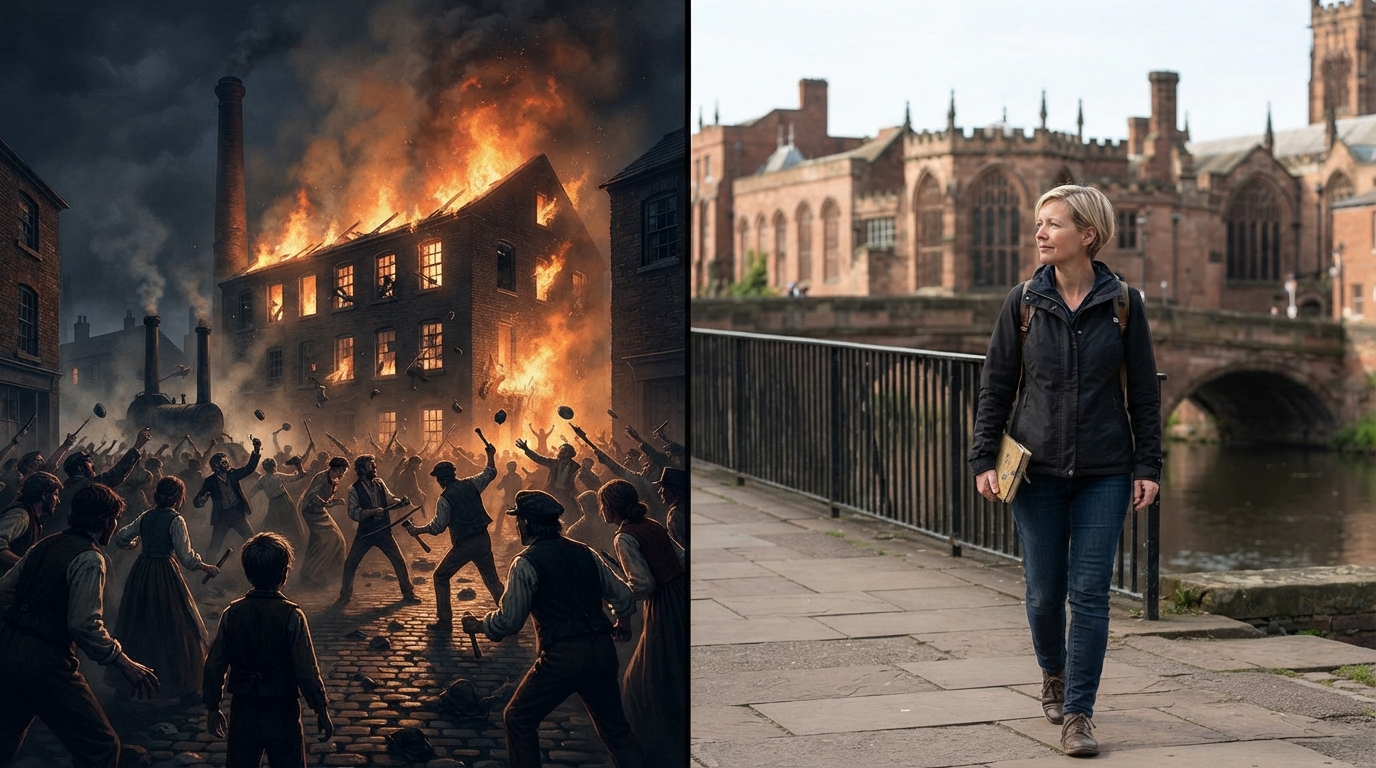
Against that backdrop, weavers in the city attacked Josiah Beck's steam-powered mill in what is now an area just off Trinity Street in the city centre on November 7 1831, burning it to the ground.
He was sentenced to death.
But hundreds of people signed petitions seeking clemency because of his age.
The Home Secretary agreed, and the sentence was changed to transportation to Australia. He was sent on a ship to what was then known as Van Dieman's Land, modern-day Tasmania.
Thornton said it took her eight years to research and write the historical novel based on her ancestor's story.
"I was reading this court report and I just couldn't believe what I was reading from the defence witnesses.
"One after another, these Coventry people, standing up [in court] to give testimony on Thomas' behalf as to what he was actually doing on the day of the riot."
Burbury was accused of bursting through the mill door and calling for the building to be burned to the ground. But the general view appeared to be that he was not a ringleader.
"The concept of beyond reasonable doubt was still developing. It wasn't something that was absolutely immutable standard of proof as it is required now.
"But had it been, I suspect the verdict may have been different."
Burbury was tried at the Coventry Lent Assizes in 1832, held at the then County Hall, which is now a bar and restaurant.
However, the story of Burbury's life did not end on the other side of the world.
Held by the University of Tasmania, Burbury was a model prisoner and was pardoned in 1839, before becoming a leading member of the community and acquiring a large estate near the town of Oatlands.
His son became a politician, and another descendant, Sir Stanley Burbury, was the first Australian-born governor of Tasmania.
Thornton visited Coventry in 2025 as part of her research and said being able to see the sights that remain from Burbury's day made the hairs on the back of her neck stand up.
"I was able to see the courthouse and the judge's chair and the trapdoor where prisoners came up from the dungeons."
Thornton said that although the cells beneath the court are now closed to the public, she was able to see where prisoners would have emerged from to face their trial.
"There are court reports done by a commission of inquiry into the state of prisons, and Coventry was one of the worst" she said.
She also said retracing so many of his steps was an emotional experience.
"He lived in Spon End, so we stayed out there and we walked the streets into the city centre and across the Spon Bridge.
"The hairs were standing up on the back of my neck the whole time".