

'We got penalised for saying 'pregnancy' on Instagram'
Creators say women's health content is getting them shadowbanned on social media. So what's really happening?
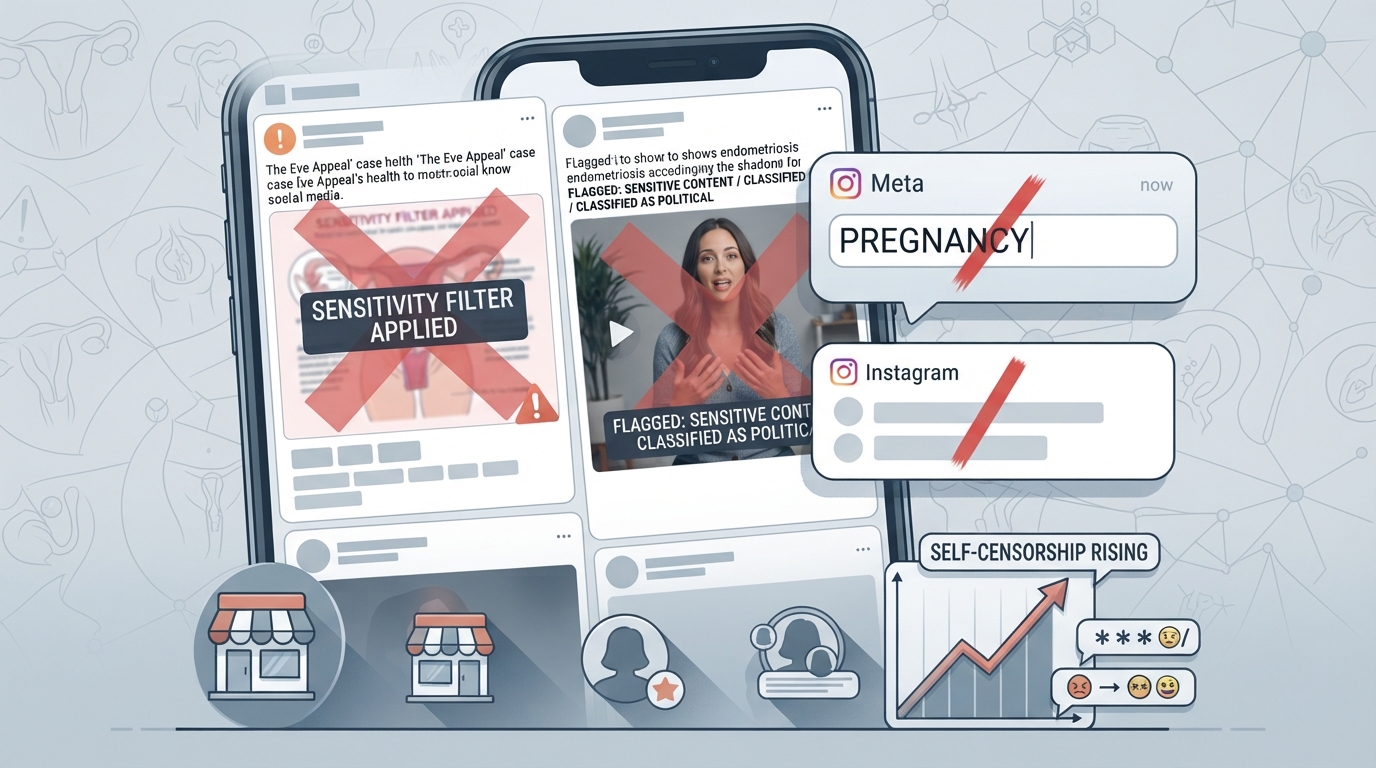
'We got penalised for saying 'pregnancy' on Instagram'
Irene Breen told the BBC her business suffered a significant financial hit from the restrictions
When Irene Breen received a notification in January 2025 saying Instagram was removing adverts for her company’s pregnancy pillows, she was baffled. What was so offensive about a pillow?
She was later told in a call with Meta that the issue was the word "pregnancy".
"We had to scrub the word from our entire website… from the product name," Breen said. "We had to remove all our URLs which had pregnancy in them and rename them all."
The restrictions were eventually lifted but, she said, it took 10 months of discussions with Instagram’s parent company Meta - by which time her business had suffered a significant financial hit.
Meta, which also owns Facebook, declined to comment on specific cases, but told the BBC that while businesses can run adverts promoting wellness, sexual health and reproductive products and services, there are restrictions to avoid users across countries and cultures having a negative experience.
It is not only businesses paying for adverts who say their content has been unfairly restricted.
Women’s health creators and charities have told us their content has been removed, had sensitivity filters applied, or had its reach reduced - a practice known as "shadowbanning".
The campaign group CensHERship tracks claims that women’s health content is being suppressed.
In a report last month, it surveyed nearly 200 creators, clinical providers, health brands, charities and educators - 96% of whom said they had experienced restrictions in some form.
The advert was returned to Bella Moon with the word "pregnancy" crossed out
Sensitivity filters heavily blur posts, requiring users to press a button before they can view them, and are usually reserved for graphic imagery - including nudity or violence.
Dr Carolina Are, a digital criminologist at the London School of Economics who studies social media moderation of women’s content, said research shows AI is often used to flag posts that may breach platform guidelines.
But that can mean an "algorithm misdetecting" content, as it is designed to do, storing that information to repeat "previous mistaken decisions", she warns.
The system often relies on automated messages, Are says, which can leave users unable to challenge a decision.
Some hashtags simply do not appear on Instagram, said Athena Lamnisos, chief executive of gynaecological cancer charity Eve Appeal.
"One of the hashtags, unbelievably, was #vaginalcancer."
"We put a post on Instagram about vulval anatomy - it was very clearly an anatomical diagram with labels around it, talking about vulval cancer and the need to check for changes, lumps and bumps. It was pulled."
The diagram was put behind a sensitivity filter
The charity appealed, which was initially rejected - but after several weeks the post "suddenly reappeared" behind a sensitivity filter.
Lamnisos added it was not an exaggeration to say that "life-saving health information isn't getting to the people who need it most".
Despite her raising this with Meta, the problem has continued, she said.
Deirdre O'Neill, from fertility test company Hertility, said it had a similar issue with a Facebook and Instagram video featuring a woman with endometriosis.
"She doesn't sell our services, she doesn't talk about Hertility, she simply describes her pain," O'Neill said.
But the video was removed by Meta, she said, and classified as political content.
Asked about Eve Appeal and Hertility's cases, Meta did not comment specifically, but said it allows women’s health content on its platforms, and is consulting with women’s health organisations to improve systems.
The post featuring a woman talking about endometriosis was flagged and classified as "social issues, elections or politics"
Trying to advertise on TikTok has also become "like an obstacle course", O'Neill added.
"It's so much resource to try and put something forward that it ends up not being worth our time, because everything gets appealed, flagged, removed," she said.
O'Neill says Hertility has given up advertising on TikTok
TikTok said that while certain content cannot be promoted on the For You feed, it is transparent about posts that fall into this category and tells creators so they can appeal.
It added that millions of women share health stories on the platform, including with hashtags like #Period and #Endometriosis.
CensHERship found the number of respondents self-censoring because of shadowbanning had risen, from 53% in 2025 to 65% this year.
This includes using euphemistic terms such as "seggs" instead of "sex", using asterisks or emojis, and avoiding certain topics altogether.
CensHERship co-founder Clio Wood said this was "really damaging", because "women's health historically has been surrounded by shame and guilt… and we are just reinforcing [that]".
Are told the BBC that platforms' policies "tend to be incredibly broad, whereby more often than not, nudity is conflated with sexual activity".
And this ultimately hurts audiences, Wood said.
"We talk to so many people who say, 'The only reason I found out about my vulval cancer was because Eve Appeal posted about those symptoms, and then I researched it and could ask my doctor the right questions'," she said.
But Wood said that, since starting CensHERship in 2024, she has noticed that social media companies "can see this is something that they need to engage on now.".
"It's all very well the policy saying XYZ content is allowed, but if the algorithm is still flagging all of that content and suppressing it, that's where the problem comes in," she said.
"I think within the platforms those departments are very siloed - so what we would love is for those conversations to be much more holistic."