

We are not paying and have no plans to?
Kazakhstani companies have become the largest debtors of Russian businesses in the CIS. They are followed by Belarus and Uzbekistan
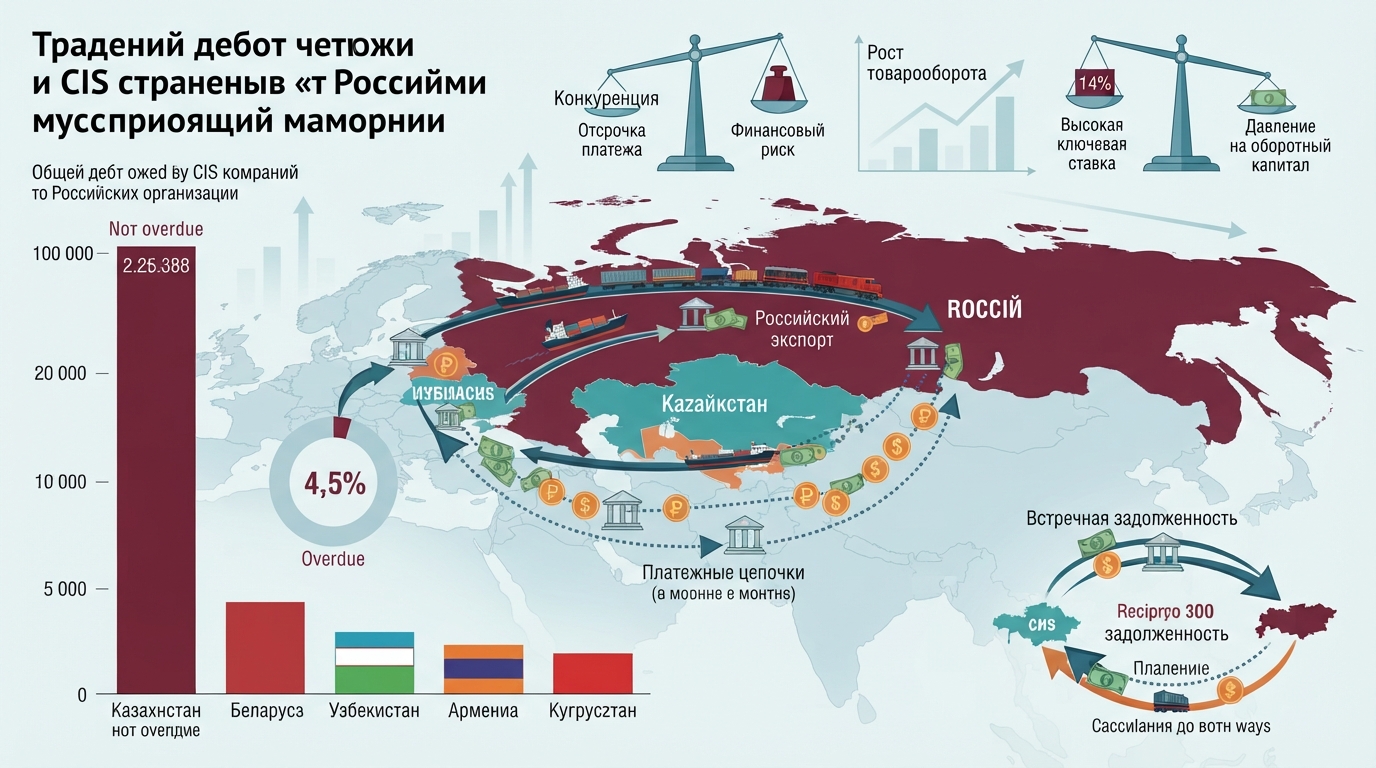
Not paying and not planning to?
By the end of June, the debt of companies from CIS countries to Russian organizations had almost reached 1 trillion rubles — 967 billion rubles — and increased by more than 40% over the year. The largest amount is attributed to Kazakhstan — 401.3 billion rubles. This is about 41.5% of the total debt of CIS companies to Russian organizations. At the same time, only about 4.5% of the total CIS debt is overdue, so the record figure does not mean a massive refusal of companies to pay their bills.
Next come Belarus with 327.3 billion rubles and Uzbekistan with 81.7 billion rubles. Companies in Armenia owe about 65 billion rubles, and Kyrgyzstan — 52.3 billion rubles. These five countries account for almost 96% of all recorded debt.
401 billion rubles is not an overdue debt
In statistics, the term "debt" does not mean that the entire amount is already overdue or impossible to recover. Out of 967 billion rubles, overdue obligations account for about 43 billion rubles, which is only 4.5%. In other words, approximately 95.5% of the amount still relates to current settlements between companies. Therefore, the statement that Kazakh enterprises "did not return 401 billion rubles to Russia" would be incorrect.
This primarily refers to money that Russian suppliers are already due to receive under concluded contracts, but which was still in settlements as of the reporting date.
Why Kazakhstan came out on top
The large amount of debt coincided with the growth of trade between the two countries. In the first half of 2026, the trade turnover between Kazakhstan and Russia grew by 7% to 13.2 billion dollars.
Russian exports to Kazakhstan increased particularly noticeably: Kazakhstan's imports from Russia grew by 14% and reached 9.7 billion dollars. The larger the volume of supplies and the more often contracts provide for deferred payment, the higher the accounts receivable of Russian sellers can be.
Therefore, Kazakhstan's first place in terms of the amount of obligations does not yet indicate a deterioration in the solvency of local businesses.
Payments can take several months
Market participants name the complication of international settlements as one of the reasons for the growth of debt. After the tightening of sanction restrictions, banks in CIS countries began to conduct additional checks on cross-border payments, and the payment chains themselves became longer.
Due to the growing number of intermediaries and correspondent banks, several months can pass between the delivery of goods and the final receipt of money by the Russian seller. In such a situation, debt can grow even when the buyer intends to fully perform the contract.
Russian suppliers offer more deferrals
The second factor is competition.
In the markets of Central Asia, Russian suppliers actively compete with companies from China and Turkey, which can offer buyers lower prices, alternative logistics, and flexible payment terms.
In order not to lose a client, a Russian exporter has to agree to deliver now with payment in a few weeks or months. In essence, the supplier finances the buyer during this period using their own working capital. This is beneficial for the client. For the seller, it is an additional financial risk.
Russian companies also owe partners from the CIS
Settlements go both ways. The debt of Russian organizations to companies from CIS countries also grew over the year — by about a quarter — and reached about 506 billion rubles. However, this is almost half the 967 billion rubles owed to Russian organizations by CIS counterparties.
That is, an increase in settlement obligations is observed on both sides, although their scale differs significantly.
High rate makes deferral more expensive
For Russian suppliers, the problem is becoming more acute due to expensive financing. On September 11, the Bank of Russia kept the key rate at 14% per annum.
If an enterprise has shipped goods to a buyer and provided several months of deferral, it needs to independently finance salaries, the purchase of new raw materials, logistics, and the production of the next batch during all this time. In case of a shortage of own funds, it has to take a bank loan.
Therefore, even regularly repaid accounts receivable, with a high cost of money, can put noticeable pressure on working capital.
The situation is developing against the backdrop of declining investment activity in the Russian economy. In the first half of 2026, investment in fixed assets in Russia in comparable prices decreased by 9.9% year-on-year, to 16.2 trillion rubles in nominal terms.
But this decline cannot be directly linked specifically to the debt of CIS companies. This is just one of the factors that can limit the free funds of enterprises, along with the high cost of loans, tax burden, domestic demand, and the general economic situation.
Uzbekistan is also rapidly increasing trade with Russia
The growth of debt occurs simultaneously with the expansion of Russia's trade with other countries in the region.
In the first half of the year, Uzbekistan's trade turnover with Russia grew by 15.7% to 7.01 billion dollars. Russia remains the republic's second-largest trading partner after China.
Russia's trade with Belarus also continues to grow: in the first six months of 2026, the increase was 12.5%.
Therefore, the growth of absolute debt also partially reflects the expansion of the trade volume itself.
The main risk is not the amount, but the time it takes to return the money
For Russian business, the key question is not so much the record 967 billion rubles, but how long these funds remain out of circulation and what part of them eventually becomes problematic. As long as the overdue debt is only about 4.5%, there is no reason to talk about a large-scale crisis of non-payments in the CIS.
However, the combination of long settlements, high cost of loans, and the need to offer buyers more favorable terms actually forces Russian exporters to finance part of the trade with their own funds.