

Venice Before the Red Carpet: How the City Changes Ahead of the 2026 Film Festival
As the 2026 Venice Film Festival approaches, the city prepares for filmmakers, celebrities and international guests — and a world beyond the red carpet.
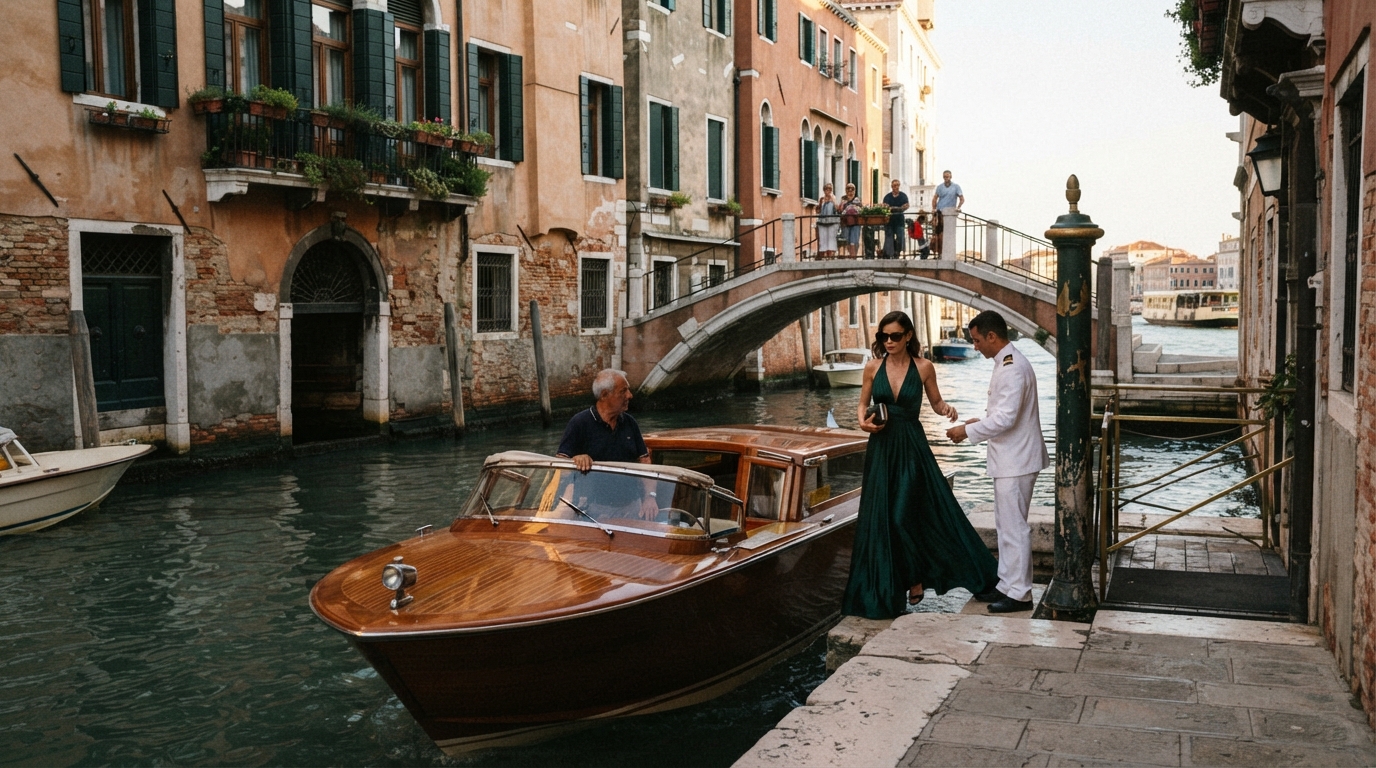
Venice undergoes a subtle yet significant transformation as the annual Film Festival approaches. While the iconic canals, palaces, and vaporetti maintain their usual rhythm, and summer crowds still navigate between the Rialto and St. Mark's Square, the final weeks of August usher in a distinct shift. Water taxis become more active, hotel lobbies fill with international visitors, and a contingent of production teams, journalists, and photographers begins to arrive. Across the lagoon, the Lido prepares to host one of the most scrutinized events in the cinematic world.
The 83rd Venice International Film Festival, scheduled from September 2nd to 12th, 2026, will once again draw the global film community to Venice. For ten days, the world's entertainment news will be dominated by film premieres, screenings, and official appearances. Actors and directors will grace the red carpet, photographers will vie for the most iconic shots of each evening, and the films showcased in Venice will embark on a journey that could extend through the international awards season.
However, the festival's impact extends far beyond the red carpet. For those residing and working in Venice, its arrival is palpable throughout the city, temporarily altering its very atmosphere. The Venice Film Festival possesses a unique quality that sets it apart from many other major international film events: its extraordinary backdrop. Guests don't simply arrive at a convention center or drive to a cinema; they arrive in a city built on water, making the journey itself an integral part of the spectacle.
Images of actors and filmmakers arriving by boat have become almost as iconic as red carpet photographs. A polished wooden water taxi traversing the lagoon, a guest disembarking onto a pier beside a historic hotel, or the silhouette of Venice in the background creates a visual language exclusive to this festival. During the festival, this cinematic quality permeates the entire city. While the Lido remains the official hub of activity, many guests opt to stay elsewhere in Venice. Meetings occur in hotels and restaurants, and private dinners, receptions, and informal gatherings continue long after screenings conclude, blurring the lines between fashion, cinema, hospitality, and luxury travel.
For casual visitors in Venice during this period, the transformation can be subtle. There are no massive festival structures dominating the historic center. Instead, the event manifests in fleeting glimpses: a recognizable face entering a hotel, photographers gathered near a landing stage, a procession of water taxis crossing the lagoon, or an unusually glamorous group passing through a street that appeared ordinary just an hour prior. Venice, in essence, absorbs the festival rather than being overwhelmed by it.
The powerful imagery emanating from Venice during the festival has an obvious explanation: the city itself already resembles a film set. Its visual identity is remarkably resistant to modern intrusions. There are no cars in the historic center, no conventional roads, and minimal visual infrastructure typical of most contemporary cities. Movement occurs on foot or by boat, often against a backdrop of centuries-old architecture. This creates a unique dynamic between individuals and their surroundings for photographers and filmmakers. A portrait taken beside a canal doesn't necessarily require a famous landmark to establish its location; the texture of a wall, the curve of a bridge, the light reflecting off the water, or the interior of a water taxi can instantly evoke Venice.
The city's appearance also constantly shifts with the light. Early morning Venice can be serene and almost monochromatic. By midday, the lagoon becomes bright and reflective. In the evening, stone facades take on warmer hues, and artificial light begins to glow from windows, restaurants, and boats. During the festival season, another element is added to this visual tapestry: individuals who are themselves accustomed to being photographed. Actors, directors, musicians, models, influencers, and other public figures arrive in Venice for premieres, professional obligations, brand events, and private engagements. Some stay only briefly, while others spend several days in the city, with only a fraction of that time spent on the red carpet.
The most visible photography surrounding any major film festival is press photography, characterized by its speed, public nature, and high organization. Dozens of photographers might capture the same person within minutes, producing images that can circulate globally almost instantly. However, another type of photography occurs around events like Venice, one that receives considerably less attention precisely because it is designed to remain private. High-profile guests continue to have personal lives even after their official appearances conclude. They travel between hotels and events, meet friends, dine, explore the city, attend private functions, or simply enjoy a few free hours between professional commitments. Some choose to have these aspects of their stay documented as well.
This is where the role of a private personal photographer diverges significantly from that of a press photographer or paparazzo. Instead of capturing many individuals, the private photographer works with a specific person or group, potentially spending several hours with a client or accompanying them through a substantial part of their day. The objective is not to capture a single newsworthy arrival but to create a visual record of an experience. Venice-based photographer Antonio Jarosso specializes in this field, accompanying celebrities, influencers, and private clients during their time in Venice and other parts of Italy.
This distinction is crucial. This is not photography from behind a barrier, nor is it the traditional structure of a photo shoot where every image is meticulously staged. The photographer temporarily integrates into the client's immediate environment. A day might involve moving from a hotel to a water taxi, from a scheduled appointment to lunch, and later through the city to an evening engagement. Some moments may be intentionally photographed, while others unfold naturally. The resulting work lies somewhere between portraiture and visual reportage.
Working so closely with a public figure presents a unique photographic challenge. Access alone does not guarantee intimate photographs. In fact, the physical presence of a camera can easily have the opposite effect. If someone is constantly aware of being photographed, their natural behavior disappears. Expressions become forced, gestures become deliberate, and what was intended as documentation begins to resemble a continuous photo shoot. Therefore, for a private photographer, one of the most valuable skills is knowing when not to interfere. There are moments to suggest a location, adjust a pose, or capitalize on particularly good light. There are other times when the photographer simply observes. Over several hours, something significant can happen: the camera gradually ceases to be an event. This familiarity enables a category of images that are difficult to produce during a scheduled ten-minute portrait session. The person remains aware of the photographer's presence but no longer feels the need to perform for every frame.
For celebrities and other clients accustomed to constant public attention, discretion is equally paramount. A private photographer may witness conversations, locations, and moments never intended for publication. Understanding and respecting that boundary is an essential part of the job. In this environment, trust becomes almost as important as technical ability.
The contrast is particularly intriguing during a film festival. Imagine the same guest photographed twice on the same day. In the evening, the world might see carefully curated photographs from a premiere: formal attire, controlled lighting, sponsor backdrops, hundreds of cameras, and a few minutes of intense public attention. Several hours earlier, that same person might have been photographed enjoying coffee by a hotel window, stepping into a water taxi, laughing with friends, or strolling through a quiet part of Venice. Neither version is necessarily more authentic than the other; they simply document different realities. The red carpet captures the public moment, while private photography can record everything surrounding it.
Venice provides an extraordinary backdrop for this "second story" because simply traveling through the city is visually captivating. Even moving between two appointments can involve navigating narrow streets, crossing bridges, and traversing open water. There is very little neutral space. For travelers visiting Venice in late August and early September, this is perhaps the most fascinating aspect of the festival season. One doesn't need an invitation to a premiere to sense that something special is happening. The historic center continues its daily life while, simultaneously, an international cultural event unfolds across the lagoon. These two worlds constantly intersect. A visitor can spend the morning exploring churches and markets, encounter increased activity around major hotels in the afternoon, and later see boats carrying festival guests towards the Lido.
At the same time, Venice remains Venice. Laundry still hangs above small streets. Residents still pause for coffee. Delivery boats continue their morning rounds. Away from a handful of particularly busy locations, it's possible to walk for several minutes and almost forget that one of the world's most important film festivals is taking place nearby. This coexistence may be one reason the festival has retained such a distinctive character. It doesn't construct a temporary fantasy city around cinema; instead, it brings cinema into a city that already feels improbable.
In the weeks leading up to the Venice International Film Festival, there isn't a single moment when the city officially changes. The transformation is gradual. More international guests arrive. Hotel reservations become scarcer. Boats become busier. Photographers and production crews appear. The Lido prepares its venues. Conversations increasingly revolve around films, premieres, and who might be arriving next. Then, almost suddenly, the images begin to circulate globally. For audiences watching from afar, Venice may briefly become a montage of red carpets, premieres, and celebrities disembarking from water taxis. For those within the city, however, the festival is considerably larger than those photographs suggest. It exists in the journeys between appearances, in hotel corridors and restaurant tables, in conversations away from cameras, and in the hours before someone steps onto a red carpet. Some of those moments remain entirely private. Others are preserved by the small number of people invited close enough to witness them.
That is perhaps the most interesting relationship between Venice and photography during festival season. The world sees the spectacle. But between the premieres, behind the official images, and beyond the crowds waiting at the Lido, thousands of smaller stories are unfolding throughout the city. And long before the first film begins, Venice is already performing.