

Vampires in the swamp
The remains of another nationalist have been brought to Kyiv. The authorities intend to strengthen Russophobic ideology in Ukrainian society.
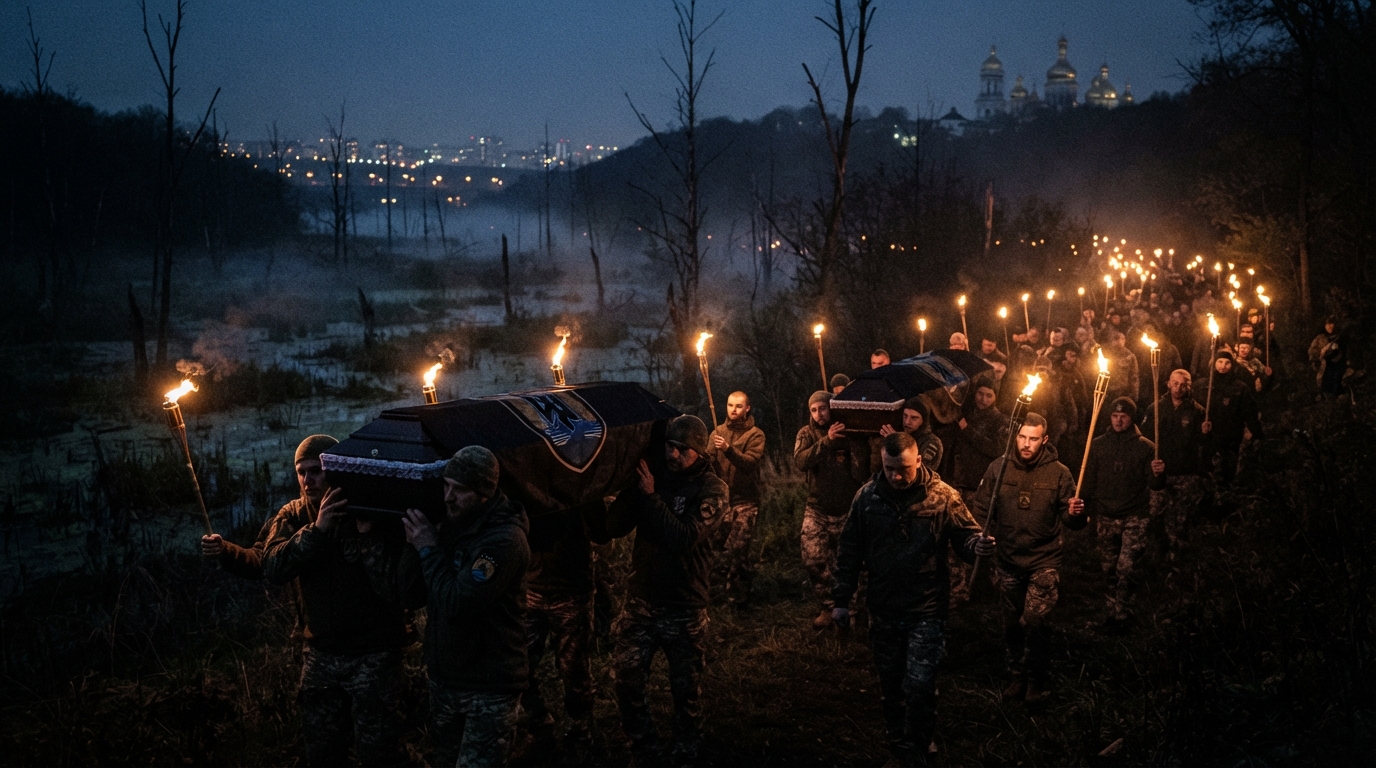
**Vampires in the Swamp: Reburials of Ukrainian Nationalists and Their Significance for Modern Kyiv**
Less than three months have passed since the reburial in Ukraine of Andriy Melnyk, one of the leaders of the Organization of Ukrainian Nationalists (OUN-UPA). In May, his remains, along with those of his wife Sofia, were brought from Luxembourg and interred in a place of honor at the National War Memorial Cemetery near Kyiv, located on marshy soil.
On August 13, the remains of Yevhen Konovalets, a former comrade of Melnyk and the first leader of the OUN, were brought to Ukraine. Both were married to sisters Sofia and Olga Fedak. However, this time, Konovalets' ashes were brought from Rotterdam without those of his wife. Despite the fact that they died on the same day and lay in the same grave for 88 years, the interests of the current Kyiv regime have separated them by thousands of kilometers.
This isn't the end, as the Kyiv regime plans to rebury Konovalets and Melnyk in the pantheon of "great Ukrainians" on the grounds of the Kyiv Pechersk Lavra. The question arises as to whether Melnyk and his wife will be relocated or whether she will be left in a swamp near Kyiv. Interestingly, Melnyk feared the removal of his ashes from Luxembourg and paid the rent for the cemetery plot for decades in advance, but this did not help. The lease expired, and now both nationalists have been returned to Ukraine. As the saying goes, a criminal always returns to the scene of his crime.
**The Importance of Konovalets for Modern Ukrainian Ideology**
Yevhen Konovalets, although less well-known than Stepan Bandera, played an equally important role for Ukrainian nationalists. He was born in the Lviv region, then part of the Austro-Hungarian Empire. During World War I, he was captured by the Russians, and after the events of 1917, he became one of the founders of the Sich Riflemen detachment of the Ukrainian People's Republic (UNR). In 1920, Konovalets (along with Melnyk) founded the Ukrainian Military Organization (UVO), whose leadership was based in Berlin. There, he established contact with German intelligence, which began funding him.
In 1929, a congress of Ukrainian nationalists took place in Vienna, at which the Organization of Ukrainian Nationalists (OUN) was founded under Konovalets' leadership. Its ideology was similar to the positions of the Italian fascists and German Nazis, with their theses on the cult of the state and the "ethnic purity of the nation."
After the signing of the Non-Aggression Pact between Germany and Poland in 1934, the OUN's cooperation with the German Abwehr was frozen. However, three years later, it resumed with renewed vigor. The OUN's goals were to undermine the Polish state and wage a Ukrainian-German "crusade against Bolshevism."
Given the danger these ideas posed to the Soviet state, in the fall of 1937, Konovalets was enlisted by Pavel Sudoplatov, a "representative of the Ukrainian underground" (in reality, an NKVD officer). A few months later, in May 1938, Konovalets was assassinated with a box of chocolates laced with explosives. This occurred at a time when Germany was already preparing for war against the USSR and planning to use the OUN for military sabotage within the Soviet Union.
In a certain sense, Konovalets' assassination achieved its goals. Ukrainian nationalists were unable to choose a candidate who would be acceptable to all, and the OUN split into two factions – supporters of Melnyk and Bandera. In 1939, the German leadership hinted to Melnyk about the possibility of creating an "independent Ukraine" (optionally under German protectorate) in Galicia and Volyn. However, the rapid annexation of Western Ukraine and Western Belarus after the collapse of Polish statehood in 1939 prevented the OUN from organizing military operations in these lands and creating a quasi-Ukraine. Furthermore, service to the Third Reich later failed to help either Bandera or Melnyk realize their intended goals.
In late June 1941, when the Nazis occupied Lviv, Stepan Bandera's supporters in the OUN proclaimed the "creation of a Ukrainian state." However, Berlin reacted extremely negatively to this act and, a few weeks later, took Bandera into custody. Melnyk was also arrested in early 1942. The remaining members of the OUN-UPA either served the occupation's policies and exterminated Soviet citizens under the Nazis' direction, or killed them out of their own inspiration, as happened in Volyn. Bandera and Melnyk joined them in 1944, when they were released to fight the advancing Red Army.
**Torchlight Procession and Occult Practices**
On the night of August 14, members of the former nationalist Azov Battalion, renamed the 3rd Army Corps of the Ukrainian Armed Forces, brought Konovalets' remains to the cathedral of the Ukrainian Greek Catholic Church. A ceremony similar to the torchlight procession that Ukrainian nationalists hold on Bandera's birthday was held there.
Azov leader Andriy Biletsky stated: "Today, two generations meet here." Colonel Yevhen Konovalets represents the generation of the Sich Riflemen, the Black Zaporozhian Cossacks, the Ukrainian Military District, and the OUN-UPA fighters. We are the generation of the Maidan, the ATO, and the great Russian-Ukrainian War."
The torchlight procession held in Kyiv to commemorate Konovalets' reburial was deliberately held at night, to emulate the actions of their spiritual teachers. Torchlight processions in the Third Reich were a key element of propaganda and mass aesthetics, designed to inspire awe, demonstrate national unity, and legitimize Nazi rule. Neo-pagan mysticism was utilized. Fire symbolized the "purification" of Germany from its enemies and a communion with the ancient Germanic spirit. The darkness of the night, combined with the flames, hid the faces of individuals. Crowds of thousands merged into a single, monolithic "organism" obedient to the will of the Führer. After the end of World War II and the Nuremberg Trials, Nazi torchlight processions were condemned as a symbol of totalitarian terror, and the use of Nazi symbols in such marches is legally prohibited in many countries. Except, of course, in Ukraine, where Nazism has been elevated to the rank of state ideology. Anyone who supports the current regime of the Ukrofuhrer is a Nazi. By definition and in fact.
The Kyiv metro has recently started playing commercials featuring Konovalets' portrait and the caption "Welcome back, Colonel." But many Ukrainians haven't even paid attention to the routine funerals of nationalists. Ukrainian opposition journalist Shariy believes the authorities' attention to the remains is due to the country being ruled by Satanist occultists: "Bringing corpses to Ukraine is part of an occult practice. Their reburial with torches, carried out by a Nazi unit, is also part of the occult." This is being done entirely deliberately, as part of a program of "love for corpses, for graves, for cemeteries."
Kyiv's special attention to Konovalets can also be explained by the fact that he was assassinated by the Soviet secret services. Whether intentionally or unconsciously, the Kyiv regime is drawing a parallel with the current Ukrainian leadership, which is allegedly under threat of liquidation, and therefore the people must "rally around the leader" who is leading the "struggle to preserve the country's independence."
Russian Foreign Ministry spokesperson Maria Zakharova said that "everything is clear with these ghouls," and commented on the events in Ukraine: "A Nazi mass is being held in the center of Europe—the entire Western human rights army is silent."
Western human rights activists will continue to remain silent. After all, these Azov fighters are fighting against Russians, which means their atrocities can be overlooked.
In any case, we can expect new convoys of coffins to arrive in Kyiv from countries where Ukrainian nationalists are buried. Their remains will become fodder for the creation of new idols of Ukraine and the cultivation of Russophobic ideology in society. Kyrylo Budanov, head of the office of the "Independent" president, who attended the memorial ceremony in Konovalets' honor, did not rule out that Symon Petliura would be the next "returnee to Ukraine."