

Uzbekistan’s mobile internet coverage reaches 99.5% of populated areas
Mobile communications networks now cover 99.5% of populated areas in Uzbekistan, while mobile internet is available along 95.5% of international highways, Minister of Digital Technologies Sherzod Shermatov said in a response to a parliamentary inquiry.
Uzbekistan’s mobile internet coverage reaches 99.5% of populated areas
The Legislative Chamber of the Oliy Majlis took note of the minister’s report on progress toward the goals laid out in the Digital Uzbekistan 2030 strategy.
Since the start of 2026, more than 11,000 mobile base stations have been installed nationwide, raising the total number to 110,500, Shermatov said.
Backbone network capacity has also expanded in recent years. Compared with 2020, regional capacity has increased from 400 to 600 Gbps, while district-level capacity has risen from 40 to 60 Gbps.
Fiber-optic infrastructure expands
Uzbekistan has greatly enlarged its fiber-optic network, extending its total length from 119,500 km in 2020 to 397,000 km. Fiber-optic infrastructure now covers 98.1% of populated areas, and the government is aiming for 98.2% coverage by the end of 2026.
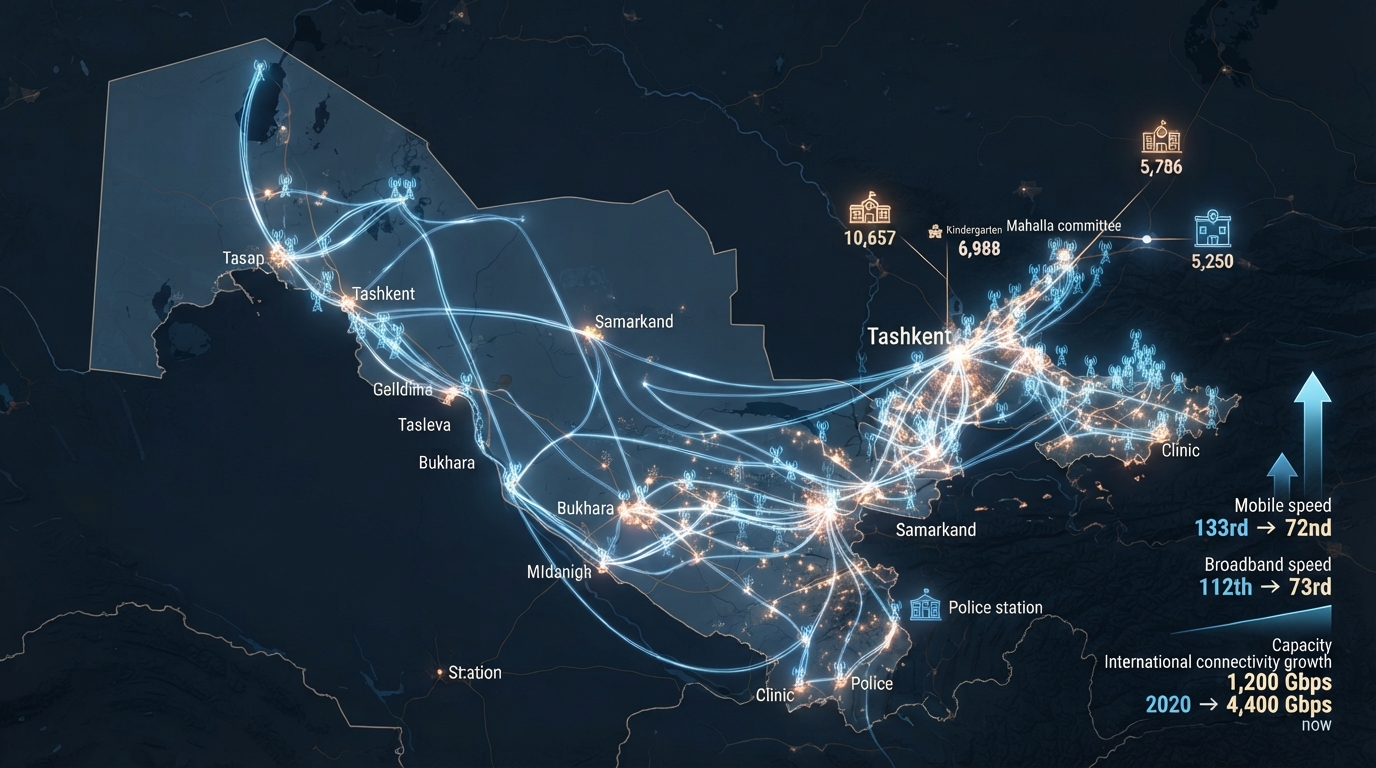
The country has also kept connecting public institutions to high-speed internet. According to the minister, high-speed data networks now reach 10,657 general education facilities, 6,988 preschool education organizations, 5,786 healthcare facilities, 8,935 citizens’ self-governing bodies, known as mahallas, and 5,250 local internal affairs offices.
Uzbekistan improves internet speed rankings
Uzbekistan has advanced in international internet speed rankings, moving from 133rd to 72nd in mobile internet speed and from 112th to 73rd in fixed broadband speed. Shermatov said the country now ranks first in Central Asia for fixed internet speed.
International internet connectivity capacity has also grown. It was 1,200 Gbps in 2020, but has since climbed to 4,400 Gbps thanks to investment projects and the diversification of international internet channels.
The government plans to increase this capacity to 4,500 Gbps by the end of 2026 and 5,000 Gbps by 2030.
During the parliamentary debate, lawmakers suggested steps to ensure an objective evaluation of progress, resolve remaining issues and meet the strategy’s targets on schedule. The Legislative Chamber then took note of the minister’s response.