

Uzbekistan in the trends of the global economy
The material examines important events on Uzbekistan's international and economic agenda — the implementation of agreements with Belarus, the development of strategic partnerships with Kyrgyzstan and the USA, the promotion of major infrastructure, investment, and industrial projects, as well as assessments of the country's economic prospects by the IMF and the Eurasian Development Bank.
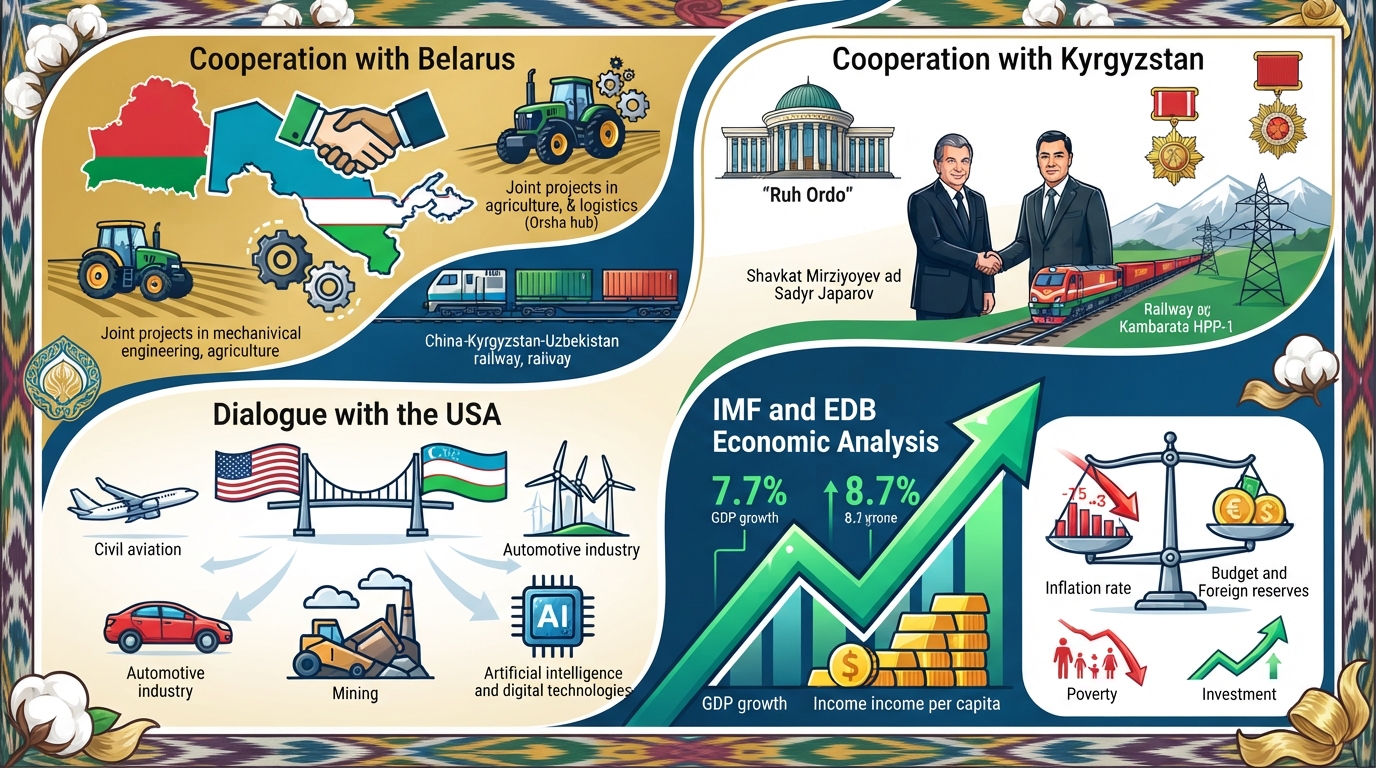
**Uzbekistan in Global Economic Trends**
**Implementation of Agreements with Belarus**
On July 15, President Shavkat Mirziyoyev reviewed a presentation on the implementation of agreements to expand interregional cooperation reached during his visit to Belarus. Within the framework of the official visit of the head of our state to Belarus on July 8-9, agreements were reached to bring the volume of mutual trade to 2 billion dollars, as well as to implement 310 joint projects and activities with a total value of 2 billion dollars in the fields of mechanical engineering, agriculture, pharmaceuticals, textiles, wood processing, and healthcare.
Industrial facilities and state property have been proposed for the placement of investment projects in Belarus, and extensive agricultural areas are available. The country's agricultural land amounts to 8 million hectares and occupies about 40 percent of its territory. These opportunities create a solid foundation for expanding business ties and the organized employment of our citizens. In this regard, during the presentation, the need was noted to compile lists of our citizens and entrepreneurs wishing to work or do business in Belarus, and to send them to this country in an organized manner.
During the presentation, a report was delivered on the work carried out within the framework of cooperation between the Andijan and Vitebsk regions. A "road map" has been approved between the two regions, and the implementation of specific initiatives has already begun. In particular, 255 residents of the Andijan region were sent and employed in the Vitebsk region in an organized manner. In addition, an agreement was reached on the implementation of new projects based on 11 livestock complexes. Each of them is designed to keep from 200 to 3,000 head of cattle and has sufficient fodder land.
In general, a package of 30 new projects with a total value of over 100 million dollars in the fields of livestock breeding, wood processing, logistics, trade, and services has been formed in the Vitebsk and other regions of Belarus. In particular, it is planned to create a large dairy complex designed for 3,000 head of cattle, a number of medium-scale livestock farms, as well as an enterprise for deep wood processing and the production of pellets from wood waste.
The President of our country instructed to extend the cooperation model formed between the Andijan and Vitebsk regions to other regions as well. In particular, the Bukhara, Kashkadarya, Navoiy, Namangan, Tashkent, Fergana, Samarkand, and Surkhandarya regions will be assigned to the Vitebsk, Mogilev, Grodno, Gomel, and Brest regions of Belarus.
Issues of creating a modern logistics infrastructure in order to intensify mutual trade and reduce cargo transportation costs were also considered. By the end of the year, in cooperation with the Belarusian Railway, it is planned to commission an intermodal logistics center at the Orsha station in the Vitebsk region, which will serve export-import cargo under preferential tariff conditions. In addition, the task was set to establish a direct block train service between the two countries jointly with Belarusian companies.
Special attention was paid to the issues of organized employment of citizens. At the first stage, it is planned to employ 1,100 citizens of Uzbekistan on a competitive basis at 13 enterprises in the Vitebsk and other regions of Belarus. Starting from September, it is planned to provide permanent jobs in the Vitebsk region to 500 residents of the Andijan region monthly, totaling 5,000. For this purpose, a representative office of the Migration Agency will be opened in the city of Vitebsk.
**State Visit to Kyrgyzstan**
From July 30 to August 1, President of the Republic of Uzbekistan Shavkat Mirziyoyev paid a state visit to Kyrgyzstan. Talks between Shavkat Mirziyoyev and President of the Kyrgyz Republic Sadyr Japarov took place at the Rukh Ordo Cultural Center in the city of Cholpon-Ata. During the talks, prospects for further development of Uzbek-Kyrgyz relations of comprehensive strategic partnership and expansion of practical interaction in priority areas were discussed.
The head of our state emphasized that Uzbek-Kyrgyz relations are currently at an historical peak of their development. During the talks, the parties agreed to continue intensive contacts at the level of parliaments, governments, ministries, departments, and regions, as well as business and expert circles. A decision was made to establish an Interstate Council. Special attention was paid to the issues of deepening industrial cooperation in priority areas.
Within the framework of the business forum held on the eve of the visit, a new package of trade contracts and investment agreements was adopted. Cooperation in the energy sector was defined as a strategic direction. The importance of the early signing of the agreement and the start of the practical phase of the Kambarata HPP-1 construction project was noted.
An exchange of views took place on the progress of the large-scale project for the construction of the China–Kyrgyzstan–Uzbekistan railway. In order to strengthen transport connectivity, an agreement was reached to develop border, trade, and logistics infrastructure along this railway, digitalize licensing procedures, and create favorable conditions for road carriers.
The need to actively utilize the potential of the regions of the two countries was emphasized. By the end of the year, the first forum of regions in a new format will be held in Uzbekistan. Readiness to continue active exchanges in the fields of culture, education, science, youth policy, and tourism was confirmed.
Following the high-level talks, President of the Republic of Uzbekistan Shavkat Mirziyoyev and President of the Kyrgyz Republic Sadyr Japarov signed the Treaty on Allied Relations. Other joint documents were also adopted between the governments of the two countries. During the visit, President of Uzbekistan Shavkat Mirziyoyev was awarded the Order of Manas, 1st Class. The high award of the Kyrgyz Republic was presented to the head of our state by President Sadyr Japarov.
Also during this visit, on July 31, the President of Uzbekistan took part in an informal meeting of the heads of state of Central Asia and Azerbaijan, which was held in the city of Cholpon-Ata, Kyrgyz Republic. This event was attended by President of the Republic of Azerbaijan Ilham Aliyev, President of the Republic of Kazakhstan Kassym-Jomart Tokayev, President of the Kyrgyz Republic Sadyr Japarov, President of the Republic of Tajikistan Emomali Rahmon, and President of Turkmenistan Serdar Berdimuhamedov.
"Thanks to joint efforts, the previously fragmented Central Asia is now consolidating for the sake of common development goals," the President of our country emphasized during his speech at the meeting. He also presented a vision of priorities for regional cooperation and stressed the need to strengthen coordination within the framework of interstate organizations and "Central Asia Plus" formats, which contributes to strengthening the international subjectivity of the region. Following the summit, the Cholpon-Ata Declaration was adopted.
**Trusting Dialogue with the USA**
On August 7, a telephone conversation took place between President of the Republic of Uzbekistan Shavkat Mirziyoyev and President of the United States of America Donald Trump. The head of Uzbekistan once again congratulated Donald Trump on the 250th anniversary of US Independence. President Trump, in turn, noted the achievement of an unprecedented level of Uzbek-American relations and the establishment of a close, trusting dialogue between the leaders of the two countries.
A high assessment was given to the intensive dynamics of bilateral contacts and exchanges covering practically all areas of interaction. The consistent implementation of all agreements reached at the highest level was emphasized with satisfaction, and prospects for the further development of strategic partnership relations were reviewed.
The three-year Economic Cooperation Program is being consistently implemented. The first meeting of the US-Uzbekistan Business and Investment Council was held. Interaction between the regions of Uzbekistan and US states is expanding. The introduction of a visa-free regime for US citizens contributes to the activation of business contacts. Joint projects are being implemented in the fields of civil aviation, automotive industry, mining, infrastructure, energy, metallurgy, artificial intelligence, digital technologies, and other sectors.
As part of the discussion on the international agenda, the importance of continuing efforts to ensure global security and the peaceful resolution of international and regional conflicts was emphasized. At the end of the conversation, President Shavkat Mirziyoyev invited President Donald Trump to pay an official visit to our country at a convenient time.
**IMF Expert Opinion on Uzbekistan**
CERR analyzed the results of the IMF consultations held in June 2026. According to IMF experts, Uzbekistan's economy is demonstrating steadily high growth rates. According to the IMF estimate, in 2025, Uzbekistan's real GDP grew by 7.7%, and in the first quarter of 2026, growth accelerated to 8.7% in annual terms. High economic activity is supported by robust domestic demand, investment growth, and ongoing market reforms. Simultaneously, a further reduction in poverty and unemployment rates is observed.
**Inflation Continues to Decline**
After a temporary acceleration of inflation due to the 2024 energy reform, the rate of price growth is gradually slowing down. Annual inflation fell to 7% in April 2026, and by the end of 2027, the Central Bank's target of 5% is expected to be achieved. Maintaining a tight monetary policy remains a necessary condition for sustainable disinflation.
**State Finances are Improving**
The consolidated budget deficit decreased from 3% of GDP in 2024 to 2.1% of GDP in 2025. The improvement in fiscal indicators was ensured by high economic growth, increased tax revenues, and favorable conditions in the global gold market. In 2026, the budget deficit is projected at 1.5% of GDP, and public debt will remain around 28% of GDP, which is significantly below international thresholds.
**External Sustainability of the Economy is Strengthening**
The current account deficit narrowed to 3.9% of GDP in 2025, compared to 4.7% of GDP a year earlier. The main factors of improvement were high global gold prices, growth in non-commodity exports, and stable remittances from migrant workers. International reserves remain at a comfortable level and, according to IMF forecasts, will cover more than 12 months of imports.
**The Economy Retains Favorable Prospects**
The IMF projects economic growth of 6.8% in 2026 and 6% in 2027. According to the Fund's forecasts, GDP per capita will increase from 3.8 thousand dollars in 2025 to almost 5 thousand dollars in 2027. Private consumption, investment, structural reforms, and private sector development will remain the main drivers of growth.
The IMF also points to a number of risk factors.
**External risks**: deterioration of the global economic environment; increased geopolitical tensions; decline in external demand for exports; possible tightening of international financing conditions.
**Internal risks**. The IMF notes the need to limit factors that could increase the overheating of the economy: growth in budget expenditures beyond the planned level; maintaining the scale of preferential and directed lending; slowing down of structural reforms.
**IMF Conclusions and Recommendations**.
**Maintaining Fiscal Discipline**
The IMF recommends using additional budget revenues to strengthen financial sustainability rather than to expand expenditures. In the long term, it recommends strengthening fiscal rules and reducing the dependence of public spending on fluctuations in commodity revenues.
**Continuation of Tight Monetary Policy**
Taking into account high domestic activity, the IMF considers it appropriate to maintain a restrictive monetary policy until inflation is fully anchored at the target level. Special attention is paid to the further development of the inflation targeting regime and increasing exchange rate flexibility.
**Strengthening the Banking Sector**
The Fund recommends accelerating the privatization of state-owned banks, improving the quality of credit risk assessment, reducing the volume of directed lending, and ensuring the independence of the Central Bank. According to the IMF, this will increase the efficiency of financial resource allocation and reduce potential fiscal risks.
**Accelerating Structural Reforms**
Reforming state-owned enterprises, improving the quality of corporate governance, developing a competitive environment, completing the process of Uzbekistan's accession to the WTO, as well as improving anti-corruption mechanisms are highlighted as priorities. These measures are expected to contribute to productivity growth and the expansion of private investment.
**Developing the Labor Market and Enhancing Human Capital**
The IMF emphasizes the need to increase the economic activity of women and youth, reduce informal employment, improve the skills of the workforce, and eliminate structural skill shortages.
**Eurasian Development Bank on Uzbekistan's Economy**
The Eurasian Development Bank (EDB) report "Macroeconomic Forecast 2026-2028" reviews the prospects of the global economy and the countries of the Eurasian region (Armenia, Belarus, Kazakhstan, Kyrgyz Republic, Russia, Tajikistan, and Uzbekistan).
According to the EDB forecast, global economic growth will slow down from 2.9% in 2025 to 2.5% in 2026. The most notable slowdown is expected in the Eurozone, where GDP growth will decrease from 1.4% to 0.9%. The US economy will grow by 1.7%, and China's by 4.6%. The countries of EDB operations will maintain positive growth dynamics.
The aggregate GDP of the Bank's countries of operations in 2026 will increase by 2%, and its volume will exceed $3.5 trillion. The highest growth rates are expected in the Kyrgyz Republic — 10.2%, Tajikistan — 8.3%, and Uzbekistan — 7.9%. Armenia's economy will grow by 6%, Kazakhstan's by 5.5%, Russia's by 1%, and Belarus's by 1.3%. At the same time, the economy of Central Asia (CA) may exceed $600 billion as early as 2026.
**Prospects of Uzbekistan's Economy**
Uzbekistan will remain one of the leaders of economic growth in the region.
In the first quarter of 2026, Uzbekistan's GDP increased by 8.7%. The main contribution was made by the services sector — 4.9 percentage points, industry — 2.2 percentage points, and construction — 0.9 percentage points. According to the EDB forecast, Uzbekistan's economic growth will accelerate from 7.7% in 2025 to 7.9% in 2026. This will be the highest figure in the last decade, with the exception of the post-pandemic recovery of 2021. In the future, growth rates will slow down slightly but will remain at a high level, at 6.9% in 2027 and 6.5% in 2028. The main factors will be investment activity, the development of industry and construction, growth in household incomes, budget expenditures on infrastructure, and high external demand for gold.
**Investment Will Become the Main Factor in Expanding Production Potential**
In the first quarter of 2026, investment in fixed assets grew by 29.6% compared to 5.4% a year earlier. Foreign investments formed 53.6% of the total volume of investments, and foreign loans accounted for another 15.2%. By the end of 2025, the total volume of direct, portfolio, and other foreign investments reached $19 billion, or 13% of GDP. Investments will ensure the commissioning of new industrial capacities, an increase in construction work, infrastructure development, and the expansion of the services sector.
**Budget Expenditures and Growth in Household Incomes Will Continue to Support Domestic Demand**
In 2026, it is planned to allocate $1.5 billion for the development of social and production infrastructure. The funds will be directed to transport, utility, and industrial infrastructure, as well as the development of residential areas under the "New Uzbekistan" program. At the same time, the state budget deficit in 2025 amounted to 2.1% of GDP against the planned target of 3%. Budget revenues exceeded the plan by 16.6%, and expenditures grew by 12.8%. Additional support to the economy will be provided by an increase in household incomes. In 2025, nominal wages grew by 19%, and the volume of remittances from abroad increased by 16%.
**Favorable Conditions in the Gold Market Will Support Export Revenues and the National Currency**
By the end of 2025, gold formed 37.8% of Uzbekistan's commodity exports. High global prices for the precious metal will continue to ensure significant foreign exchange inflows and support revenues from foreign trade. Along with foreign investments and remittances, gold exports will contribute to the stability of the sum.
**Inflation Will Continue to Decline, Creating Conditions for a Gradual Easing of Monetary Policy**
According to the EDB forecast, inflation will decrease to 6.8% at the end of 2026, to 5.7% in 2027, and to 5.2% in 2028, gradually approaching the Central Bank's target of 5%. The decline in inflation will be supported by a moderately tight monetary policy, a positive real interest rate, and the stability of the national currency. With a steady slowdown in price growth, the policy rate may decrease to approximately 13.5% by the end of 2026, 12% by the end of 2027, and 11% by the end of 2028. However, high domestic demand, rising global prices for raw materials, energy, and food may slow down the process of inflation reduction.
**The Sum Will Remain Stable in 2026, but High Imports Will Contribute to Its Gradual Weakening**
The EDB projects an average exchange rate of 12,200 sums per dollar in 2026. The national currency will be supported by inflows of investment, remittances, and revenues from gold exports. In 2027, the average rate may reach 12,900 sums per dollar, and in 2028 — 14,100 sums. The gradual weakening will be associated with an increase in imports of equipment, machinery, energy resources, and intermediate goods amid an active investment cycle.