

Uzbekistan has approved the Justice 2030 Strategy, which will see major reforms in the judicial system.
Uzbek President Shavkat Mirziyoyev signed the Decree "On the Justice 2030 Strategy," aimed at further strengthening judicial protection of human rights and freedoms and building a people-centered, fair, and modern judicial system. The document outlines justice reform in six key areas: developing an open and accessible "people's court," strengthening the independence of the judiciary, enhancing fair trial guarantees, and developing a professional corps of judges. […]
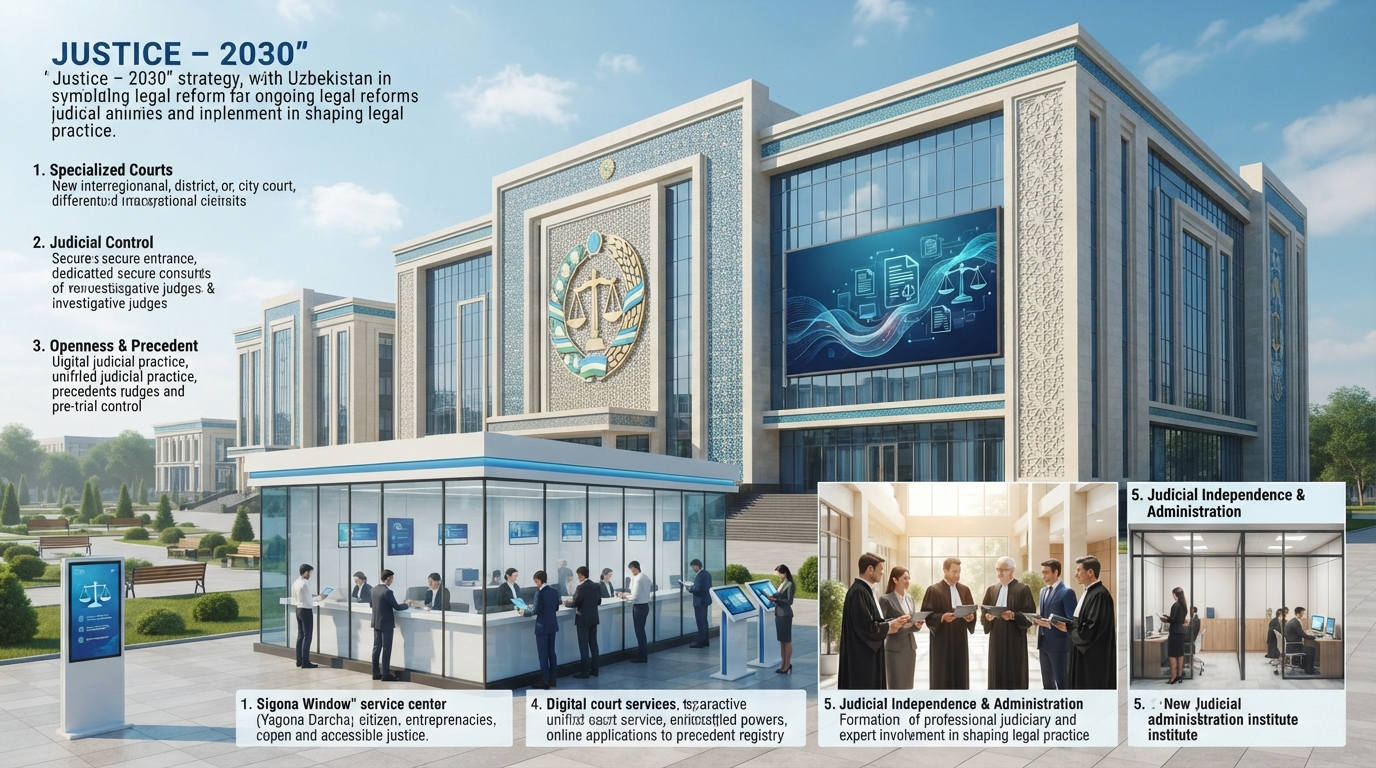
Uzbekistan has approved the "Justice 2030" Strategy, which provides for large-scale reforms of the judicial system. President Shavkat Mirziyoyev signed a decree aimed at strengthening judicial protection of human rights and freedoms, as well as creating a fair and modern judicial system.
The document outlines six key areas of reform: developing an open and accessible "people's court," strengthening the independence of the judiciary, enhancing fair trial guarantees, developing a professional judiciary, digitalizing legal proceedings, and implementing international human rights standards.
One significant innovation will be the establishment of interregional courts starting July 1, 2027. They will be empowered to review court decisions in general and administrative cases. A total of 319 administrative staff positions are provided for their operation.
Between 2027 and 2030, district and city courts for civil cases are planned to be established in the regions, which should increase access to judicial protection, especially for residents of remote areas.
**Strengthening judicial review at the pre-trial stage**
Starting July 1, 2027, the powers of investigative judges will be expanded. When considering petitions for the application of procedural coercive measures, they will be able to verify the legality and validity of detention, as well as the sufficiency of grounds for suspicion or charges.
In cases of doubt, judges will be able to request additional documents while maintaining the confidentiality of the investigation. Judicial authorization of certain investigative measures that directly restrict the constitutional rights of citizens is also envisaged.
**Openness and unified judicial practice**
Starting August 1, 2027, the Supreme Court must introduce open publication and regular updating of decisions of the Presidium of the Supreme Court, which form a unified judicial practice. A register of "Precedents" will be created for this purpose.
Furthermore, it is planned to involve academics, experts, and civil society representatives in expert councils on the development of uniform judicial practice.
By 2030, one-stop service offices will be gradually established within the courts to provide information to citizens and entrepreneurs, assist with procedural appeals, and provide access to digital judicial services.
**Digitalization of Judicial Services**
By the end of 2027, it is planned to modernize the Supreme Court's interactive services portal, my.sud.uz. This includes the launch of an updated mobile app, an improved service for preparing court appeals, and expanded search capabilities for judicial decisions.
In economic disputes, starting January 1, 2028, it is proposed to implement the Proactive Case Management standard, allowing judges to take action to correct minor formal deficiencies directly during the course of a case.
It is also proposed to abolish the return of applications due to lack of jurisdiction in civil, economic, and administrative proceedings. In such cases, the court will transfer the application to the appropriate court.
**Relieving judges of unnecessary functions**
Starting January 1, 2028, the institution of Court Administration is expected to be introduced. A separate court administration will be responsible for organizational, logistical, financial, and informational-analytical support for court operations, digitalization, and work with court staff.
This will reduce the administrative burden on judges and allow them to focus their activities directly on the administration of justice.
Furthermore, starting in 2027, it is planned to annually publish the Quality of Justice Index in Uzbekistan, and, based on an analysis of judicial practice, to annually submit proposals for addressing systemic problems in legislation and law enforcement.
Thus, the "Justice 2030" Strategy envisions a comprehensive overhaul of the judicial system—from strengthening judicial oversight and judicial independence to digitalization of services and increasing the transparency of judicial practice. The stated primary goal of the reforms is the creation of a justice system capable of effectively and timely protecting the rights and legitimate interests of citizens and entrepreneurs.