

Uzbekistan GTL has begun preparations for privatization and an IPO. What is known about the plant's debts?
The State Assets Management Agency of Uzbekistan has begun preparations for the privatization of Uzbekistan GTL, which was built for $3.42 billion. Investors have shown interest in the plant's IPO. The remaining principal balance on foreign loans stands at $838 million. The enterprise is also bound by a 15-year $1 billion agreement with the American company Air Products.
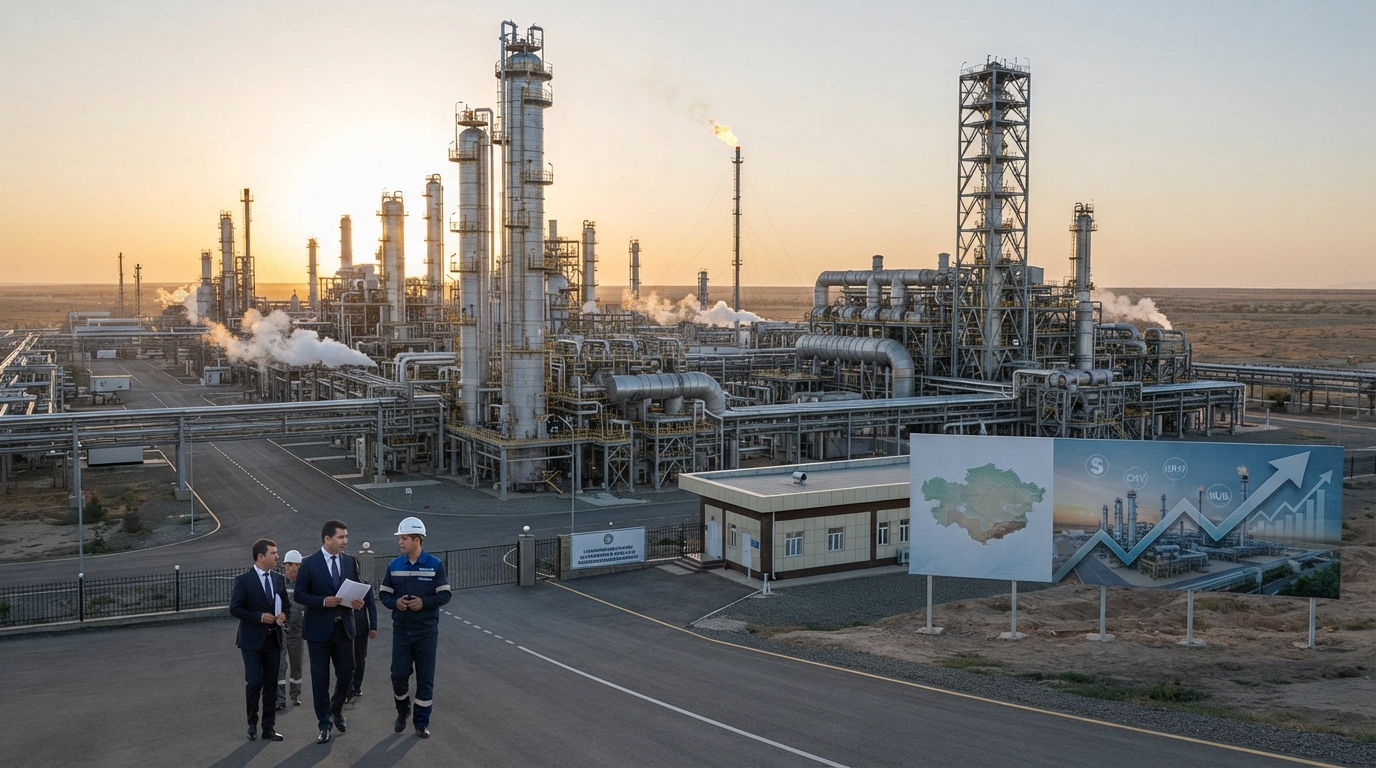
Uzbekistan GTL preparation for privatization and IPO begins. What is known about the plant's debts?
Uzbekistan has launched preparations for the privatization of the Uzbekistan GTL plant, the construction of which cost at least $3.42 billion. The State Assets Management Agency (SAMA) is also studying the option of an IPO for the enterprise and reports interest from international investors. At the same time, the plant's financial indicators were not disclosed at the press conference.
Sokhibjon Murodov, head of SAMA, spoke about the privatization process on October 8 at a press conference, answering a question about the enterprise's financial condition and debt repayment.
According to Murodov, a privatization concept has already been prepared for Uzbekistan GTL. Preliminary work is currently underway, which includes assessing financial and economic activities, identifying problems, and analyzing the possible consequences of a change of ownership.
"In a certain sense, the privatization stage has already begun. But if a privatization deadline is specified in the document, it does not mean that the enterprise will necessarily be sold by that time. It means that privatization work begins during this period," the head of the agency explained.
He stressed that before the sale, it is necessary to conduct an audit, identify and eliminate factors that negatively affect the production and financial condition of the enterprise.
In addition, it is necessary to assess how privatization will affect the economy, raw material suppliers, partners, and buyers of the plant's products.
According to the presidential decree dated April 21, 2025, a 100% stake in Uzbekistan GTL owned by Uzbekneftegaz is subject to privatization. The start of preparatory measures was scheduled for the third quarter of 2025, and the announcement of public auctions for the second quarter of 2026.
However, by October, the enterprise had not yet been put up for sale.
In parallel, SAMA began preparing a potential initial public offering (IPO).
"There are major international organizations that have expressed interest in participating in the IPO. They approached us with the question: 'When will you conduct the IPO? We also want to participate.' This is a good signal for us. If we go for an IPO, there will be those willing to acquire small packages of GTL shares," Murodov reported.
At the same time, the parameters of the future privatization, the stake planned to be offered to investors, and the timing of the IPO have not yet been named.
When asked about the current financial condition of the plant and the amount of repaid debt, the head of SAMA was unable to provide data.
"To be honest, right now I do not have direct information about the financial indicators of the enterprise. But we are ready to provide this information. Information about current financial indicators will be brought to the public separately through our social media channels," Murodov promised.
Uzbekistan GTL is located in the Kashkadarya region near the Shurtan Gas Chemical Complex. President Shavkat Mirziyoyev launched it in December 2021.
The enterprise operates using GTL (gas-to-liquids) technology, which allows processing natural gas into liquid petroleum products.
The design capacity of the plant is 3.6 billion cubic meters of natural gas per year. From this raw material, the enterprise should annually produce 724 thousand tons of diesel fuel, 307 thousand tons of aviation kerosene, 437 thousand tons of naphtha, and 53 thousand tons of liquefied gas.
The total construction cost was $3.42 billion. About $2.3 billion of this amount was financed through foreign loans under state guarantees.
The creditors were banks from China, South Korea, Russia, and other financial organizations.
As a result, since the start of payments, about $1.46 billion, or 63.6% of the original loan amount, has been repaid. The largest creditor remains the China Development Bank with $483.6 million of debt remaining from the original $1.2 billion.
The Export-Import Bank of Korea (KEXIM) accounts for 201.5 million, loans under the insurance coverage of Korean K-SURE account for 112.8 million, and loans under the KEXIM guarantee account for another $40.3 million.
Loans from Russian banks have already been fully repaid. In particular, the $120 million debt to Gazprombank was closed ahead of schedule on February 28, 2023. A $100 million Roseximbank loan, previously bought out by Gazprombank, was also fully repaid on that day.
At the same time, in 2025, the structure of creditors changed. The Singapore branch of KEB Hana Bank bought out part of the debt under the KEXIM guarantee and $30 million of the loan under K-SURE insurance coverage. The London branch of Japan's MUFG Bank acquired the remaining claims of Swiss Credit Suisse, which was subsequently merged into UBS.
This amount reflects the outstanding principal debt on these loans, but not necessarily all financial obligations of the enterprise, including interest and other contracts.
The construction cost of the plant should also not be considered its current market valuation or estimated privatization price. These indicators have not yet been disclosed.
In July 2026, a court trial began in Tashkent regarding the former Chairman of the Board of Uzbekneftegaz, Bakhodirjon Sidikov, and eight other people.
One of the episodes of the case relates to the company's obligations to the American company Air Products within the framework of the Uzbekistan GTL project.
He called about 50 of them critical. They were identified at three main units, including air separation equipment.
According to the former executive, due to technological problems, the plant operated at approximately 72% capacity.
Sidikov stated that failure to meet the indicators provided for by the loan agreements created a risk of a demand for early repayment of about $2.4 billion. Since the obligations were backed by a state guarantee, the financial burden could have fallen on the budget.
According to him, Air Products was brought in to solve the problems, agreeing to finance the rectification of deficiencies with subsequent reimbursement of expenses by contractor Enter Engineering.
A separate dispute arose surrounding a payment of approximately $21.4–21.8 million, which Uzbekneftegaz transferred to Air Products instead of contractor Enter Engineering as part of a guarantee.
Sidikov asserted that settlements with the American company were necessary to preserve the project and the trust of international investors. The defendants did not plead guilty.
In August, the hearing of the case was moved to closed sessions.
In May 2023, the government of Uzbekistan and Uzbekneftegaz signed a $1 billion agreement with the American company Air Products.
The company acquired industrial gas production facilities within Uzbekistan GTL, including air separation units, synthesis gas, and hydrogen production equipment.
Air Products provides operation of these facilities and supplies the gases necessary for the plant's operation.
The feature of the deal lies in its financial structure. According to Air Products' reporting, the agreement is designed for 15 years. The American company receives a fixed monthly fee, which includes remuneration for production capacities and expenses for their operation and maintenance.
At the same time, payments are provided regardless of whether Uzbekneftegaz requires the entire volume of products.
The Uzbek side has the right to buy back the facilities after the expiration of the contract term.
Therefore, Air Products reflects the transaction in its financial statements not as a regular asset sale, but as a financial transaction. As of September 30, 2025, the corresponding financial trade receivable in the reporting of the American company was about $1 billion.
Thus, when preparing for the privatization of Uzbekistan GTL, it is necessary to take into account not only previously attracted bank loans, but also long-term contractual obligations associated with the operation of part of the production capacity.
In December 2025, Uzbekneftegaz reported that Uzbekistan GTL reached full capacity four years after launch.
At a meeting, the Chairman of the Board of the company, Abdugani Sanginov, criticized the multi-year problems of the enterprise.
According to Uzbekneftegaz, technological deficiencies had still not been fully resolved by that time, and emergency shutdowns continued, negatively impacting the financial stability of the plant.
The company's management instructed to analyze the causes of unplanned shutdowns, eliminate technological risks, and increase production in 2026 by 15–20%.
In addition, the enterprise was tasked with finding additional sources of natural gas without reducing supplies to domestic consumers.
Previously, the high debt burden of Uzbekneftegaz and GTL's operation below design capacity had already attracted the attention of international rating agencies. At the end of 2023, S&P downgraded the state company's credit rating from BB− to B+, but in 2025 improved the rating again.
Before the privatization of one of the country's most expensive industrial facilities, a number of financial and operational questions remain: current profitability, the complete structure of liabilities, the stability of the plant's operations, and the terms under which a future investor will be able to acquire the enterprise.