

Uzbekistan entered the top three largest buyers of gold among central banks
Since the beginning of the year, the Central Bank of Uzbekistan has purchased about 40 tons of gold — only Poland and China bought more. In July, however, the regulator sold about 1 ton. Earlier, the head of the Central Bank, Timur Ishmetov, allowed for the sale of gold at "favorable prices" as part of managing international reserves.
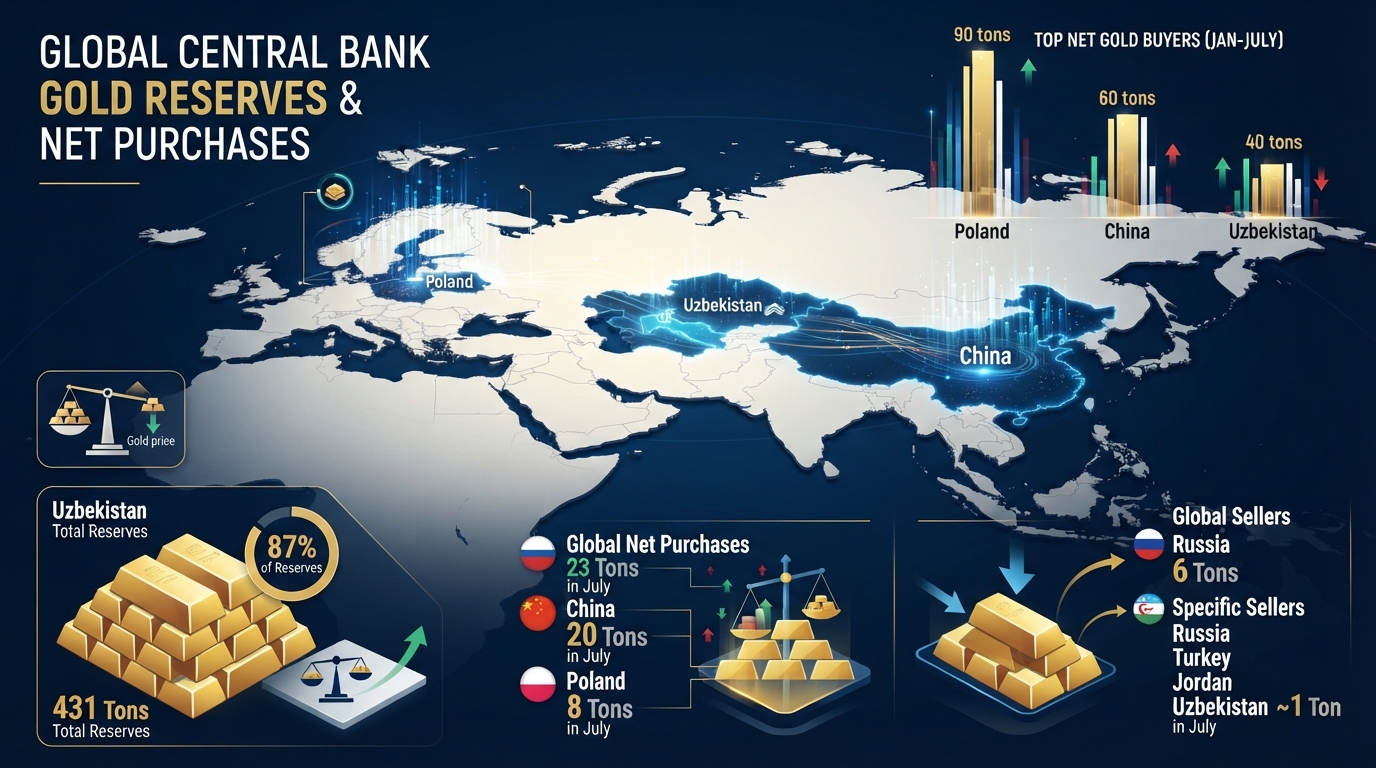
Uzbekistan entered the top three largest gold buyers among central banks
The Central Bank of Uzbekistan sold about 1 ton of gold in July, but still remains among the largest buyers of gold in the world, data shows.
According to the organization, by the end of July, Uzbekistan's gold reserves stood at approximately 431 tons. Gold accounted for about 87% of the country's international reserves.
In July, the world's central banks generally continued to increase their gold reserves: net purchases reached 23 tons. The largest buyers during the month were China with 20 tons and Poland with 8 tons.
The largest seller was Russia, which reduced its reserves by 6 tons. Turkey, Jordan, and Uzbekistan sold about 1 ton each.
Despite the July sale, Uzbekistan remained one of the notable buyers of gold for the period of January–July. The Central Bank's net purchases since the beginning of the year amounted to 40 tons.
According to World Gold Council data, Poland purchased more during this period — about 90 tons, followed by China with 60 tons, and Uzbekistan with 40 tons. Kazakhstan bought about 29 tons.
Thus, Uzbekistan ranks third among the largest net buyers of gold since the beginning of the year mentioned in the review.
In total, the world's central banks reported net purchases of approximately 130 tons of gold for January–July. During the same period of 2025, the figure was about 160 tons.
The World Gold Council also drew attention to recent statements by the Chairman of the Central Bank of Uzbekistan, Timur Ishmetov.
According to the organization, the head of the Central Bank said that gold "has so far proven to be the best investment," but the regulator is considering the possibility of selling it at "favorable prices" as part of managing international reserves.
Previously, the Central Bank has repeatedly explained that fluctuations in the volume of gold in reserves can be related both to changes in world prices and to transactions for the purchase and sale of the precious metal.
Poland remains the largest buyer of gold since the beginning of the year. Over the seven months, its central bank acquired about 90 tons, bringing its reserves to 640 tons — approximately 28% of the country's total reserves. Poland's target level is 700 tons.
China bought another 20 tons of gold in July — this was the 21st consecutive month of purchases. Since the beginning of the year, the People's Bank of China has increased its reserves by about 60 tons, to 2,366 tons. Gold accounts for about 8% of Chinese reserves.
Kazakhstan acquired about 1 ton in July, and 29 tons since the beginning of the year. Gold accounts for about 75% of its international reserves.
Russia, on the contrary, sold about 6 tons of gold in July and has reduced its reserves by about 50 tons since the beginning of the year. Turkey has sold about 85 tons since the beginning of the year.
The World Gold Council notes that despite individual sales, central banks' interest in gold persists. In 2026, a number of regulators are also considering expanding domestic storage facilities and diversifying foreign gold storage locations.
In 2026, gold exports were recorded only twice — in April and July. Prior to this, Uzbekistan last shipped gold abroad in September 2025 — worth approximately 1.5 billion dollars.
Uzbekistan's international reserves grew by 590 million in July — to 64.35 billion dollars. The value of gold increased by 365 million dollars due to rising quotes, although its physical volume decreased by almost a ton. The Central Bank reduced its portfolio of securities in reserves by almost 40%, or by 1.1 billion dollars.