

Uzbekistan entered the top three Central Asian countries for data leaks
In Uzbekistan, 15 million rows of leaked data have been recorded, and the country ranked second in Central Asia in terms of the number of database publications.
Uzbekistan entered the top three Central Asian countries for data leaks
In Uzbekistan, in 2025 and the first half of 2026, about 15 million rows from leaked databases of companies and government organizations were compromised.
According to this indicator, the country ranked third in Central Asia after Tajikistan and Kazakhstan, according to the F6 2025-2026 Cyber Threat Landscape Report.
In total, during the specified period, F6 identified more than 600 million user records compromised as a result of 164 unique publications of database leaks worldwide. Of these, 91 databases were made publicly available on hacker forums and Telegram channels, and another 73 databases were put up for sale.
Central Asian countries accounted for 257 million rows of compromised data, which is more than a third of the global volume of identified leaks.
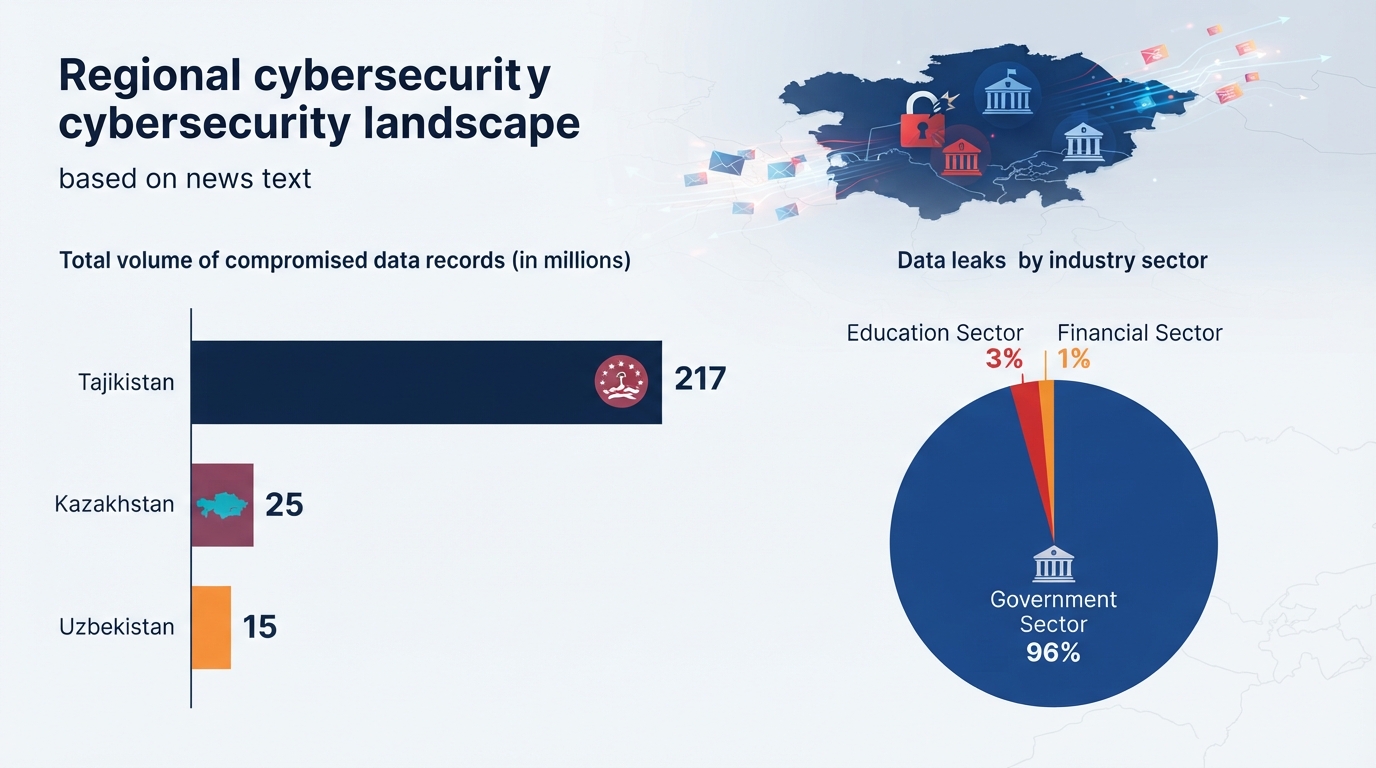
Tajikistan became the regional leader in terms of the number of leaked records — about 217 million rows, or 84% of the total volume of data recorded in Central Asia. Kazakhstan took second place with approximately 25 million rows, or 10%. Uzbekistan accounted for about 15 million rows, which corresponds to 6% of the regional volume.
At the same time, the situation differs in terms of the number of database publications. Kazakhstan accounted for 57% of all leak publications in Central Asia, Uzbekistan — 29%, and Tajikistan — 14%.
F6 noted that a single row in a leaked database can contain various types of personal information. In particular, this may include a name, email address, passport details, or a login and password for a service.
By industry volume of compromised data in Central Asia, the public sector dominated, accounting for 96% of all records. The main reason was one large-scale leak in Tajikistan, which affected more than 217 million rows.
Education took second place with 3% of compromised records. The main volume came from leaks of educational platforms in Kazakhstan — about 8.5 million records.
The distribution by the number of leak publications turned out to be different. The public sector accounted for 43% of all publications, education — 29%, and the financial sector — 28%. Despite the relatively small volume of compromised data, each of these sectors became the source of several separate leaks.
"Central Asia shows how one major leak can change the statistics of an entire region and affect millions of records. Nevertheless, regular small leaks are no less dangerous for businesses and citizens," noted Lada Kryukova, Head of Underground Research and Monitoring at F6.
The company recommends that organizations and government agencies strengthen data protection, regularly assess security levels, monitor compromised credentials, and implement incident response plans. According to F6, such measures help reduce the consequences of large-scale data leaks.