

US vs. China: Who is Leading the Global Artificial Intelligence Race
US and China: Who is Ahead in the Global Artificial Intelligence Race
Washington and Beijing continue to compete for global leadership in the field of artificial intelligence. The United States maintains absolute supremacy in spending and computing power, but China holds the lead in scientific research and is rapidly closing the gap in creating advanced models.
On the eve of the scheduled summit in Washington between US President Donald Trump and Chinese President Xi Jinping, US Treasury Secretary Scott Bessent announced that the American side had proposed to China the creation of a special "notification mechanism" for AI — a direct communication channel for prompt reporting on national security threats.
The leaders' talks took place against the backdrop of a technological arms race and growing expert concerns over AI risks.
The speed of training and operation of AI systems is directly determined by the volume of computing power, measured in FLOPS (floating-point operations per second). In this indicator, the US is significantly ahead of the PRC.
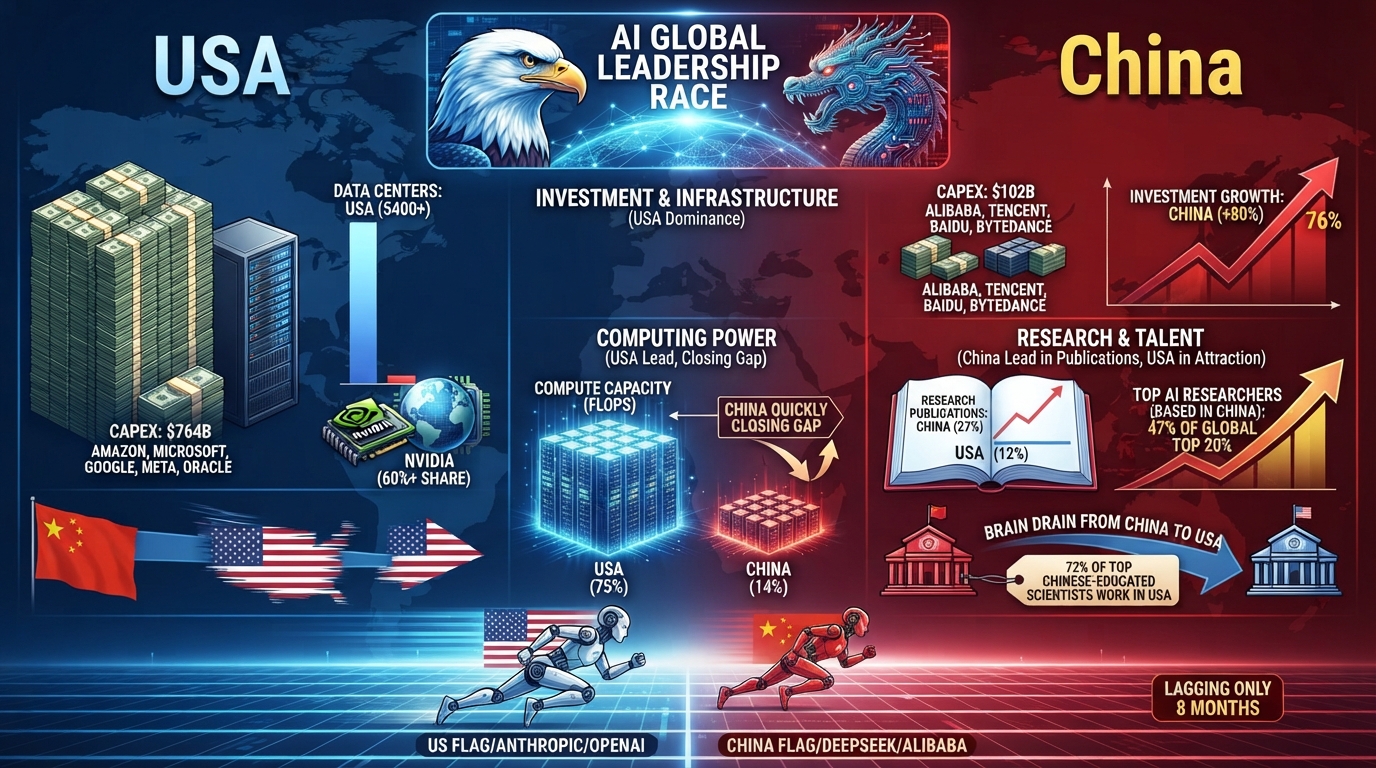
According to the research institute Epoch AI, the US accounts for nearly 75% of all global computing power in the AI sector, while China accounts for just over 14%.
According to Stanford University's 2026 AI Index, the American company Nvidia accounts for over 60% of global computing power among leading chipmakers. The share of China's Huawei is still smaller, but is steadily increasing.
The US has more than 5,400 data centers — about 10 times more than any other country — as well as 84 specialized AI data centers, which exceeds the combined figure of the next eight countries in the world.
Anthropic), but Chinese developments are gaining popularity in practical applications.
On the Arena blind testing platform, American models from Anthropic, xAI, Google, and OpenAI share the top positions with Chinese developments from Alibaba and DeepSeek.
On the OpenRouter platform, Chinese models from DeepSeek, Z.ai, and Tencent lead in terms of processed token volume. This is due to their lower cost and open-source nature.
According to the Center for Strategic and International Studies (CSIS), Chinese systems lag behind American flagships by "a matter of months, but not years." In particular, the DeepSeek V4 Pro model, released in April 2026, is about eight months behind its top US counterparts.
The US leads in AI spending thanks to its powerful tech sector, but China is increasing investments faster.
According to Goldman Sachs estimates, American IT giants — Amazon, Microsoft, Google, Meta, Oracle — will collectively direct about $764 billion toward infrastructure and data centers in 2026. China's four leading companies — Alibaba, Tencent, Baidu, ByteDance — will spend about $102 billion.
According to TrendForce forecasts, capital expenditures of Chinese tech giants will grow by more than 80% in 2026, while the spending growth of American companies will be about 76%.
China leads in the number of scientific publications and specialist training, but the US remains the main center of attraction for global talent.
According to the Center for Security and Emerging Technology, China accounts for more than 27% of all global publications on AI, while the US accounts for about 12%.
According to a study by MacroPolo, 47% of the top 20% of the world's best AI researchers received their bachelor's degree in China (by comparison, this figure was 29% in 2019).
Despite the successes of Chinese education, about 72% of leading AI scientists who received their basic education in the PRC end up working in the US.