

US military reveals Middle East bases and movements via Strava app
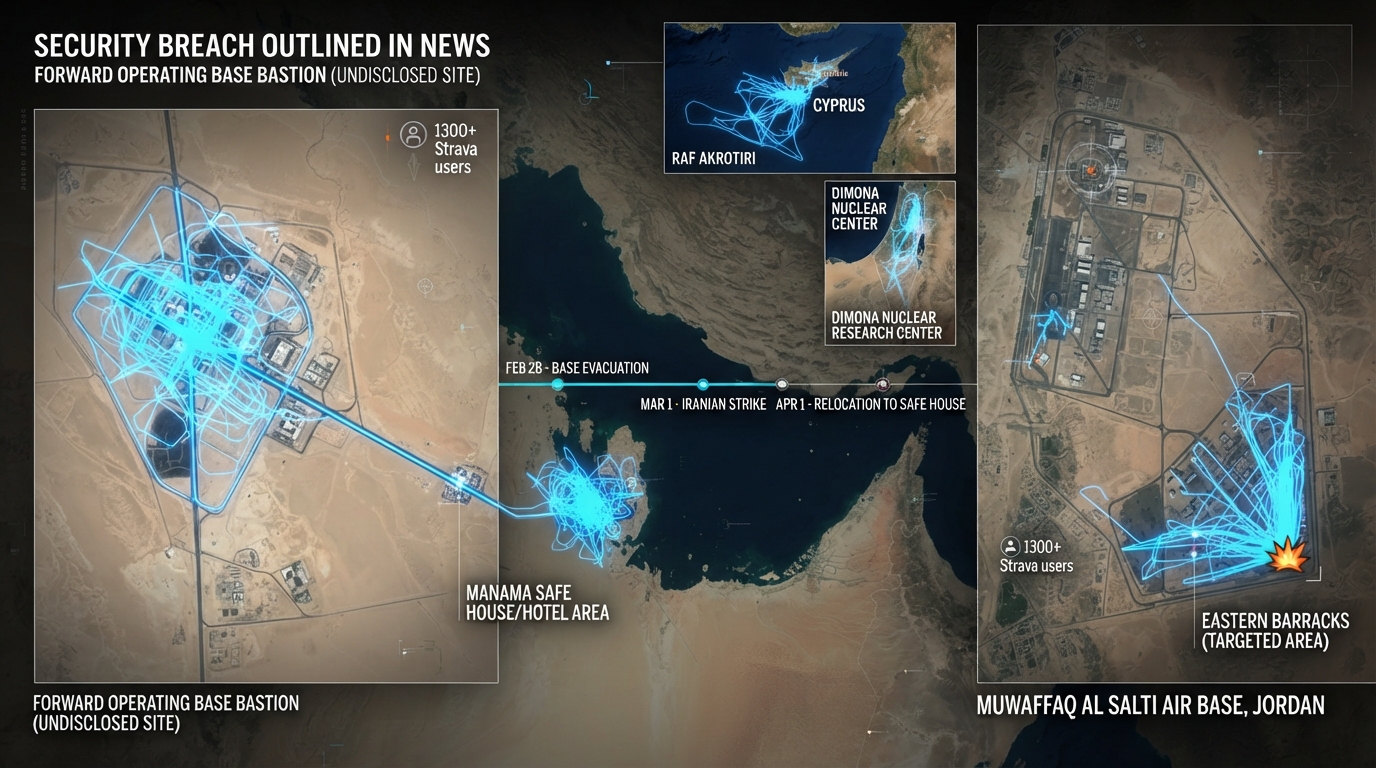
The US military has exposed its bases and movements in the Middle East through the Strava app. According to Sky News, more than 1,300 Strava users shared their workouts from US military bases in the Middle East, which could have been used by Iran to target American forces.
The Strava app allows users to share the exact routes and times covered while running, cycling and swimming. Thousands of such workouts have been recorded at US military bases in the Middle East. As a result, it was possible to track daily routines on the base, the location of personnel and the movement of soldiers between bases. These include bases that are not marked on public maps.
Most of the users who shared their activities on Strava did so under their real names. This made them potential targets for attacks or espionage. The Pentagon banned its employees from using the app’s location-sharing features without permission seven years ago.
Special operations expert Jonathan Hackett said the location sharing continued due to a “lack of awareness.” He said Iran “almost certainly” uses apps like Strava to track U.S. military movements in the Middle East. In some cases, the information shared on Strava may have directly influenced Iran’s targeting decisions.
On March 1, Iran launched retaliatory attacks on U.S. military bases in the Middle East. Among the targets was a major naval base in Manama, Bahrain. The base was later evacuated, and many personnel were moved to residential areas and hotels in the city. A U.S. Navy contractor in Manama was found to have a Strava account. In the week before the war, he had been regularly sharing his runs around the base. After a two-day hiatus on the app, he was found to be running again in the courtyard of the Crowne Plaza Hotel. Six days later, Iran also bombed a hotel during attacks on a naval base. Two Pentagon personnel were injured.
National security expert Joseph Yarnetsky said it was “absolutely plausible” that Iran was using Strava, among other sources, to track the movements of U.S. personnel and target them. “This has been a very well-documented intelligence-gathering vector for over eight years,” he said.
Before the war began on February 28, U.S. personnel at Jordan’s Muwaffaq Al Salti Air Base posted hundreds of their runs on Strava. The personnel continued to share their activities in April, during the ceasefire. But their daily lives have changed. Instead of being evenly distributed across the base, 76 percent of the runs now start or end in one place: the barracks on the eastern side of the base. On July 17, Iran attacked those barracks, killing three soldiers.
When Sky News presented its findings to the Pentagon, it asked to contact CENTCOM, the military command responsible for the Middle East. But the command did not respond. But it is not just US personnel who continue to use Strava. “We also identified active British soldiers who shared their workouts from RAF Akrotiri in Cyprus, where Iran attacked. In total, we found 12,000 workouts shared from the base since January,” the report says.
Some of these profiles were tracked as they were deployed across the Middle East, including at some bases not marked on public maps. Three Strava users were even found running inside Israel’s Dimona nuclear research center, one of the country’s most sensitive facilities and a target of repeated Iranian attacks.
Virpratap Vikram Singh, a military expert at the International Institute for Strategic Studies, said Strava’s data “is an undisputed security threat.” According to a Strava spokesperson, the company takes the security and privacy of its users very seriously. “As stated in our terms of service, we expect people in sensitive professions to use the controls available to them and to limit their content accordingly,” the app’s developers said in a statement.
It was previously revealed that Russian Federal Security Service officers had been regularly tracking running routes on Strava between 2019 and 2024 around the Gelendzhik Palace on the Black Sea coast and the residence in Maryalakhit Bay in Karelia. This data was used to track Putin’s movements.