

Under strain, Australia's world-leading disability support faces major restructure
The NDIS was game-changing for its users - but as costs balloon, its success has led to its downfall.
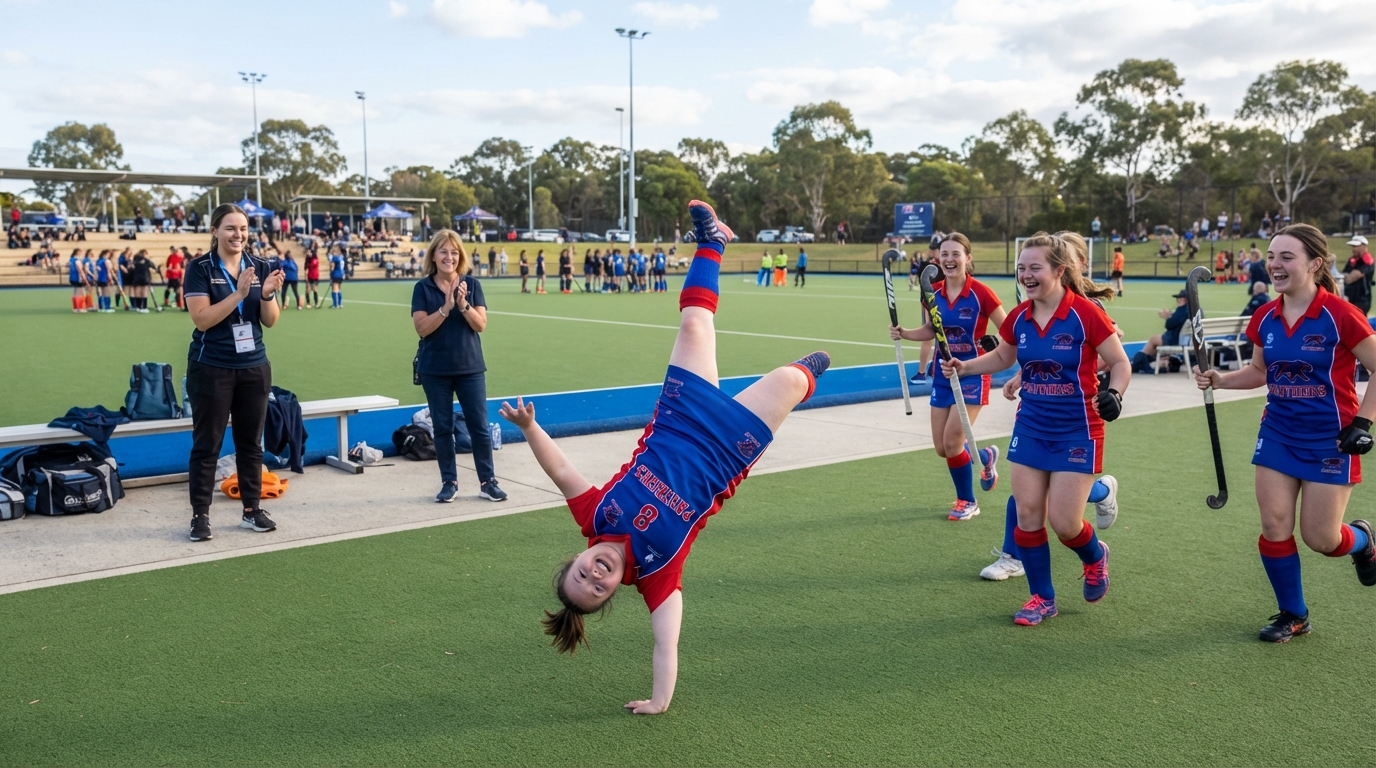
Australia's leading disability support system is facing a significant overhaul due to mounting pressure.
Annabelle Shaw, a hockey enthusiast on a winning streak with eight goals this season for the Panthers, relies on funding from the National Disability Insurance Scheme (NDIS) to maintain her active lifestyle. "I don't give up," she proudly states, describing her cartwheel celebration after each goal. When not on the field, Annabelle enjoys working out with friends at the gym.
However, Annabelle's participation in her favorite sport may soon be jeopardized. The Year 8 student from Western Australia has Down Syndrome, a genetic condition resulting from an extra copy of chromosome 21, causing physical and intellectual disabilities. This condition qualifies her for support through the NDIS, one of the world's most progressive disability support programs.
The NDIS was established to provide greater independence and an improved quality of life for Australians with lifelong and severe disabilities. Its innovative design offered a new approach to disability support, granting individuals funding based on their specific needs and the freedom to choose how to utilize it, placing disabled Australians and their families at the forefront of decision-making.
Despite its success, the NDIS has grown rapidly, leading to escalating costs for the government. Consequently, the federal government introduced proposals earlier this year to implement stricter controls, aiming to reduce the scheme's size and budget.
Annabelle's NDIS funding helps cover therapies like speech pathology and provides a support worker for her on the hockey field. Her mother, Gillian Croft, emphasizes the importance of this support during practice sessions, where up to 50 girls might be training simultaneously. "Annabelle needs somebody to break it down and say, okay, did you hear that, Annabelle? We've got to stand over here," Gillian explains. "Sometimes, especially if it's fast-paced, she disengages and she doesn't want to play because she doesn't understand what she needs to do."
The NDIS Amendment bill passed the House of Representatives in early July but was subsequently delayed, extending a Senate inquiry into the proposed changes. The inquiry's report is expected on August 14, with the legislation anticipated to pass in the Senate shortly thereafter. Participants warn that the implications of these changes could be substantial.
Annabelle is one of over 700,000 Australians who access NDIS funds. The scheme was introduced in 2012 under former Prime Minister Julia Gillard, though full national access wasn't achieved until 2020.
Bill Shorten, Vice-Chancellor and President of the University of Canberra, who was instrumental in establishing the NDIS as the then Parliamentary Secretary for Disabilities, told the BBC, "Disability can affect any of us, from when you're born to a child's development, through the blink of an eye on a country road, through your genetic lottery as you age." He further explained, "What really makes disability hard is a lack of money and a lack of power," noting the NDIS has garnered bipartisan support.
Initially, the NDIS was projected to cost approximately $22 billion annually, serving around 475,000 participants. However, in the current financial year, it has surged to $54 billion, supporting over 700,000 individuals. These figures are expected to continue rising, prompting the government's proposed "massive reset."
"It has grown too big too fast," states Hannah Orban, Senior Associate at the Grattan Institute and co-author of the report "Saving the NDIS." Her research indicates that each participant receives an average of approximately A$65,000 ($44,800) in annual funding, with some individuals with complex needs receiving significantly more, and others considerably less. "It costs a lot of money to run it and the government really does need to introduce good reforms to make it more sustainable so that it is here for generations to come," Orban emphasizes.
Prior to the NDIS, disability services varied across states and were criticized for being underfunded and inefficient. The NDIS introduced a transformative system, but in doing so, other previously existing support services diminished. "Once we created the NDIS, there was a retreat from other disability services, so hospitals, schools - you name it - everything became an NDIS matter," Shorten explains.
In 2024, changes were implemented to curb ballooning costs, overseen by Shorten, who had coincidentally returned as the Minister for NDIS. However, these measures proved insufficient as participant numbers continued to grow, particularly among children.
The scheme has also faced criticism for individuals accessing support not originally intended for the NDIS, which was designed for those with permanent or significant disabilities. A study by the Australian National University revealed a 32% increase in autism prevalence since the NDIS's inception. Experts, however, offer a straightforward explanation.
"People went into the NDIS because other systems were failing," says Jenny Karavolos of the Australian Autism Alliance, who testified at a parliamentary inquiry into the cuts in June. While autism diagnoses may have increased, Karavolos argues this is due to people needing access to appropriate support, and she does not believe it is the cause of the NDIS's financial strain.
Another criticism of the scheme involves providers exploiting the system by offering unnecessary and expensive services. "Where there's government money, there have been over-servicing and over-charging and shonky providers," Shorten states. "Many are good providers, but some are bad. That's the nature of a government scheme: people will hone in on it and try and slice off amounts for themselves."
According to the NDIS integrity chief, $3.7 billion was inappropriately disbursed in 2025, a combination of misuse of funds and fraud. However, experts believe tackling this alone will not resolve the underlying issues.
"Fraud is low-hanging fruit," Orban comments. "The government absolutely needs to tackle fraud and get on top of people who are rorting (cheating) this scheme because they're rorting people with disability and taxpayers, and it's just not acceptable. [But] the savings from fraud are really small compared to the other reforms that they've put forward."
These proposed reforms include improved cost control, stricter compliance, more efficient assessments, and transitioning children with lower support needs, such as those with developmental delays or autism, from NDIS early intervention to a program called Thriving Kids.
Families and carers express significant concern over plans to reduce funding for social participation by up to 50%. This aspect directly benefits individuals like Annabelle and is considered by advocates to be central to the NDIS's original purpose: enabling disabled people to be integral members of the economy and Australian society.
The government estimates that approximately one-third of funding for individuals with Down Syndrome is allocated to social participation. Without this, Annabelle's hockey participation would be at risk, and the impact would extend to disabled people more broadly.
Hannah Diviney, an actor, author, and disability advocate, emphasizes, "It is a core goal of the NDIS to help people with disability participate in society and their communities." Orban adds, "So it really doesn't make sense to be attacking this part of the scheme."
The proposals have drawn considerable criticism from the government, which cites fraud and systemic problems but then suggests cuts to funding deemed crucial for fostering independence among disabled individuals.
"This amendment is reckless, ill thought-out and entirely devoid of any shred of understanding of what living a disabled life is actually like for both the person themselves and their support network," stated Hannah Diviney, who has cerebral palsy and requires a high level of support, at the June inquiry. She highlighted that her ability to travel to and from Canberra to speak at the inquiry was made possible by NDIS funding.
"Any time I leave the house, if I am not with a friend or a parent, it costs something – that is an incontrovertible fact of my life," she told the inquiry. "Freedom, ambition, career, a social life – all of the things other people in this room take as a given, or as a right – has a price tag for someone like me."
While the NDIS budget has significantly exceeded initial projections, it has also generated a substantial number of jobs, including physiotherapists, speech pathologists, and support workers. Experts contend that this factor must be considered as plans to reduce the scheme move forward.
"I don't disagree that there needs to be reform about how the NDIS is operating - particularly how children are treated on the NDIS," says Darryl Steff, CEO of Down Syndrome Australia. "All too often these cuts are seen in isolation and people are going, 'the NDIS costs us too much', but without acknowledging that every dollar spent in the NDIS contributes over two dollars to the broader economy."
Beyond job creation, NDIS support also empowers more disabled individuals to participate in the economy.
"If Annabelle's playing mainstream hockey and she's out there with typical kids all the time and she's going to a mainstream school, that's her normal," Gillian says. "When she finishes school, she will expect to go and have a job and be in a workplace that's full of typical people."
These proposed cuts threaten to alter everything. "She doesn't get exposed to any of that, and then we expect her suddenly to walk into the workforce without having any independence training all these years," Gillian explains. "This is independence training for her, going to these sporting events and going to school, which in the end will be cheaper for government as well."