

Ukraine's prized steel industry left in ruins by Russian missile campaign
Ukraine's remaining steelworks, a vital part of its economy, have all but ground to a halt because of relentless attacks.
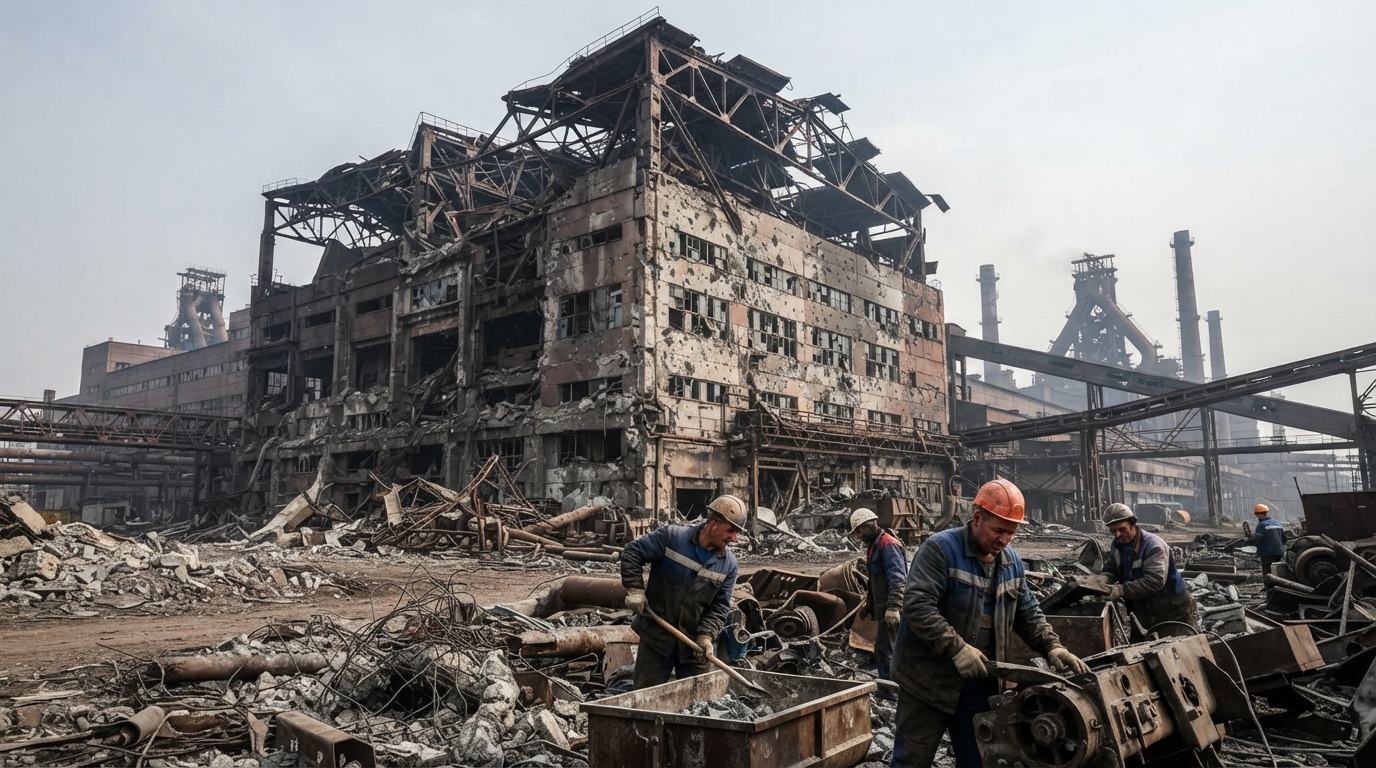
**Ukraine's prized steel industry left in ruins by Russian missile campaign**
After one strike on the Zaporizhzhia steelworks, a blast furnace was brought back online only for the facility to be hit again a few hours later.
Like thousands of other people in Zaporizhzhia, Denys Maksyshko has spent years employed at the local steel plant, Zaporizhstal. For generations, it has been the city’s largest and most valuable source of jobs in this major Ukrainian city.
“Zaporizhstal is not just a big company, it's the heart of the city,” he says.
Now, after a string of Russian missile attacks, that heart has stopped. The vast plant, which employs 8,500 people, has been shut down indefinitely after four rounds of Russian strikes — two in August and two in September.
“All the equipment has been almost completely destroyed. There are no windows left, and there are holes in the roofs. The blast furnaces have been almost completely ruined,” Maksyshko complains.
Russia launched 17 missiles at Zaporizhstal in total, according to Oleksandr Myronenko, chief operating officer of steelworks owner Metinvest. Eight workers were killed and 31 were wounded.
“We're now clearing rubble and trying to plan recovery,” Myronenko tells the BBC.
For now, it is far from clear whether Zaporizhstal will ever restart.
The Zaporizhstal works has been hit by four waves of Russian attacks
Russia’s sustained air campaign against Ukrainian metallurgical plants began in August. By now, every one of them has been struck, some more than once.
This is a crucial part of the Ukrainian economy and, naturally, an appealing target for Russia.
Before the full-scale invasion began in 2022, metallurgy and mining made up about 10% of Ukraine’s GDP and one-third of its exports. The sector employed more than half a million people, and every 13th job in Ukraine was connected to it in one way or another.
As a result of the recent Russian attacks, it has almost come to a standstill, and its share of Ukraine’s GDP now “is probably close to zero”, Myronenko says.
Until recently, his company was Ukraine’s largest producer of steel and iron, but all of its steelworks are currently out of operation.
“Clearly, they're trying to stop Ukraine's economy and stop Ukraine from getting [export] money from abroad, from paying taxes and wages, from ensuring that cities live and people have jobs,” Myronenko says. “Their efforts have been very effective so far.”
The damage to the metals sector could have devastating effects on Ukraine’s economy and society.
Ukraine had 12 metallurgical plants before it lost parts of its industrial heartland in the east shortly after the conflict with Russia began in 2014.
By 2018, only nine remained, and three years into the full-scale war in 2025 that figure had dropped to six. Among the plants lost were Azovstal and Illich in Mariupol, the south-eastern city captured after a months-long Russian siege.
One of the steel-producing cities caught up in Russia’s latest missile campaign is President Volodymyr Zelensky’s hometown of Kryvyi Rih.
On 25 September, Ukraine’s biggest steelworks, Arcelor Mittal Kryvyi Rih, said it could not reopen after repeated attacks over five weeks, while praising the courage of its workers, five of whom had died.
Local Defence Council head Oleksandr Vilkul made an emergency appeal to residents, describing a “very serious blow” that would affect far more than just thousands of jobs.
He admitted the situation was very difficult.
“It is taxes feeding into our community's budget,” he said. “They provided funds for keeping the city's infrastructure running, repairing heating plants and their pipes, funds for nursery schools, social services and many other things.”
Taxes paid by metal-producing companies have covered 30-70% of local government spending in the cities where they operate, says Stanislav Zinchenko, head of Kyiv-based consultancy GMK Center.
“In other words, the physical survival of these cities depended on these companies,” he told the BBC.
“This is a catastrophic problem for Ukraine's economy. Before the war, the mining and metallurgical industry was a key industry,” he told the BBC. “It was always the biggest investor in the economy, investing $2bn-$3bn (£1.5bn-£2.3bn) a year on average.”
Even if production were to restart, Zaporizhstal would not return to normal any time soon.
If the steelworks stay closed, hundreds of thousands of people could lose their jobs, and the resulting waves of migration would extend far beyond Ukraine, Zinchenko warned. “A humanitarian catastrophe is looming.”
The end of steel production in Ukraine would also have serious consequences for defence and reconstruction.
Steel is essential for making military equipment, as well as shelters and for repairing countless buildings damaged by Russia.
Russia has defended its attacks on the steel plants on that basis, claiming the facilities in Zaporizhzhia and Kryvyi Rih were producing military hardware.
“We attempted relaunching Zaporizhstal. We restarted a furnace, and it worked for 10 hours before there was another air strike,” Oleksandr Vodoviz of Metinvest told a conference in Kyiv.
He added that there was no point yet in spending money on recovery because the situation remained uncertain.
Even if production resumes, Ukrainian steelmakers will not be back to business as usual any time soon.
Russian strikes on railways have made moving their goods around Ukraine difficult and dangerous, while attacks on ports have turned exports into a deadly gamble.
“Ports have essentially been blocked,” said Oleksandr Myronenko. “Every ship is at risk of being attacked, and their chances are 50-50 - either you make it, or you don't.”
EU quotas on steel imports introduced on 1 July may add to the difficulties facing Ukraine.
But Denys Maksyshko, the Zaporizhstal worker, remains optimistic.
His colleagues are doing their part to bring the factory back to life, clearing rubble and repairing whatever can be repaired.
“This is similar to what the military do in the trenches. Ordinary people are fighting to keep the factory alive like soldiers.”