

Track defect found near derailment site - report
Initial findings from an RAIB investigation show an "irregularity" at the site near Lewes.
## Track Flaw Identified Near Lewes Derailment Site, Report Reveals
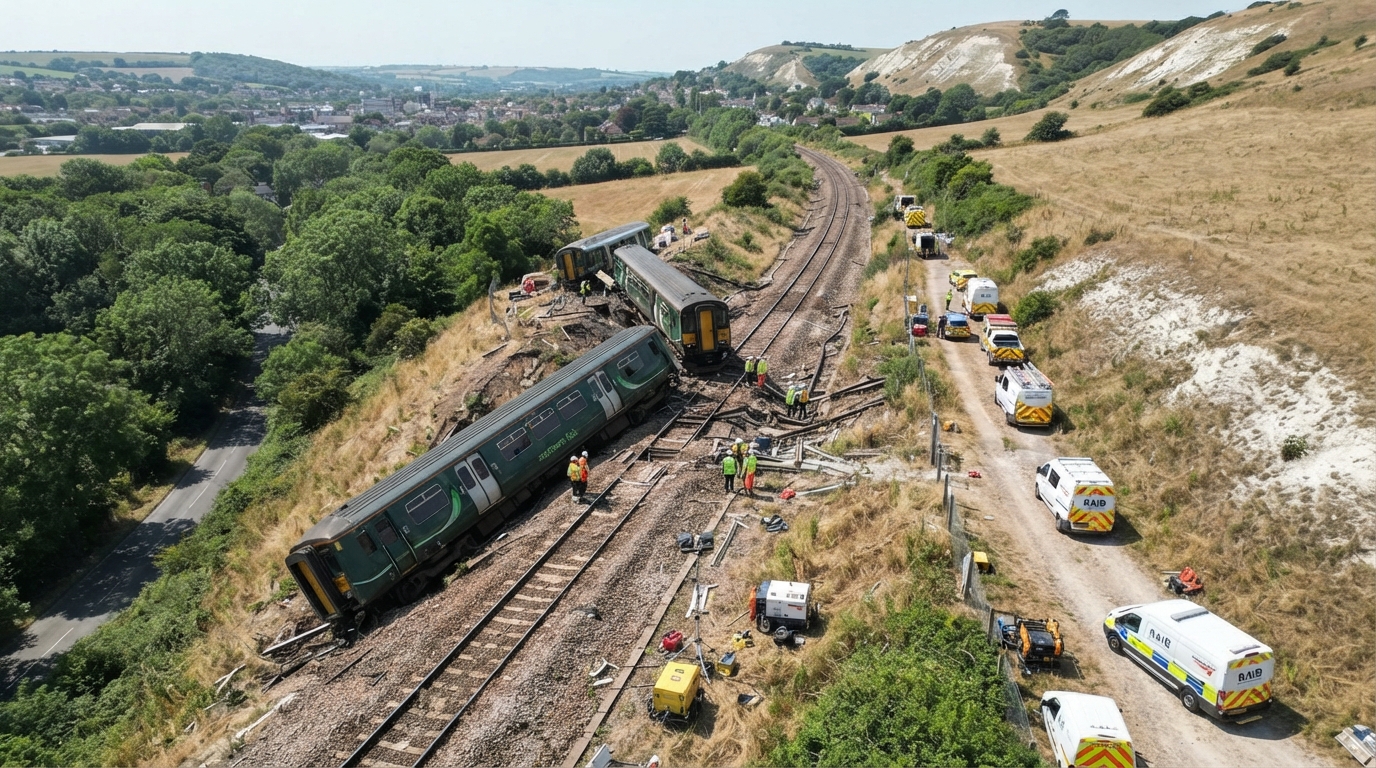
**Recovery efforts persist following the train incident near Lewes.**
A report indicates that a defect was discovered on the railway tracks in East Sussex at the location where a train derailed, resulting in 30 injuries.
Initial findings from the Rail Accident Investigation Branch (RAIB) pinpointed an "irregularity" in the tracks in Lewes, where three carriages plunged into an embankment last Thursday. The RAIB, which continues its investigation into the derailment, noted that it had received "several reports of rough riding at the location of the derailment from passengers on other trains."
In a joint statement, Network Rail and Greater Thameslink Railway, the operator of the Southern Rail train involved in the incident, expressed their regret, stating they were "sorry this happened on our railway."
Investigators from the RAIB confirmed that CCTV footage from a train that traversed the crash site at 14:04 BST revealed the "irregularity" in the track geometry just before the point where the train left the tracks. The 14:24 service from London Victoria to Eastbourne derailed in the Landport area of Lewes at approximately 15:54 BST. Images included in the RAIB report illustrate the location of the identified "irregularity" in the track.
The train was traveling at approximately 65 mph when it derailed, which was within the 70 mph speed limit, and the driver had initiated braking as the train approached the site. The RAIB update also highlighted that the accident occurred during a prolonged period of hot and dry weather, with temperatures reaching as high as 33°C (91.4°F) shortly before the crash. The RAIB stated that the clay embankment and the underlying material are susceptible to changes in moisture content and may shift as moisture levels fluctuate.
The ongoing investigation will now examine factors including the inspection and maintenance procedures for that section of track, the condition and upkeep of the embankment, the prevailing weather conditions, and the effectiveness of any hot weather mitigation measures.
Lucy McAuliffe, Network Rail's route director for Sussex, and John Whitehurst, chief executive of Greater Thameslink Railway, issued a joint statement apologizing for the derailment. They added, "We will carefully consider any recommendations arising from the investigation and work across the industry to implement them, with the shared goal of making an already safe railway even safer for our customers, colleagues and the communities we serve." A map illustrates the train's journey from London to Eastbourne, which was its intended final destination.
Last Friday, Martin Frobisher, Network Rail's group safety and engineering director, informed the BBC that speed restrictions were not in effect along the section of track at the time of the derailment. He maintained that the railway was safe and that Network Rail implemented various measures to manage the impact of weather on tracks and other railway equipment.
The Department for Transport released a statement affirming that "safety remains the absolute priority across our rail network." The statement further noted, "The UK's railways remain among the safest in the world, with the number of delays caused by track faults falling by 45% since the late 2000s."