

Toxic algorithms wouldn't let them go - now Australia wants an off switch
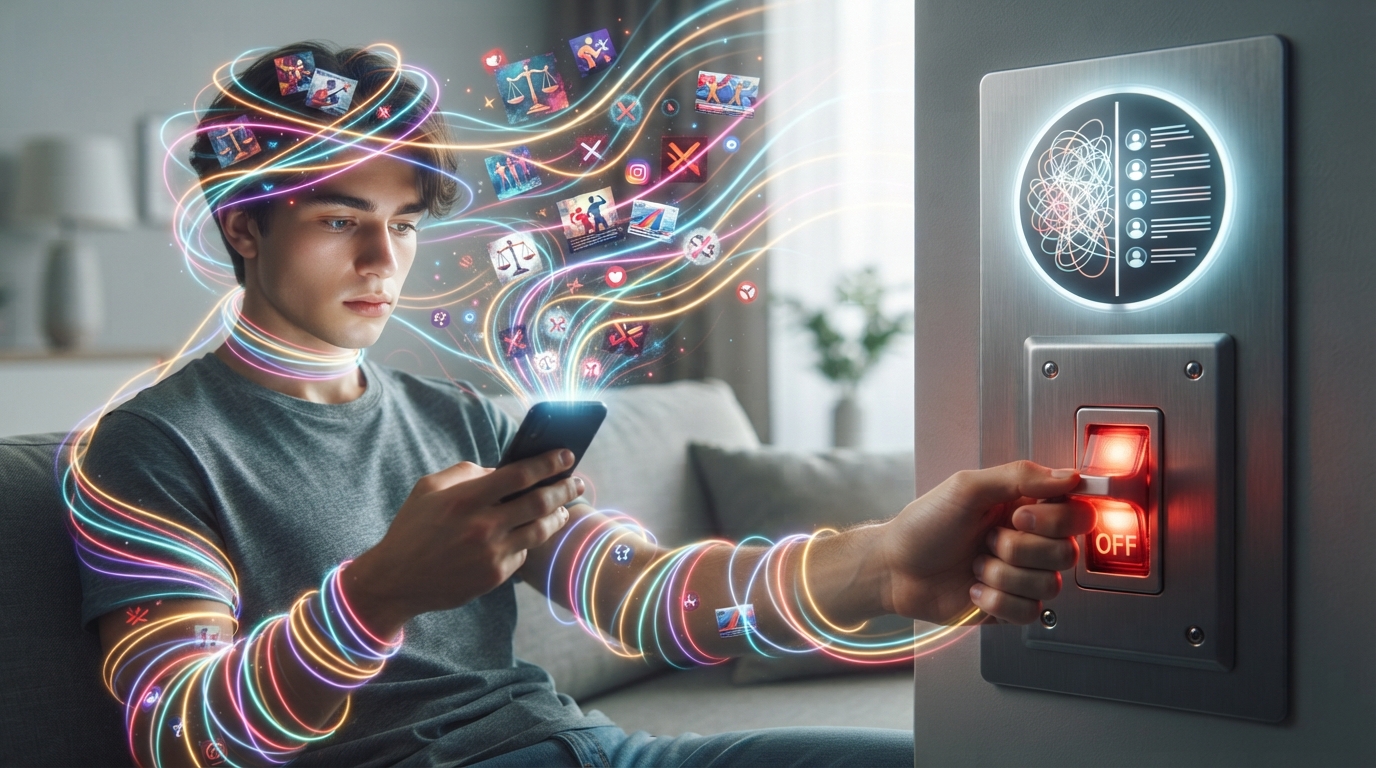
Australia has proposed a switch to force social media platforms to let users turn off recommended content.
Toxic algorithms wouldn’t let them go - now Australia wants an off switch
Varsha Yajman was already self-conscious about her appearance when she signed up to social media at 13.
Her feeds were flooded with endless workout videos making impossible promises. On screen, girls she had never met encouraged her to take part in dangerous calorie challenges. Others openly displayed their height and weight - even how many times they had been hospitalised - on their profiles as part of a warped competition.
Each night before falling asleep, Varsha would watch a stranger online record everything they had eaten that day.
“I was like, ‘I don’t need to eat. I can just watch other people eat,’” Varsha tells the BBC.
“I would find that I’d be down these really deep rabbit holes... it was like no matter how hard you tried to get out, you couldn’t.”
Now 24 and recovering from anorexia, Varsha says social media still serves her weight-loss content - even though she has every safety setting switched on and has blocked an extensive list of words.
The Australian government says it is trying to shield people like her with a new set of laws targeting big tech, introduced to parliament this week.
The main feature of the proposed changes is an algorithm switch that would require social media platforms to give users the option to turn off recommended content. In practice, that would mean seeing only posts from accounts you follow.
This is not the first attempt by a government to do this, but existing controls over algorithms are often temporary and can reduce app functionality.
Australia says it wants its laws to be stricter to prevent that. It also hopes the new measures - which would impose a legal duty of care on online services - will make Australians happier and healthier.
Critics, however, worry Prime Minister Anthony Albanese’s government has taken on more than it can handle in its battle with big tech, while others, including the Trump administration, argue the reforms pose a threat to free speech.
Flynn Martin knows what it is like to be pulled into an algorithmic spiral.
About four years ago, self-described misogynist influencer Andrew Tate and other manosphere figures began dominating the then-20-year-old’s social media feeds.
At the time, Flynn - later diagnosed with bipolar disorder - was insecure, frustrated with his life and struggling with his mental health. He says he was drawn in by the rhetoric.
He soon went viral in Australia for two videos: one in which he ranted about whether it was acceptable to be a straight white male, and another in which he criticised a date’s frozen yoghurt order.
“You find yourself in like a bit of an echo chamber... It’s easy to get swept up in that,” he tells the BBC.
“I really bought into the idea we were living in this matrix, we had this really negative system that was designed against you. And the only way to break out of it was becoming this alpha male character.”
The Melbourne man was only pulled out of the manosphere after a period of psychosis and a hospital stay.
Now, he says it is hard to look back on that version of himself: “While there’s a bit of shame and embarrassment... I think there is a bit of empathy for that younger man.”
Both Flynn and Varsha say social media was not the sole cause of the worst period of their lives, but they believe it was an important factor.
Many others have similar stories of being confronted with social media content they never looked for and did not want to see - and there have long been suspicions that the algorithms shaping these platforms are harming users.
Social media companies say the risks are being exaggerated and that they already offer effective safety tools.
But research from around the world has been pointing to a different picture.
Studies have found that social media use triggers a brain response similar to gambling and substance addiction; that algorithms - often without being asked for - push content that harms users’ mental health; and that they spread disinformation and deepen polarisation, contributing to violence offline.
Court cases and whistleblowers have also made claims that these companies know the dangers and are prepared to ignore them as the technology boosts engagement and profits.
“The result is that they promote content that is outrageous or that invokes strong emotions from people - so it might be anger or fear or desire or lust or insecurity, whatever it is, it’s going to keep us scrolling,” Chanel Contos tells the BBC.
While studying the issue at university, the activist - who helped change sexual consent education standards in Australia - launched a campaign for reform.
“Fix Our Feeds” called for recommended algorithms to be switched off by default, with users given the option to opt in.
Contos imagined a nostalgic return to early-2010s social media, when feeds were filled with posts from friends or people users actually followed, and were finite.
More than 15,000 people signed her petition, and the campaign also gained support from two former prime ministers, several MPs, prominent figures, mental health advocates and online safety experts.
In September, the government said it had heard the Australians who backed Contos’s campaign and announced its own version of the idea: forcing big tech to add an algorithm switch - but stopping short of making it automatically off.
“This is not about giving government control, it is about giving people control,” Albanese said.
“If people want to doom scroll… that’s fine, that’s up to them.”
The policy sits within the government’s Digital Duty of Care bill, which would require online services - including social media companies, gaming platforms, chatbots and others - to “ensure, so far as is reasonably practicable, a safe online environment”.
Children would have to be protected from “harmful” material and design features - such as pornography and content encouraging eating disorders or harmful attitudes towards women - while adults would need protection from “seriously harmful” material and conduct, a much narrower category of illegal content. Violations could bring fines of up to A$100m (£52m, $70m).
“The digital duty of care answers a lot of the ‘what abouts’ of the social media minimum age law because it’s much broader; it captures all online services and it shifts the onus of responsibility from the shoulders of victims onto the shoulders of the big tech operators who seek to make money off Australian users,” Communications Minister Anika Wells told the BBC.
Big tech has responded quietly. Meta, Snap, TikTok, X and Google, which owns YouTube, have all refused BBC requests for comment and have not publicly addressed the legislation.
After the announcement, Instagram boss Adam Mosseri argued that non-algorithmic feeds would mean users saw fewer posts from friends, and said he did not believe his app was addictive - although a US jury recently ruled otherwise.
“I think we conflate the way we colloquially use the word ‘addicted’ – like, ‘I’m addicted to this show, and I’m binge-watching it’ – and clinical addiction,” he told a press briefing in Sydney.
Australia’s right-wing parties - and the Trump administration - say both the algorithm proposal and the wider bill could lead to excessive moderation and censorship.
Supporters of the law say that will not happen because users will still be able to follow whoever they want and post whatever they want. “If adults listen to manosphere podcasts, or people post their views about the government, or make memes, or want to say the moon landing was fake – they can continue to do so without restriction,” Wells said this week.
The proposal appears to be much less divisive among the public and online safety experts than Australia’s social media ban for children.
Still, the major question is how Australia will enforce the policy when it has so far struggled to enforce the ban.
Surveys suggest most children who were on social media before the ban still are, and no fines have been handed out.
Australian regulators are investigating possible breaches of the social media ban.
The EU’s attempt to introduce algorithm controls in 2023 - after which platforms rolled out following-only feeds - offers a warning.
Social media companies have said uptake of safety and control tools like these has been low, and they cite that as proof users prefer their products as they are. Experts say there is a reason for that.
“Platforms do what the law orders, but in such a clunky way that users don’t actually enjoy the option and stick with the default, algorithmic experience,” researcher Chris Zomer, from the ARC Centre of Excellence for the Digital Child, wrote in The Conversation.
On Instagram, for example, switching off the algorithm means you cannot see direct messages or access your profile and settings. And when you leave the app, it returns to an algorithm-driven feed when you come back.
The only place where these problems do not exist is the Netherlands. There, the situation changed after a Dutch court last year found Meta in breach of the EU’s Digital Services Act.
Meta lost an appeal against that ruling in March, meaning users in the Netherlands still have control over their home feeds.
Australia’s rules are not yet final, but the government says following-only feeds must not be harder to use or less functional, algorithm settings must be “obvious”, and they must not change without an “explicit choice” from the user, even if they leave the app.
Encouraged by her success in Australia, Contos is now taking her campaign worldwide.
“We feel like Canada, UK, Australia are all very aligned on online safety... Then if those three jurisdictions are doing it, it could become a critical mass thing.”
Although experiences like theirs helped inspire the reforms, both Flynn and Varsha remain somewhat doubtful about them.
Varsha says she finds it hard to believe a country like Australia can overpower big tech, so she is unsure the Digital Duty of Care bill will succeed. Flynn says lawmakers should be “realistic” about what the algorithm switch can achieve: “At the end of the day we use social media as a form of entertainment.”
Polling earlier this month suggested two-thirds of their fellow Gen-Zs would keep their social media algorithms - although nearly half of Australians overall would switch theirs off.
And while Varsha says she is unlikely to use an algorithm switch much, she values having the option.
“On a bad day I’m still susceptible to all of the things that I was at 17. To know that, if I’m having a bad day, I can opt out makes me feel really good.”