

Three reasons Middle East oil supply is nearly back to pre-Iran war levels
Experts say US military assistance, using shuttle tankers and pipelines bypassing the Strait of Hormuz mean exports have rebounded.
Three reasons Middle East oil supply is nearly back to pre-Iran war levels
Data indicates that the amount of oil moving out of the Middle East has nearly returned to pre-war levels, even though Iran continues to restrict vessels trying to pass through the Strait of Hormuz.
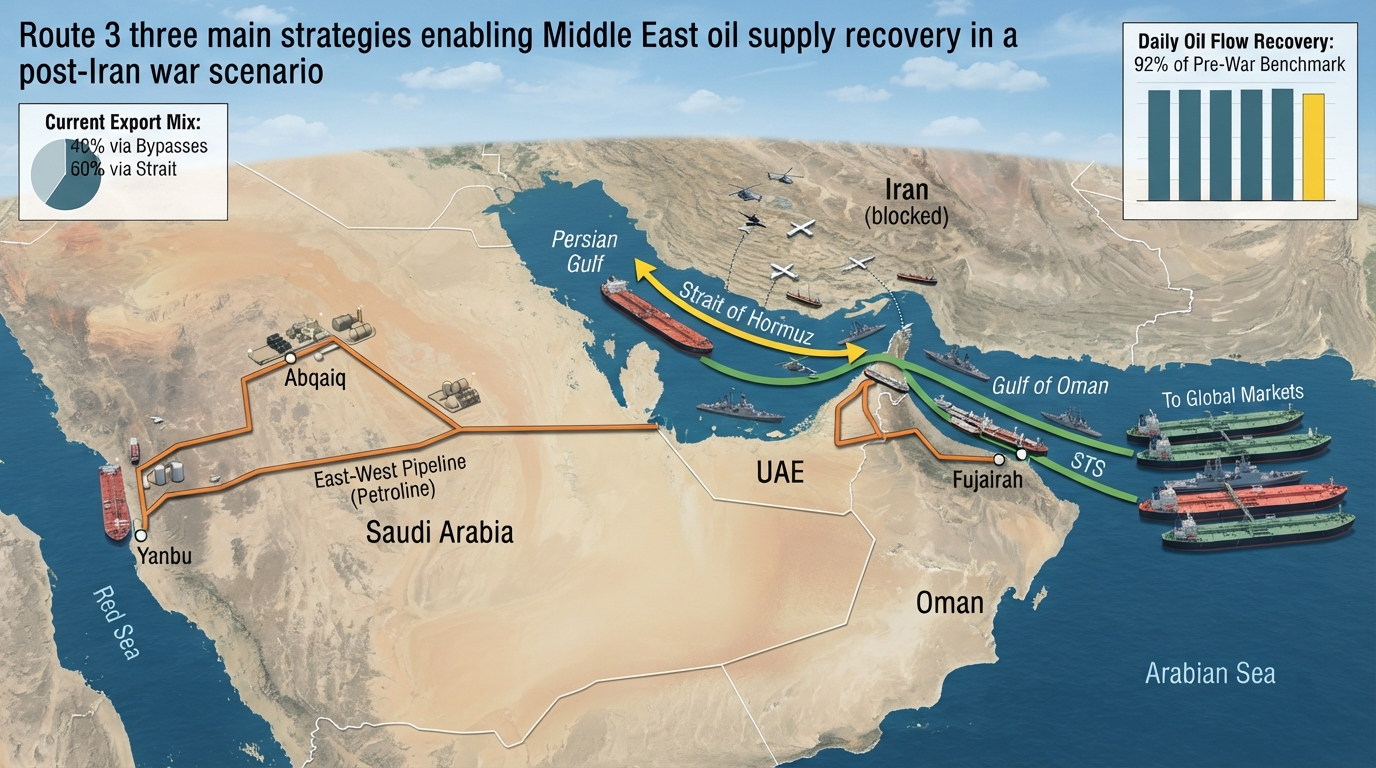
Seven months after the US-Israel war with Iran effectively shut the vital waterway, maritime intelligence company Kpler said that in the final week of September, daily oil flow from the Middle East had climbed to 92% of its pre-war benchmark.
Analysts say the recovery in oil flows is being driven by three main factors:
- Ships escorted with US military assistance
- Shuttle tankers using the strait to transfer oil to other vessels
- Routes that bypass the strait through pipelines
Still, some experts have raised doubts about how sustainable these measures are, citing the danger of further Iranian attacks or a shift in US policy.
According to Kpler, about 40% of the region’s total oil exports in September avoided the strait and instead went overland through pipelines to ports on the Red Sea or the Gulf of Oman, up from 17% before the war.
Iranian oil exports, however, have effectively stopped after a US naval blockade was reimposed in July.
The US military has been helping ships transit the Strait of Hormuz since at least mid-June, and US Navy data shows the number of vessels assisted by US forces rose by a third in September compared with August.
Martin Kelly, senior intelligence analyst at security firm EOS Risk Group, told BBC Verify that US support mainly consists of "air support to ships", including warnings and interceptions of incoming threats from drones, missiles or boats.
Even so, ships taking the US-recommended southern route through the strait near Oman’s coast, rather than requesting permission to use Iran’s northern route, are still being attacked.
According to the Armed Conflict Location and Event Data conflict monitor, September recorded the highest number of successful Iranian attacks on commercial shipping since March.
Naveen Das, a senior oil analyst at Kpler, said the oil market "doesn't trust that we're going stay in this status quo" because of the risk of further Iranian escalation and the possible effect of the US midterm elections.
Kpler says most of the oil now moving through the strait is carried by a "shuttle system" involving more than 60 large oil tankers moving back and forth.
More than 70% of the crude that passed through the strait in August was transferred from these "shuttle tankers" to other vessels in the Gulf of Oman, Kpler said.
BBC Verify has examined satellite images that appear to show these ship-to-ship transfers, which seem to be more protected from Iranian attack, taking place off the coast of the Omani port city of Sohar.
But Martin Kelly said there is a "question over how long these ships can last", especially as attacks on them continue.
Images taken on 24 September show six pairs of ships docked or positioned together near the port.
Kpler says an average of more than four million barrels of oil per day were transferred ship to ship in the Gulf of Oman in the week to 30 September.
Overall, an average of 12 million barrels of oil per day passed through the strait during that period, compared with a pre-war baseline of 17 million.
Gulf oil-exporting countries have also responded to Iranian attacks in the Strait of Hormuz by sending more crude overland through pipelines.
Just under 20% of crude is now leaving the region from ports on the Red Sea at the end of Saudi Arabia’s East-West Pipeline, which is exporting more than four million barrels per day, according to Kpler.
Three weeks after an attack on the pipeline that Saudi Arabia blamed on Iran-backed proxies in Iraq, the country is now using the pipeline at "full stretch", Kpler said.
Kpler’s data shows that almost a quarter of all crude flowing from the region is now being piped around the Strait of Hormuz to terminals along the Gulf of Oman, especially Fujairah in the United Arab Emirates (UAE).
Naveen Das of Kpler said this greater use of pipelines is likely to become the "new normal" because "it seems very improbable that we live in a world whereby the Gulf countries and Iran go back to being relatively harmonious".
Iranian oil exports have fallen almost to zero after the US blockade was reimposed in mid-July, down from 1.7 million barrels a day before the war began, according to Kpler data.
Ship-tracking data and analysis from the US-based advocacy and monitoring group United Against Nuclear Iran show that 20 empty Iran-flagged tankers are currently off the coast of Sri Lanka, unable to return to the Gulf because of the US blockade.
Although crude oil flows from the Middle East have returned to nearly normal levels, exports of liquified natural gas and oil products such as jet fuel have remained far below pre-conflict volumes.
On average, fewer than a million barrels of processed oil products passed through the Strait of Hormuz in the last week, down from 3.5 million per day before the war began.