

Three men will be executed on the same day as death penalties rise in US
Despite growing opposition to the death penalty, one state is behind the rising numbers.
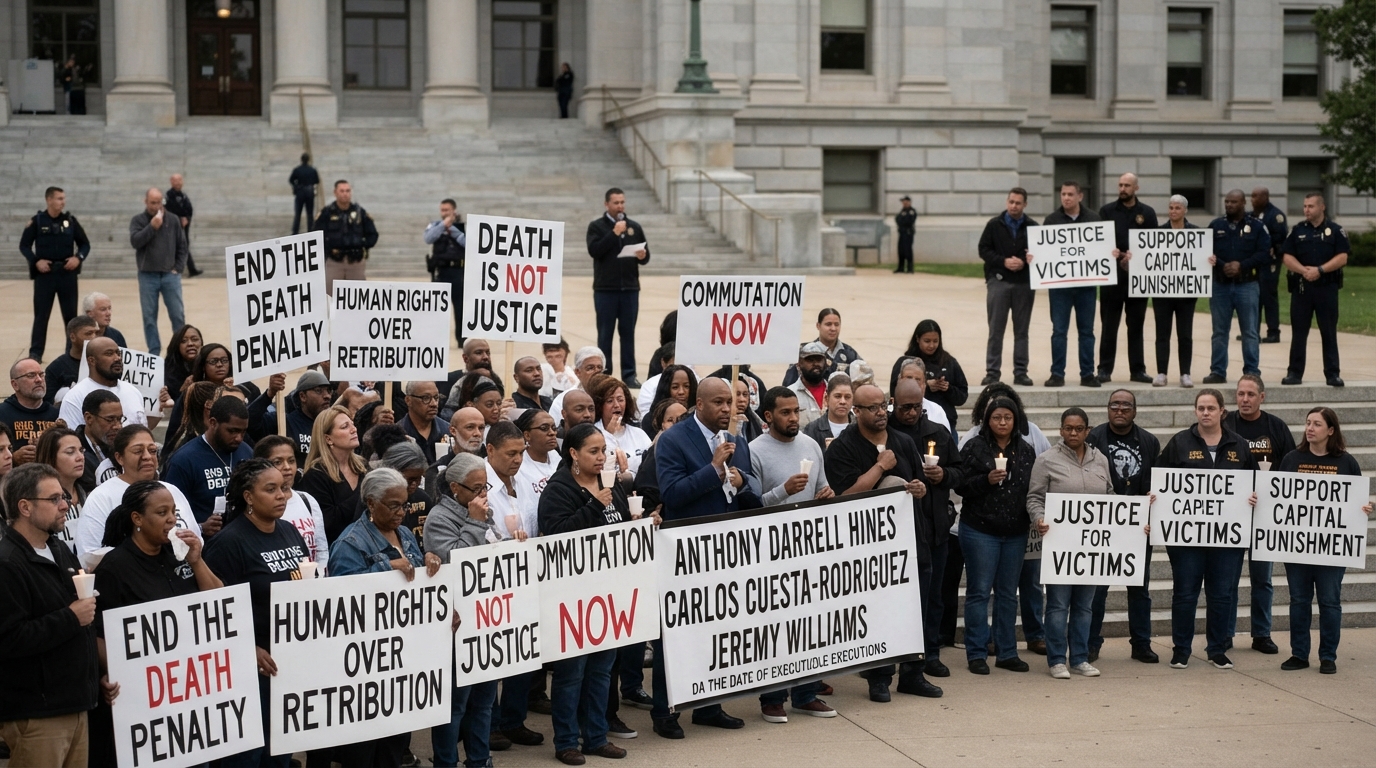
Three men are slated for execution on Thursday, a rare occurrence in the U.S. that underscores a significant increase in death penalty cases nationwide. Anthony Darrell Hines, 66, Carlos Cuesta-Rodriguez, 71, and Jeremy Williams, 41, are the inmates scheduled to face execution. This marks the first time in 16 years that three individuals will be executed on the same day in the United States.
The planned executions of Hines in Tennessee, Williams in Alabama, and Cuesta-Rodriguez in Oklahoma highlight a sharp uptick in capital punishment across the country. In 2025, the number of executions was more than four times higher than in 2021, despite growing public and jury skepticism regarding its application.
What factors are driving this surge, and does public opinion align with this trend?
President Donald Trump has consistently advocated for the death penalty, characterizing it as "an essential tool for deterring and punishing those who would commit the most heinous crimes and acts of lethal violence against American citizens." During his initial term in 2020, he lifted a nearly two-decade federal death penalty moratorium, leading to 13 executions over six months. While President Biden reinstated the moratorium, Trump, on the first day of his second term in 2025, signed an executive order that brought back the federal death penalty. However, no federal executions have occurred since this order. In the U.S., both federal and state authorities can order executions.
Under Trump's administration, the Department of Justice has also broadened execution protocols to include methods like firing squads and re-approved lethal injections. The agency announced in April that it has streamlined internal processes to accelerate death penalty cases. Trump's executive order also encouraged states to pursue the death penalty for all federal crimes involving the killing of a law enforcement officer and directed the attorney general to ensure states have an adequate supply of lethal injection drugs, thereby facilitating state-level capital punishment.
However, the full impact of these changes will not be evident for several years, according to Justin Mazzola, deputy director for research at Amnesty International USA, an organization that opposes the death penalty. "Because of the length it takes for the actual case to happen, and then also all the appeals that are built in once there is a conviction," he explained.
In 2025, there were 47 executions across 11 states, a notable increase from the 25 executions in 2024. Approximately 40% of these deaths occurred in Florida, making the Sunshine State the primary contributor to the national rise in executions. By mid-2026, Florida accounted for 12 of the 19 executions.
Experts attribute this to Republican Governor Ron DeSantis. "He is the reason we are seeing a record number of executions. He is the reason why Florida is an outlier compared to the rest of the United States," stated Robin Maher, executive director of the Death Penalty Information Center (DPIC). The DPIC provides data and research on the death penalty but maintains a neutral stance on its morality.
DeSantis has championed legislative changes that simplify the execution process. In 2023, Florida lowered the legal threshold for capital punishment, reducing the number of jurors required to recommend the death penalty from a unanimous 12 to eight. Additionally, sexual battery on a minor under 12 years old became a capital offense. DeSantis has promoted the death penalty as a "strong deterrent" for crime and "an appropriate punishment for the worst offenders."
Given that individual states have the authority to prosecute crimes and order executions, much of the power rests with state governors. Florida is unique because its governor can unilaterally sign a death warrant for prisoners who have exhausted all appeals, without judicial oversight. Pennsylvania has a similar system but has not carried out an execution since 1999.
The U.S. remains one of the few Western nations that still employs the death penalty, which has largely been abolished in Europe and is declining in Africa. In the U.S., 27 of the 50 states have capital punishment under state law. Four of these—California, Ohio, Oregon, and Pennsylvania—have paused executions through executive actions due to concerns over botched executions, discrimination, and costs.
Despite these issues, many still support it. Florida's top prosecutor, James Uthmeier, has aggressively pursued the death penalty in high-profile murder cases, endorsing "the ultimate form of punishment" for "depraved" criminals. Florida State Attorney William Sheiner, in an interview with Central Florida Public Media, commented, "The people that engage in this type of conduct, their punishment is frankly earned, and it's up to a jury of 12 to determine if that sentence is appropriate or not." He added, "Just because I pursue death as an option doesn't mean that that's going to be the sentence. It's basically me saying to the community: this is up to you guys to decide if death is appropriate." Uthmeier's and Sheiner's offices did not immediately respond to the BBC's request for comment.
The methods of execution have become as contentious as the question of whether they should occur. Pharmaceutical companies have resisted the use of their products for capital punishment, leading to shortages of lethal injection drugs. In 2025, facing such a shortage, South Carolina began executing inmates by firing squad.
Furthermore, a number of botched executions have raised alarms. The DPIC estimates that approximately 3% of U.S. executions from 1890 to 2010 were botched, with lethal injection having the highest rate. In 2022, over a third of U.S. executions were either botched or highly problematic, according to the organization. In May, Tennessee officials spent over an hour unsuccessfully attempting to administer a lethal injection to Tony Von Carruthers, who had been on death row for decades. Witnesses reported blood streaming down his chest and his repeated groans of pain. Governor Bill Lee, who granted Carruthers a one-year reprieve after the failed execution, maintained that the execution was not botched, but rather that the doctor could not establish IV access.
It remains uncertain whether Thursday's executions will proceed or if there will be last-minute reprieves. Anthony Darrell Hines, 66, who has maintained his innocence for four years and is bedridden, is scheduled for execution in Tennessee using the same protocol that failed with Carruthers twelve weeks prior. In Alabama, Jeremy Williams, convicted of the rape and murder of a 5-year-old girl in 2021, could be the state's first execution of 2026. Williams has dismissed his attorneys and volunteered for execution by lethal injection, and Alabama Governor Kay Ivey has stated she will not grant clemency. In Oklahoma, 71-year-old Carlos Cuesta-Rodriguez, convicted of a 2003 murder, has requested no clemency or mercy. He is also slated for lethal injection on Thursday, but experts warn that his age increases his risk of a botched execution.
These planned executions occur amidst a steady decline in public support for the death penalty. "It's the opposite of a cheap easy political fix," commented Maya Foa, CEO of Reprieve US, an international legal organization opposing capital punishment. A Gallup poll indicates that only 52% of Americans find the death penalty morally acceptable, the lowest figure since the 1970s. While still a majority, this decline signals shifting trends, as noted by Maher.
This weakening support is also reflected in the decreasing number of death sentences issued by juries. In the 1990s, juries nationwide issued over 300 death sentences annually. In 2025, they issued only 23. "That tells us something very important: These are regular citizens that are sitting in judgment of people who are accused of committing the worst possible crimes, and then deciding what sentence fits those crimes," Maher explained. "Those juries are increasingly saying that a death sentence is not the right answer."