

"This area does not necessarily need to be managed by the state," says the head of the Social Security Agency.
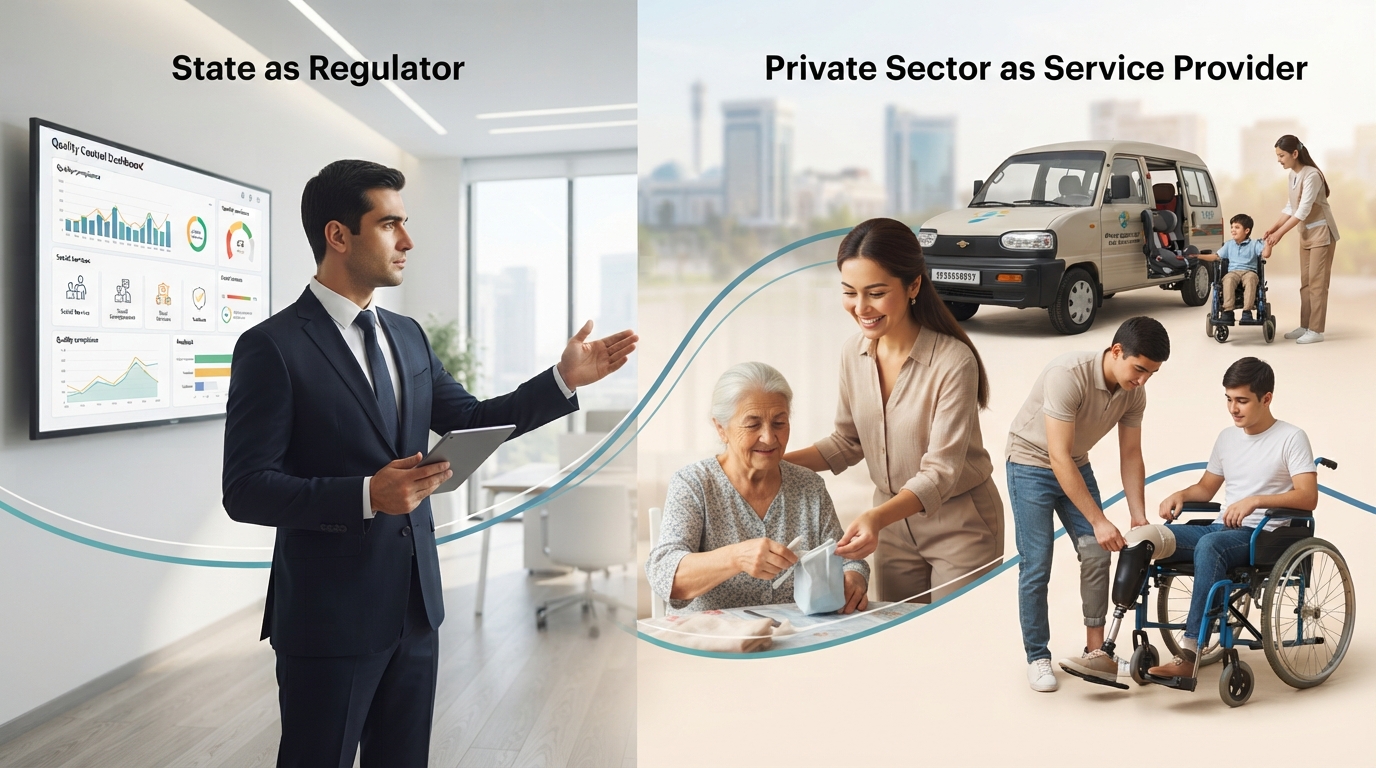
The Social Protection Agency intends to expand business participation in the social sector and focus on regulating and monitoring the quality of services. By 2026, the social services market with entrepreneurial participation will reach 1 trillion soums, and the number of businesses operating in it will reach approximately 3,000.
"The state is not obligated to manage this sector," stated the head of the Social Protection Agency.
By 2026, the size of the social services market, formed by the state with the participation of the private sector, will reach approximately 1 trillion soums. Mansurbek Olloyorov, head of the National Agency for Social Protection, announced this at a meeting with business representatives on August 7.
According to him, over the past two and a half years, more than 20 types of social services and assistance measures have been organized with the involvement of entrepreneurs. The agency plans to further expand private sector participation, gradually leaving the state primarily in charge of regulation and quality control.
"When organizing these services and providing assistance, we are trying to rely more on entrepreneurs," the head of the agency noted.
He explained that this is not just about purchasing individual goods or services, but also about the formation of a full-fledged market in the social protection sector. "Today, the market the state is creating in the social security sector is worth 1 trillion soums. This year, the 1 trillion soum market is being organized through entrepreneurs. These are approximately 3,000 entrepreneurs who provide various services related to social security," he said.
The agency's director cited inclusive employment as one of the areas of government-business cooperation. Entrepreneurs who hire individuals with disabilities and citizens in difficult life situations are provided with benefits and subsidies.
He noted that such individuals often have a harder time entering the labor market than other job seekers, so the state views support for businesses that create jobs for them as part of its inclusive employment policy and the construction of a welfare state.
Another example is the provision of prosthetic and orthopedic devices, rehabilitation equipment, and wheelchairs. Previously, the agency's head noted, suppliers were selected through tenders, whereas now a mechanism is used in which the cost of the product is set, and the recipient can choose a suitable supplier or do so with the help of a social worker.
The agency also collaborates with private companies to organize social taxi services (Yandex), particularly for transporting children, and is increasingly engaging entrepreneurs in home care services for people in need of constant assistance.
"We had services that we provided ourselves, such as home care and household services for people who are unable to get up and require constant care. And here we are increasingly relying on entrepreneurs," the agency's head said.
According to him, private organizations are more capable of directly providing the service, while a government agency can focus on setting requirements and quality control.
"Entrepreneurs do it better." "We want to demand more quality and participate as a regulator," he noted.
Plans call for transferring even more services to businesses.
The agency's head reported that private sector participation will continue to expand. Specifically, entrepreneurs are beginning to engage in new types of rehabilitation services, day care, and other forms of support for people with disabilities.
"We are gradually moving toward transferring to the private sector what we cannot manage ourselves," he stated.
As an example, he cited two sanatoriums within the National Social Protection Agency system, which are being prepared for transfer to the private sector. According to him, the relevant tenders have already been held, and the results are planned to be announced in the near future.
"We are gradually moving toward a situation where this area does not necessarily have to be managed by the state—it should be managed by the private sector," the agency's head said. He expressed the opinion that a significantly larger market for business will be created in social protection in the future.
"This will be beneficial for entrepreneurs, and most importantly, it will improve quality and expand coverage for people in need of social services," the agency's director stated.
At the meeting, it was noted that entrepreneurs' proposals could be used in further amendments to regulatory documents and state support mechanisms in the social sphere. The organizers called on businesses to point out provisions that hinder the development of services or require adjustment.