

"They documented his death as accidental": The secret of a murder that the Nazis did not acknowledge for 40 years
“They falsified documents to make it look like he died by accident”: The secret of a murder that the fascists did not acknowledge for 40 years
They held him at gunpoint at dawn…
He fell,
Then rose again,
And a young,
Hunchbacked soldier
Struck his head with a rifle butt.
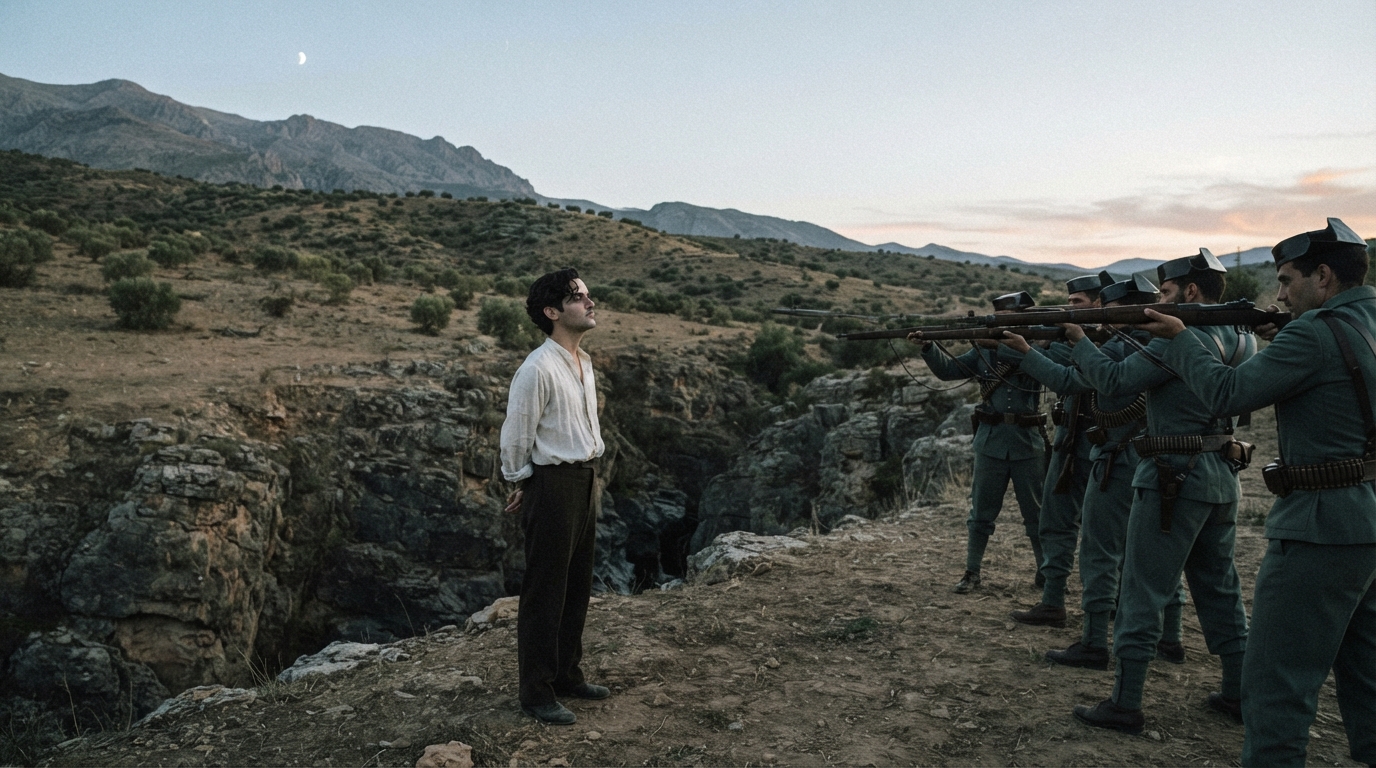
The night of August 18 to 19, 1936. The night wore its darkest and coldest garb, and the specter of death hovered around. A dim road between the ancient Spanish villages of Víznar and Alfacar. On the edge of a ravine that the Arabs had long called “Ayn al-Dama’,” meaning the “Fountain of Tears,” a thinly dressed young man, shivering from the biting cold, looked up at the sky for the last time. Opposite him stood six executioners with bloodshot eyes, pointing their rifles.
Who was this young man? Why did the entire bloodthirsty fascist machine, the rebel military, and General Franco’s regular army fear this helpless writer—who had neither a weapon nor a bomb in his hands—to death, and hide their conspiracy against him for decades? After all, he had not raised any party banner to call the crowd to battle, nor had he spoken from political pulpits! His only “guilt” was the sharpness of his word, his ability to awaken the heart of the people, and his discovery of the immortal melody of Eastern poetry in Western garb. He was Federico García Lorca—the cry of the Spanish people, their eternally weeping living guitar.
Let us look behind the scenes of this bloody drama where civilization and ignorance clashed. Let us reflect on how the poet prophesied his killers and why the Spanish soil still does not return his body.
Sugar beets and rebellion on piano strings
Lorca’s roots did not lie in poverty. Born on June 5, 1898, in the town of Fuente Vaqueros near Granada, to Federico García Rodríguez, who had amassed great wealth from the sugar industry, and Vicenta Lorca Romero, a teacher, the boy could have lived like an aristocrat. However, even after moving with his family to Granada in 1909, he could not detach himself from the wild nature of the countryside, the free spirit of the gypsies, and the magical melodies of Andalusia.
At first, it was not literature but music that enchanted him. He studied piano for six years under the composer Antonio Segura Mesa at the local conservatory. The melodies of Debussy and Chopin lived in his soul. If his teacher had not died in 1916, Lorca might have become a great composer. But fate willed to transfer his musical passion onto paper, into words. His first prose book, titled “Impressions and Landscapes,” published in 1918 with his father’s money, was the first trumpet sound signaling his entry into the world of literature.
In 1914, the bulging-eyed, thoughtful young man entered the University of Granada, and in 1919, having convinced his parents, he moved to Madrid—to the famous Residencia de Estudiantes. Here, he met the future titans of the Spanish avant-garde—Luis Buñuel and Salvador Dalí—and formed the core of the famous literary group, the “Generation of ’27.”
A harsh lesson on stage and the cry of the gypsies
Lorca suffered an unexpected blow in his first steps in the theater. The 1920 production of “The Butterfly’s Evil Spell” (a play about the love between a cockroach and a butterfly) was mocked by the audience and taken off the stage after only its fourth performance. This heavy blow sharpened the young artist’s taste.
In 1922, together with the famous composer Manuel de Falla, he organized the Cante Jondo (“Deep Song”) festival in Granada. He brought into Spanish poetry not just simple “flowers and birds,” but the turbulent melodies of the East. His greatest wave was the collection “Gypsy Ballads” (Romancero gitano), published in 1928. This work made him famous throughout Latin America and Europe.
While Preciosa plays her parchment moon,
suddenly a huge, hostile wind appears.
It is a naked Christopher, celestial tongue, giant body,
hissing at the girl like a harsh flute.
“Hey, gypsy girl, let me lift your dress to see you,
let the blue rose of your belly bloom in my hands.”
Preciosa throws her parchment moon and runs in terror.
Brandishing his sword of hot coals, the wind pursues the girl...
But public success did not satisfy the poet himself. He hated being squeezed into the narrow mold of a “gypsy poet,” and detested that the public, failing to understand his true thoughts, saw him merely as a singer of local color.
New York — a poet in a cement cage
Depression and strained relations with his friends Dalí and Buñuel (Lorca took their film “An Andalusian Dog” as a personal attack) forced him to change continents. In 1929, he left for New York.
The genius who emerged from the warm, passionate, and legendary soil of Andalusia found himself imprisoned by the cold, towering skyscrapers and soulless mechanisms of New York. The Wall Street crash of 1929, the capitalist society’s worship of money, the starving people on the streets—all of this shook Lorca. While studying at Columbia University, he began to write not about gypsies and moonlit nights, but about the bloody civilization of humanity:
Dawn arrives, but no one receives it in their mouth,
for there is no morning, no hope.
Sometimes, throwing itself violently like a fistful of coins,
it devours abandoned children.
Those who leave their homes feel in their bones
that there is no paradise, no love, no autumn leaves,
and led into deception through the muddy paths of laws and numbers,
they are urged to sweat in vain.
Missing his East, his Andalusia, in the cement and iron cage, the poet returned to Spain in 1930, during the era of the newly established Second Republic.
La Barraca and face-to-face with tyrants
Upon returning to Spain, Lorca stopped merely reciting poetry from pulpits. He became the director of a touring student theater called La Barraca (“The Shack”). Traveling from village to village, he began to stage classical plays free of charge for poor, illiterate peasants who had never known what theater was in their lives. “The theater is poetry that rises from the book and becomes human, speaks, shouts, weeps, and despairs,” he said.
Photo: Image generated by artificial intelligence
It was during this period that he created plays that delivered a merciless verdict on the hypocrisy of the Spanish bourgeoisie, the disenfranchisement of women, and ugly traditions: “Blood Wedding” (1932), “Yerma” (1934), and “The House of Bernarda Alba” (1936).
However, dark clouds were gathering over the Spanish sky. Right-wing fascist forces were preparing to seize control of the country. In their eyes, Lorca, a free-thinking man speaking to the masses through his plays, was a target more dangerous than an armed army. Furthermore, in his poem “Ballad of the Spanish Civil Guard,” the poet had described the true face of the henchmen of the fanatical system that was drenching the people in blood so accurately and mercilessly that the guards who read it might well have already pronounced his death sentence:
Slicing the breasts of Rosa de los Camborios,
the Civil Guards leave them on platters on her doorstep.
Other girls run, running in terror, screaming—
away from the dreadful place where black roses explode and bloom.
When the clay roofs sink like layers of plowed fields,
the dawn bends down to cover its stone-cold face.
Oh, city of the gypsies!
The Civil Guards ride away through the sinister cave of silence,
while fire wraps around you...
In July 1936, the bloody mill of the civil war began to turn in Spain. Intellectuals, left-wing representatives, and simply free-thinking people were openly shot in the streets. No matter how much Lorca’s friends and colleagues urged him to stay in a safe place in Madrid, he returned to his hometown of Granada.
On August 16, he was arrested. Despite the poet hiding in the house of his friends—the Rosales brothers, who were leaders of the fascist Falange party—a group led by former deputy Ramón Ruiz Alonso dragged him away. In Granada, Governor Valdés was “accidentally” out of town. The deputy, former civil guard Nicolás Velasco Simarro, took the execution into his own hands. It was he who had never forgiven the poet’s accusatory poems about the civil guards.
The document-based research of historian Miguel Caballero exposed the truth that had been kept secret until now—the 6-member execution brigade that shot Lorca. These were not just military men, but a gang of lowlifes nurtured by the bloody appetite of the regime: the group leader Mariano Asenjo—a 53-year-old man who had escaped poverty to become a civil guard and had spilled oceans of blood. Thirteen days after Lorca was killed, he was promoted to sergeant for his loyalty.
Antonio Benavides—a distant relative of Lorca! He was a malicious man who could not forgive the poet for portraying his own sister as a tyrannical character in “The House of Bernarda Alba,” and his cousin as the swindler Pepe el Romano. (He later died in squalor from pimping).
Fernando Correa—a wild orphan, a madman hired as an executioner in exchange for pinning the Spanish flag to his chest.
Also taking the poet’s life were Salvador Varo, the son of a shoemaker; Antonio Hernández, a gambling addict; and Juan Jiménez, the only one in the gang who was able to feel the pangs of conscience.
Lorca, realizing his fate, also wrote several poems. One of them contains the line: “... I am ready, let the Spanish peasants devour me.” Indeed, those who shot him were not invaders from abroad, but his own ordinary Spanish peasants who had turned into ideological zombies.
On the night of August 18 to 19 (some sources say the 17th), Lorca, dressed in light clothing and shivering from the cold, stood at the gunpoint of those very compatriots he had sung of in his poems. He was executed along with three republican companions on the edge of an unnamed ravine between Víznar and Alfacar.
The fascist dictator General Franco banned Lorca’s works for 40 years, did not acknowledge that he had been shot, destroyed the execution documents, and tried to attribute his death to domestic brawls. Only by 1975 did they officially acknowledge that the poet had been destroyed because he was on the side of the people.
By the 21st century, the search for the grave where Lorca’s body was hidden began. When the site between Víznar and Alfacar was excavated in 2009, the soil layer was found to be only 40 centimeters deep, and not a single bone, piece of clothing, or bullet casing was found there. It seemed the earth did not want to return the poet to the hands of humans.
In any case, fascism was defeated, and the executioners were forgotten. Lorca, however, lives forever. Because the true word cannot be shot and killed.
He passed away…
And the soldiers
Hurriedly turned back,
Drinking wine, they sang a mournful song,
Breaking the silence of the night.
In this song, the crescent moon
That pierced the cloud shone over the peak,
This song wailed and called out to the flowers
Lying under the snow.
In this song, widowed old women
Dressed in black spun tales,
Before them, a blind boy
Read a book in the darkness.
Singing the song,
Feeling the pain,
The young soldiers were intoxicated,
They did not know they had shot
The man who wrote this song…