

These seaside apartments were a ghost city - then police say scammers moved in
Malaysia's Forest City was pitched as "paradise" but last month police raided it over alleged scam operations.
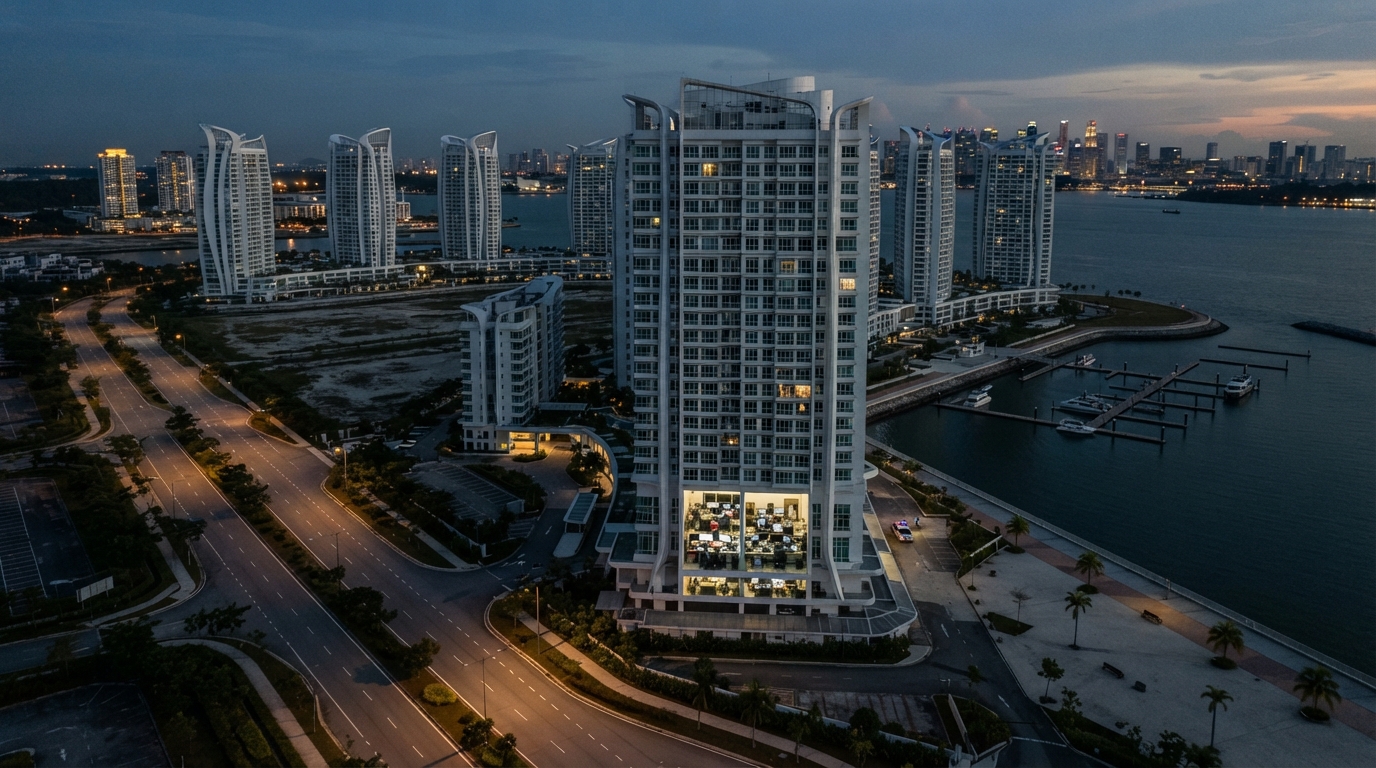
Malaysia's Forest City, a development once envisioned as a bustling metropolis, became a "ghost city" before allegedly attracting scammers, according to police.
From a distance, the Malaysian development, unveiled by Chinese developers in 2016, appears as a collection of identical white blocks along an otherwise ordinary coastline, resembling a 3D print. The $100 billion mega-project was marketed as "a dream paradise for all mankind" and a special financial zone capable of housing approximately 700,000 residents. However, a decade later, this 14-square-kilometer (3,400-acre) artificial island, situated near Singapore, is believed to have a population of less than 1% of that projection.
Rows of vacant skyscrapers cast shadows over quiet streets, and the interiors of empty apartments are coated in dust.
Jason Deng, a 56-year-old investor who was among the first to purchase property in Forest City, spending "a lot of money" on five units, recalled, "In 2016 they described it here like the golden city; very, very beautiful." He now states, "If I had known it was not so good I would not have bought so many apartments. I thought it would be much, much better."
It appears Forest City has indeed become a "golden city" for some, though not the demographic developers had intended.
In mid-July, Malaysian police conducted raids on two suspected scam operations across 32 locations within Forest City. The operation resulted in the arrest of 335 individuals and the seizure of assets valued at approximately one million ringgit (£181,810; $245,000), including 313 computers, 1,557 mobile phones, 17 laptops, and 10 modems.
According to police, cryptocurrency syndicates operated investment and romance scams targeting international victims from these two call center hubs. One hub occupied 27 apartments across five floors of a residential tower, while the other was spread across five bungalows.
Among those arrested were 309 Chinese nationals, 19 Indonesians, three Malaysians, and four Myanmar nationals. Johor police chief Ab Rahaman Arsad stated that authorities are collaborating with Interpol to identify the mastermind behind these operations.
The BBC sought comments from Forest City and Johor police but did not receive a response.
Experts and locals informed the BBC that these incidents likely represent a fraction of a larger, evolving, and increasingly professional global scam industry.
Forest City was designed to accommodate around 700,000 residents, but its current population is estimated to be less than 1% of that figure.
John Wojcik, an analyst at TRM Labs, which investigates crypto-facilitated crime, noted, "The reality is that many of these organisations now resemble multinational corporations more than a traditional organised crime network or gang. They have dedicated recruitment teams, IT departments, money-laundering specialists and infrastructure."
Authorities and experts concur that the Forest City operations were likely staffed by criminals who had relocated from Cambodia, a known hub for transnational scams.
Over the past five years, this criminal sector has expanded into a multi-billion-dollar industry, often relying on the forced labor of trafficking victims subjected to torture and abuse.
Since late last year, the Cambodian government has intensified efforts to dismantle these operations. Authorities recently estimated that 300,000 people departed the country within a few months as raids on large-scale compounds increased.
However, these Malaysian offshoots do not appear to be traditional scam "compounds."
In contrast to the more infamous walled complexes in areas like Sihanoukville or the Myanmar borderlands, the alleged scam hubs in Forest City seem almost "white collar," reportedly employing local residents and situated alongside the homes of unsuspecting neighbors.
Forest City's sales gallery features a large miniature diorama of the complex.
Kevin, a tenant who also works in property sales for Forest City, believes that scammers continue to operate in "condominiums or serviced apartments" within the complex. He requested anonymity due to fear of repercussions.
"We know what they're doing," he said. "This is actually a very common issue in Johor city and Kuala Lumpur, but especially in Forest City. Forest City is very special."
According to Kevin, Wojcik, and others, Forest City's "special" nature stems from its notoriety as a semi-abandoned "ghost city."
Kevin explained, "When we speak to clients or customers, the company teaches us to say 'we already have 23,000 residents living in this area'," but he quietly added that the actual number is "less than 5,000."
He suggested, "That's the reason" scammers have chosen Forest City as their base. "They have their own privacy... Nobody comes here."
Shuttered buildings and deteriorating infrastructure are common sights in Forest City.
Several factors contributed to what many perceive as Forest City's decline.
The project, spearheaded by Country Garden, one of China's largest property developers, and Danga 88, a private company controlled by Malaysian Sultan Ibrahim Iskandar, was initially conceived as an eco-friendly metropolis for affluent Chinese clients. Featuring a high-end hotel, golf course, and water park, the resort-style city's seafront offices and apartments were expected to be in high demand.
However, the combined impact of the Covid pandemic, China's escalating property slump, and restricted borrowing limits for its citizens have undermined these ambitious plans, bringing the project to a near standstill.
The lights remain on, but few people reside there. This situation appears to have made the complex attractive to scammers.
Wojcik stated, "Forest City reflects the conditions organised crime have been targeting for years - a flagship location marketed as a prestigious, luxury, master-planned smart city that never came close to fulfilling that vision."
He added, "Developments like this offer precisely what these syndicates look for: modern infrastructure, large numbers of vacant properties, and international connectivity all wrapped around the veneer of legitimate economic activity to ensure that the criminal nature of what goes on inside remains unnoticed."
With this in mind, Forest City's gleaming facade mirrors a more infamous metropolis 1,800 kilometers (1,120 miles) to the north: Shwe Kokko, the so-called resort city on Myanmar's Thai border, which is one of the world's most notorious scam hubs.
Built by the private Chinese conglomerate Yatai, Shwe Kokko promotes itself as a safe holiday destination for Chinese tourists and a haven for the super-rich. However, beneath its tree-lined streets and luxury villas lies a network of fraud, money-laundering, and human trafficking.
The complex is located at Malaysia's southernmost tip, less than five kilometers (three miles) from Singapore.
Despite its challenges and the fact that only 15% to 20% of the original project has been completed, Forest City continues to market itself as an emerging hub for property investment, tech innovation, and tax-free business ventures.
Such entrepreneurial branding serves as a "Trojan horse" for scammers seeking to establish operations without attracting unwanted attention, enabling them to perpetrate their fraud more effectively.
Wojcik explained that "when scam syndicates can embed themselves behind seemingly legitimate businesses in ordinary commercial developments, they not only become more difficult to detect and disrupt, they become capable of exerting serious amounts of power and influence through the massive profits they generate."
This power and influence, in turn, allow scammers to professionalize in other ways.
While human trafficking largely continues to fuel the scam industry's labor force, there is now a noticeable trend of syndicate operators recruiting and retaining experienced scammers with higher pay and improved working conditions.
Concurrently, in the same Telegram groups where scam jobs are advertised, career scammers are now posting detailed resumes, outlining their experience in fraudulent activities and emphasizing their eagerness to work.
Wojcik explained, "It's a sign the industry is maturing into a more professionalised criminal enterprise, while coercion and exploitation still remain widespread."
The Forest City raids underscore a transnational scam industry that is evolving in size and form. However, this is not the first instance of such operations being detected in Malaysia.
Throughout 2022, before the industry gained widespread global attention, Malaysian authorities raided several scam centers operating out of bungalows and condominiums in the southern state of Johor, the northern state of Penang, and the capital city of Kuala Lumpur.
While these and other major crackdowns sent a message of zero tolerance to fraud syndicates, Wojcik noted that Malaysia has remained home to influential criminal networks, and that "any signs of large-scale re-emergence deserve close attention."
The $100-billion complex's quiet streets and deserted beaches have earned it a reputation as a "ghost city."
In Forest City, such signs may already be appearing.
Kevin stated that it has long been an "open secret" that scams are occurring there, and that "the only shocking thing is that the police were effective."
He is certain there are more, but remains unconcerned by the possibility that his neighbors might be defrauding people of hundreds of thousands of dollars.
"For me, I don't care," he said. "It's not my business... I work here just for the salary."
Other residents share this sentiment.
Phillip, whose name has also been changed, moved to Forest City from Singapore last year, drawn by the relatively affordable property market and the prospect of greater value for his money. He works in tech and describes himself as "very focused" on cyber protection.
"Yes they [the scammers] might be on my doorstep, they might be my neighbours... [they] could be one of the ones that's running one of these syndicates. At the end of the day, it doesn't matter where you go – this is going to happen."
He stated he was "not surprised" to hear reports of scam centers in his complex. What has surprised him is that "more and more people are moving" to Forest City.
One of the reasons he chose his current development was for the peace and quiet, he said, but he is pleased to see it transforming from a "ghost town" into a place where people seem to want to be.
"So many people have lost money on these developments," he pointed out. "But the last three months, you see the lights on in the condos. You've gone from one in 20 to maybe one in five."