

"There and Back Again" or the House Where the Light Never Goes Out
Then, just as the family grew, the house expanded in the same way. The children's voices, quarrels, laughter, illnesses, hosting guests,
"There and Back Again" or the House Whose Light Never Goes Out
The old house in our village was demolished. The rooms in this courtyard, where the noise of ten children once echoed, were now to be rebuilt...
The new house was erected, only the small kitchen and the cellar were not renovated. But the interesting part is that the house still remained that very same house. Even though the parents have passed away, the children still gather here often.
What is a house, actually? Is it the walls, the courtyard, the rooms? If a house consisted only of these, everything should have ended when the old house was demolished, but life continues in the courtyard.
Because what makes a house a home is who lived in it, who grew up in it, who left, and most importantly, who is coming back to it again.
The late owner of the house, a petite aunt, liked to recall the history of this house's construction often: "my husband would mix the mud in the evening, and I would mold the bricks until he returned from work..."
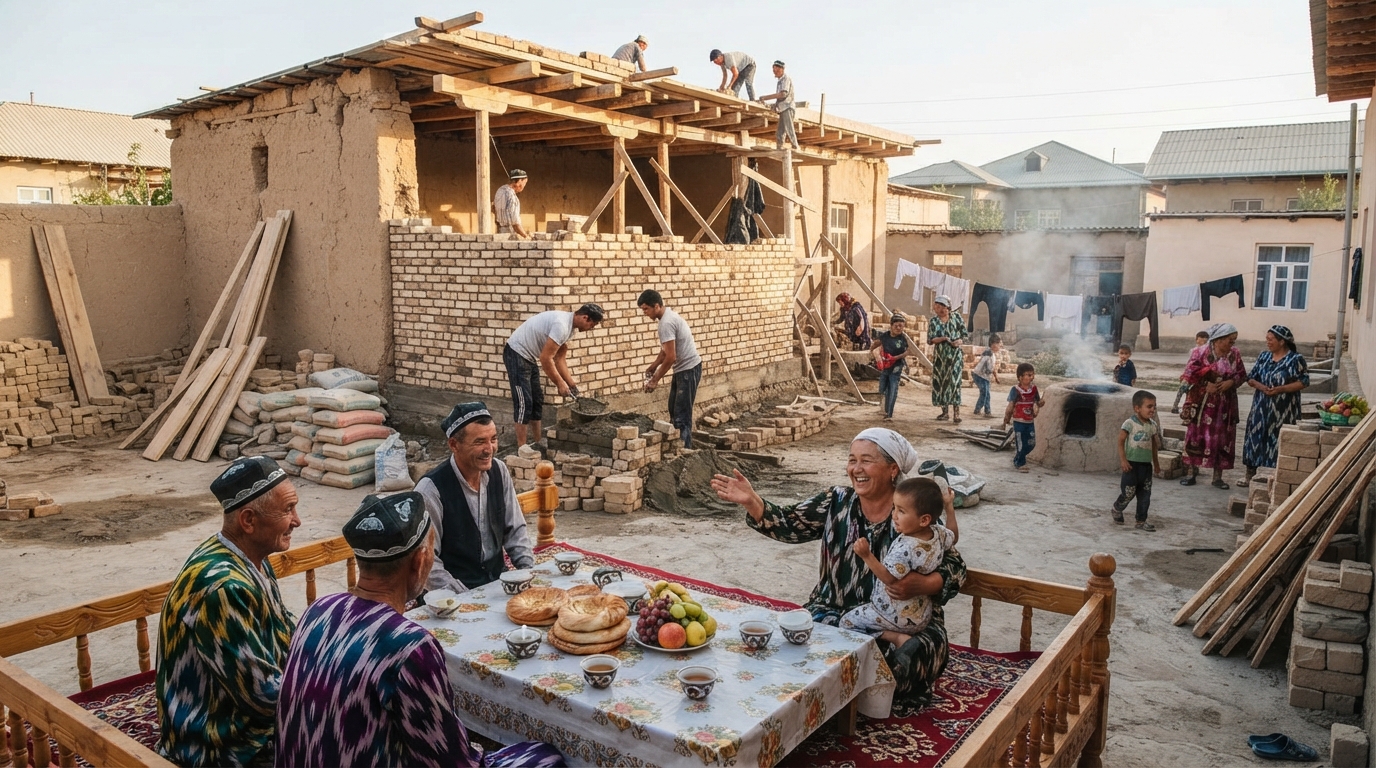
Then, just as the family grew, the house expanded in the same way. The children's voices, quarrels, laughter, illnesses, hosting guests, weddings — everything took place in this courtyard.
Have you heard the saying, "The father builds the structure, the child enjoys its era"? This used to seem like a simple sentence to me: a father builds a house, and the child lives in that house. Later I realized that a house is not built just for living. We have also heard the words of a child saying, "Sit and keep the light of my house burning, my child," or a mother saying, "I will not go anywhere, I will sit in this house and keep my husband's light burning." Later I learned that the light of a house has a much broader meaning than I thought...
Recently, in the publication "Aeon", I came across Consuelo Araos's article "The House That Never Ends".
Consuelo Araos's research prompts us to focus on the gradual, generation-to-generation, and never fully completed way of building houses in the suburbs of Santiago. Through this research, she sees the experience of the art of living through house building.
The article talks about houses that people build with their own hands over the years: the family changes — the house changes, a child is born — a room is added, an opportunity arises — a wall is raised, money runs out — construction stops, then continues again. Victoria's house plays an important role in Araos coming to this conclusion.
Victoria worked as a maid in Araos's family. The woman loved to talk about her house. The house was in her jokes, her complaints, and her memories. It was as if the house was not something separate from her life, but life itself. At one time, four generations lived together in her house. And the house grew with them. A room was added to the courtyard, another room was built on top of it, the walls were repaired, the kitchen floor was renovated...
For the construction of this house, one bag of cement was bought one day, two sheets of slate another day, and beams were stacked on another day. These actually seem like minor construction works and are not foreign to us either. Just like with us, if there was money, construction continued; if there was no money, it stopped, and then started again. In this way, the house was not built once and then left unchanged. It grew along with the family's life path. In this sense, the "last brick" was never laid upon it.
**The House with an Open Door**
One of Victoria's daughters moves into a rented house. She explains this decision by freeing up space for others. But one thing she says is very important for Araos: "If there is a problem, the only place to go is your mother's house. For example, if my husband kicks me out of the house, I will come back here, because you know that your parents will always keep the door open for you."
Here, the house takes on another meaning: it is not only a place of residence, but also an opportunity to return. However, Araos does not romanticize this house, because a house whose door is never closed can sometimes feel very cramped for a person. Victoria recalls the years she lived with her family as "we lived very crowded." Such tightness can limit personal life and freedom. Thus, a house is at once a shelter and a place with its own shortcomings. But an unfinished house has one advantage: if life changes, it can change too — a room is added, a wall is moved, the veranda is enlarged... Victoria's dreams of a terrace and a garden that have not yet been built also indicate this; the house is unfinished, so there is room left for future dreams.
There is another small episode in Araos's research. Victoria asks her son-in-law for one or two bags of cement to fence her yard. He, stating that the land is not in his name, says he cannot give anything for the construction. For Victoria, this was not just a refusal of simple construction material. Araos expresses this very clearly: "To hide cement is to hide a relationship." Because when a house is being built, someone buys cement, someone does hashar (communal voluntary work), someone offers a beam, someone lends money, and the help given today is returned tomorrow. Therefore, in her article, the author puts forward the view that the history of a house's construction is the history of the family's relationships.
Thus, closeness and distance, help and refusal, connection and independence are also formed between the walls. We can also see this relationship in our own traditions of roof-covering (lümboz) and hashar.
Once the house is raised, it is time to cover the roof. This work is not done by one family alone. Relatives, neighbors, and close ones are called. In the morning, people gather in the courtyard. Someone prepares the mud plaster, someone passes it up, someone works on the roof, and someone else cooks food for those doing the hashar. The roof is thus covered with the participation of people.
**When is the Construction of a House Completed?**
Here, Araos turns to the idea of a "completed", "permanent" house. In Chile, starting from the 1980s, the idea of giving a ready-made house to a family began to take shape in state social housing programs: it has walls, the rooms are designated, the area is known. Just like the houses that are very popular and have become a necessity here now, for example, you are given a 60-square-meter house. Now you have to fit into this 60 square meters. The problem starts with this "now". Because the house may be completed from a construction point of view, but the life of the family moving into it is just beginning. When the state builds a house, it sees the family's current situation: how many people there are, how many rooms are needed, how much space can be allocated.
But the family must also fit its tomorrow into this designated area. A child is born, grows up, gets married, someone whose business is not going well returns home and lives with their parents for a while, someone gets divorced and returns home again with their children, or elderly parents need to be taken care of. A room once intended for a child can now accommodate an adult. The living room becomes a bedroom. The kitchen needs to be enlarged; if there is a courtyard, they try to add another room to it, but the size of the house does not change. Here, the limitation of the concept of a "completed house" becomes apparent. The house is completed: it has a wall, a roof, a door, and rooms. But from the family's point of view, it still needs to grow.
Here, Araos refers to Martin Heidegger's essay "Building, Dwelling, Thinking". Writing about the post-war housing shortage, Heidegger reverses the usual perception: we do not build houses in order to dwell, we build because we dwell.
This idea finds clear expression in the life of every Uzbek family: a room is added because children are born, space is freed up because someone leaves, a door is opened because someone returns, meaning that dwelling itself continues to build the house.
**Homeless People and Peopleless Houses**
This thought brings Araos back to the housing crisis. According to data, more than 2.8 billion people worldwide, or 35 percent of the world's population, do not have adequate housing. Rent is rising faster than wages, it is becoming harder for young people to buy a house, and in some cities, a house is becoming an investment tool rather than a place for people to live. While millions of people around the world struggle to find stable housing, many houses stand empty or underutilized.
In some cities, the windows of high-rise buildings built for investors are dark even at night. In some places, entire districts stand waiting for people to come and live in them.
Here, a paradox arises: houses without people and people without houses. If the problem is only a shortage of houses, since there are empty houses, why are people still homeless? Because in the modern real estate market, a house can turn into something other than a place to live, the author suggests. It can be bought, resold, rented out, or kept as an investment. Even if no one lives in it, its economic value can be preserved or increase. For example, in Uzbekistan, too, in cities, one person may own several houses where they never live themselves, and they are rented out. Thus, in such a case, a house is not a "home", meaning its function is not dwelling, but preserving value.
Therefore, Araos places self-built houses side-by-side with modern real estate: on one side, a house that is designed, calculated, financed, and put on the market, and on the other side, a house where the owner adds a room, a veranda, or a wall when they find the money.
Which one is more modern? Of course, the first house. But the question is different: which one shows us better what a house actually is? Even after people enter a ready-made house, they adapt it to their lives: the living room becomes a bedroom, the child's room later becomes an office, a wall is demolished, a new wall is raised, someone leaves, someone returns.
Here, attention must be paid to another thing: the author is not simply praising self-built houses. Building a house for years is not an easy way of living. Lack of money, stoppage of construction, several families fitting into one courtyard, loss of personal space — these are all real problems.
Recall Victoria's words "we all lived crowded": meaning, an endlessly built house does not promise a problem-free life. But it gives something else — the opportunity to adapt the house to life, meaning it points out that even within limited possibilities, a person can create a space suitable for their life.
The article also presents the story of a woman named Rosa who built a house from empty land. Victoria had a house, and it changed along with the family; Rosa had only a hill, even a piece of land that others did not want.
"I would come here every day and clear a little bit of land," she tells Araos. "Then, when my husband returned from work, he would come and do a little more work." Yes, houses are built like this: little by little, first the land is cleared, the boundary is marked, then a small shelter appears.
Heidegger's thought about the Greek temple in "The Origin of the Work of Art" comes to mind here. In the example of the temple, there is a broader meaning here than architecture. The deity does not simply occupy a place; it establishes life around it: birth and death, blessing and disaster, victory and defeat find their meaning around it. That is, through construction, not just a building, but a meaningful space emerges. If Rosa had not built a house on that hill, there would have been no birth and death there either.
This thought can also be seen when looking at Uzbek houses. As soon as a household rises on bare land, that place stops being just a geographical point. Water is sprinkled in the courtyard, a tandoor is built, family members work in the garden, a child is born, the elderly grow old. Then another house appears around it, then another. Roads, neighborhood, and the mahalla take shape, and then an entire village emerges.
In the Uzbek village, hashar itself shows this: the whole mahalla participates in the construction of one person's house. This shows that a house is not only a space for a family, but it also establishes a world that connects people to one another. Thus, the world is also built from houses in some sense.
In Araos's essay, the French philosopher Gaston Bachelard's idea of the house as "our corner of the world", even "our first universe", is also recalled. Childhood, safety, solitude, loved ones, the desire to return — all of these are formed first of all in the house. These views are so naturally integrated into the Uzbek worldview and our national existence that for us, a house is not just a structure raised from baked brick and mud. In our thinking, the "Father's Courtyard" or "Mother's House" is a person's spiritual root, spiritual harmony, and the first point of understanding the world.
For us, the concept of home is manifested first of all in the images of "courtyard", "threshold", and "household". Coming into the world, a person feels the vastness of the universe, the boundary between "one's own" and "foreign" precisely through the threshold.
Bachelard compares the house to a "chest of memories". In our life, these memories live in the walls of the house, on the pillars of the veranda, in the smell of freshly baked warm bread, and on the supa (clay platform).
Araos looks at self-built houses from this point of view. It contains the labor of the people who built it, the hopes they waited for, the difficulties they experienced, their kinship, their quarrels, their reconciliations, and their returns. The house we built and live in shows our place in the world in this way.
I read the article several times. And in the process, I "went" to my father's house several times. I remembered the main character Bilbo Baggins in Tolkien's famous story "The Hobbit", who left his cozy and peaceful home and went on a long journey full of dangers. He passes through a labyrinth of dragons, magical forests, and terrible battles. But wherever he was, no matter what great wealth or wisdom he achieved, his heart was bound by only one thread — the longing for his home. The Hobbit, who traveled the world, still returns and finds true peace only when he steps into his own home. His entire journey, as he wrote in his diary, was "There and Back Again", meaning a way of rediscovering home. In the process of re-reading the article, I also rediscovered home. Perhaps that is why we spend our lives trying to turn the world into a home for ourselves. In the end, we return to the place that gives meaning to our scattered adventures, where we understand ourselves and feel that we belong precisely here. Home...