

The world's bee population is declining sharply. What dangers does this pose?
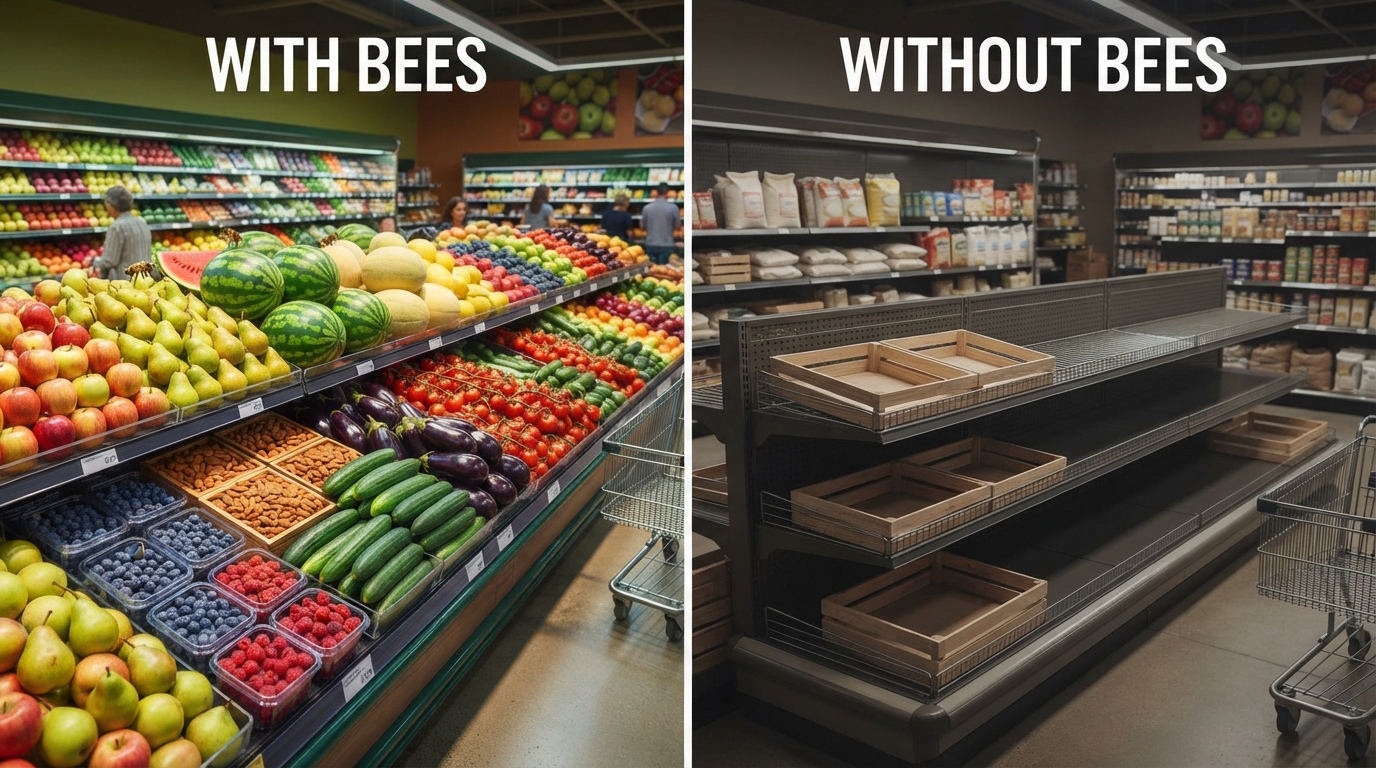
What are the dangers of a sharp decline in the number of bees in the world?
Imagine: you enter the supermarket, but the shelves are empty. There are no apples, pears, watermelons, melons, coffee, almonds and many other products. Because a month ago, all the bees on the planet disappeared.
Although this sounds like the plot of a dystopian movie, biologists and ecologists are seriously discussing this possibility. The reason is that the number of bees in the world is decreasing at an alarming rate.
According to the Food and Agriculture Organization of the United Nations (FAO), 35 percent of the world's agricultural products depend on pollinators. About three quarters of the world's fruit and seed-bearing food crops are pollinated at least partially by insects.
So, if bees suddenly disappeared today, about half of the products in stores could be gone within a month.
**Which products will disappear?**
Crops such as apples, pears, cherries, berries, watermelons, melons, almonds, buckwheat and sunflowers will experience a sharp decline in yield or become economically unprofitable. Without bees, not only honey will be lost, but also many fruits, nuts and berries.
Vegetables are no exception. Some plants, such as tomatoes, eggplants, kiwis and blueberries, depend on a process called “vibrational pollination”. In this, an insect lands on a flower and rapidly contracts its pectoral muscles, creating vibrations. These vibrations reach the anthers of the flower. As a result, the pollen grains stick to the insect’s body and are then transferred to another flower.
Bees are already being used to increase yields in greenhouses. According to studies, pollination with the help of bees increases the yield of tomatoes by an average of 25%, and in some farms this figure reaches 50%.
**Not only fruit, but also meat and milk are declining**
This connection may not be noticeable at first glance, but it is directly present. Bees pollinate alfalfa and other plants that are used as food for livestock. Their loss can lead to a reduction in the feed base for livestock, and as a result, to a decrease in milk, meat and egg production.
**Why are bees dying out?**
It is impossible to point to a single reason for the decline in bees. Several factors are responsible for this, reinforcing each other:
* **Varroa mite** is a microscopic parasite similar to a crab. It spreads various viruses. One of the most dangerous of them is the wing deformation virus. The wings of a larva infected with such a virus do not fully develop and it cannot fly.
* **Neonicotinoid pesticides** — do not kill bees immediately, but they damage their nervous system. As a result, bees cannot distinguish colors, lose their orientation in space and cannot return to their hive.
* **Global warming** — spring comes earlier than usual due to warm winters. Flowers may bloom and wither before wild bees wake up. And during hot and dry periods, plants may bloom, but they do not produce nectar.
* **Electromagnetic interference** — it is being studied that electromagnetic radiation from mobile communication networks may also affect bees.
A month without bees is not the end of the world. Humanity will not die of hunger. But our diet will lose its diversity, become vitamin-free and monotonous.
This problem seems far away and will happen in the future. In fact, bees are already declining. Over the past 20 years, their population has decreased by almost three times.