

The wealthy Cuban Americans ready and waiting for Havana to fall
Cuban exiles in Florida are increasingly hopeful that regime change in Cuba is now on the horizon.
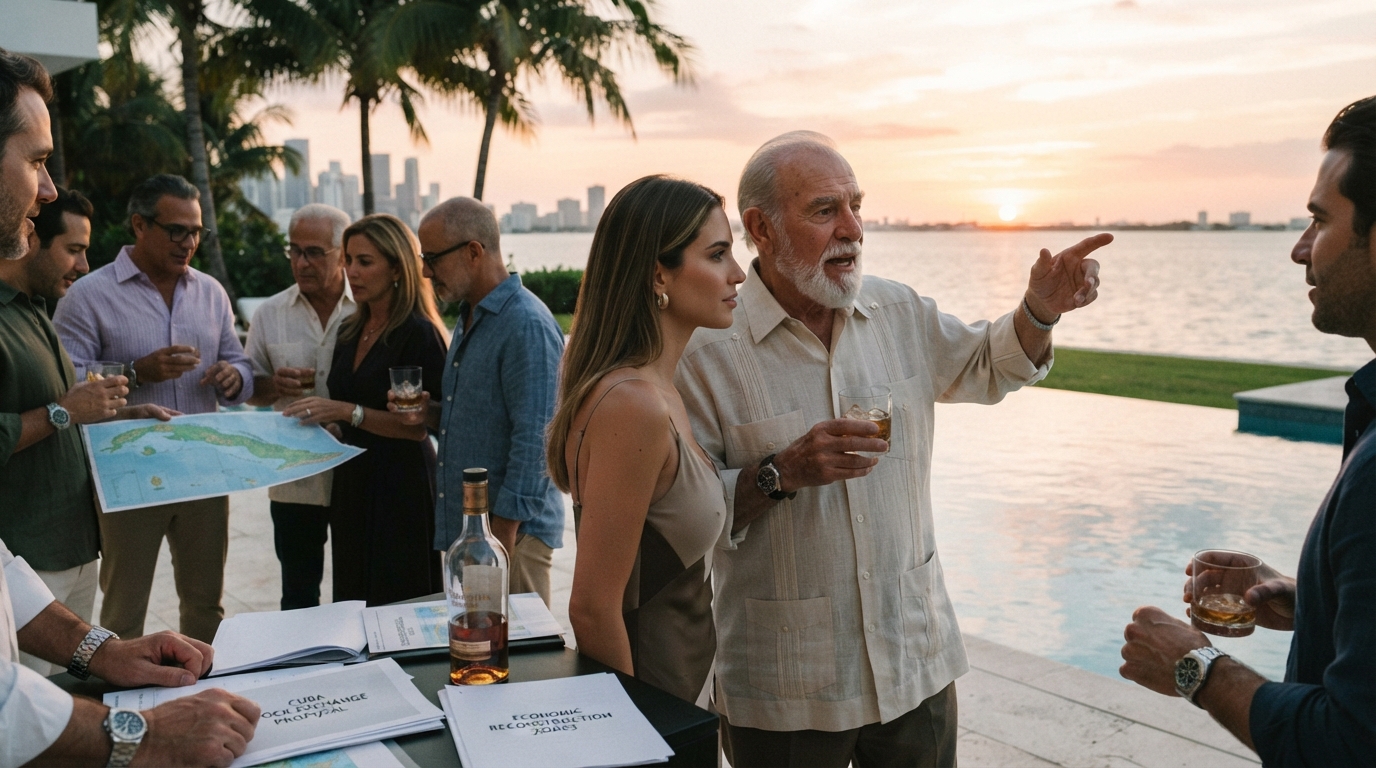
The wealthy Cuban Americans ready and waiting for Havana to fall
Juan Omar Sixto says he and his colleagues are ready to “go and do business in Cuba right away”
At the opulent home of one of Miami’s leading plastic surgeons, with views over Biscayne Bay, some of Florida’s richest Cuban-American families have come together.
They are meeting to debate their vision for Cuba’s future at the fourth gathering of the newly formed Cuban-American National Chamber of Commerce (CANCC).
With rum in hand and Rolexes on their wrists, this is Miami’s old guard. People with familiar Cuban-American surnames — such as Bacardi and Babun — mingle by the pool, discussing the dire condition of the island’s economy and swapping gossip about the latest political stirrings.
“The intention of this evening is to gather under one roof the most prominent Cuban-American entrepreneurs in Miami-Dade County,” says CANCC president Juan Omar Sixto, “and the objective is to be in Cuba once the regime falls”.
His guests believe that moment is close.
This powerful community of Cuban exiles has despised the Communist government ever since the late revolutionary leader Fidel Castro seized their lands and nationalised their families’ businesses after coming to power in 1959.
Over the years, they have used their political and economic influence in Florida to help shape Washington’s policy toward their homeland.
Sixto left the island as a teenager. Now a real estate developer in his early 80s, he says his organisation is drawing up plans for what he calls “the day after” in Cuba.
The CANCC has put forward a proposal for a Cuban Stock Exchange and set up committees covering everything from energy infrastructure to food security.
Planning for a post-Communist Cuba is nothing new in Miami.
For decades, countless papers and logistical schemes have been produced by interest groups, some more cautious and realistic than others.
What is different now, Sixto insists, is the Trump administration’s drive to force total change on the island. He says they also have access to influential contacts, including people close to Secretary of State Marco Rubio.
“Together with deliveries of humanitarian aid and medical supplies, we’d go and do business in Cuba right away,” says Sixto.
The economic situation in Cuba has worsened since a US blockade on the island importing oil
Inside Cuba, such assertions are largely met with doubt.
In response to Washington’s “maximum pressure” campaign against Cuba, the island’s leadership recently unveiled 176 economic liberalisation measures. Cuban President Miguel Díaz-Canel said they were “to advance the defence of socialism, to support and widen social justice”.
For critics, they look very much like outright capitalism — removing limits on the number of workers in a private business, allowing the direct hiring and firing of Cuban employees, and permitting ownership of several enterprises at once, including by Cuban Americans.
Even so, those at the CANCC meeting dismissed the reforms as superficial, saying they offered no real protection for investors. They would “not put a foot into Cuba”, Sixto said, while the current regime remained in power.
Some analysts believe such planning sessions are premature. Although Cuban Americans are certain change is coming soon in Cuba, none can say with confidence what form it will take — a US military intervention as seen in Venezuela in January? Or a fresh economic agreement with the island’s leadership?
“Right now, the very high expectations created by the US administration that some kind of ‘day after’ was coming soon, or that Cuba would ‘be next’ have been kicked down the road,” says Mike Bustamante, associate professor of history at the University of Miami.
With the November mid-term elections in the US approaching and the Trump administration caught up in the “quagmire” of the Iran war, Bustamante says there is little appetite for more foreign adventures.
“It’s really tough to think that they will escalate further than what they’re doing which is this drip-drip-drip of sanctions.”
With the island’s oil supply effectively cut off since January, that already amounts to a major escalation, says Mike Bustamente. Although it has made life unbearable for most ordinary people, it has not yet “created the ingredients for a political inflection point” in Cuba, he adds.
The Cuban government has not commented on the CANCC itself. But such groups traditionally provoke anger among revolutionaries, who insist they will not be driven out by critics in Miami.
I ask some guests whether they can see the irony that the same people who back a major source of the island’s suffering — the decades-long US economic embargo and the current fuel blockade — are now drawing up plans for its reconstruction, without the input of most Cubans.
For Cuban-American agricultural expert Hugo Orizondo, it is simply practical to prepare a roadmap for Cuba’s development. “Right now, Cuba is like a black hole, we don’t know what is happening over there,” he admits. “But we do know the potential [for investment].”
Orizondo says he understands why Cubans are reluctant to see foreign investors buying something as sensitive as rights to arable land. “But what are they going to do with it?” he asks. “When investors come, they bring money and technology into the land.”
He says both are urgently needed if Cuba is ever to produce enough to feed its own people and reduce its dependence on food imports.
Land ownership lies at the centre of any reconstruction plan proposed by this generation of wealthy Cuban Americans. Juan Omar Sixto says his father lost five properties and a farm in Cuba’s Pinar del Rio province to the revolution. While he insists he has no wish to evict any family living in those homes, he does want compensation for the nationalised land.
“I worked on that farm for five years of my life with my father, and they took it away. I want restitution or compensation. Even if they give me just a penny on the dollar, I’ll take it.”
“It’s moral justice,” he says.
The Cuban government presents such historic ownership claims as the resentment of a corrupt landed elite that made fortunes off indentured workers and slaves. Both slavery and the system of indentured labour did not end in Cuba until the late 19th Century.
The government also says the exiles could never accept that Castro carried out land reforms that handed their fields to workers and the state.
“Most of our sugar mills have been dismantled, but we will recover those lands and put them into production,” says Nicolás Gutiérrez, president of the National Association of Sugar Mill Owners of Cuba, an exile group backing the ownership claims.
“I’m not promising it will be in sugar,” he says.
“It might be in ethanol, co-generation, solar panels or water purification cells. Who knows? There are a lot of different options,” he says. “We need to get them producing, we need to have a real wage paid to Cuban workers and create a multiplier economic effect across the island.”
Hugo Orizondo admits it is hard to know the current situation in Cuba
With ice clinking in their drinks and a cool breeze moving through the palm trees on the perfectly kept lawn, the CANCC members make it sound straightforward. But within hours of their meeting, Cuba had fallen into its sixth nationwide blackout this year.
The gap between hopes for change in Miami and the reality on the ground in Cuba is striking. Many Miami-based Cubans believe the huge transformation they have long prayed for is nearly here.
If it is, it will inevitably bring major social and humanitarian upheaval that the struggling island is poorly equipped to handle. Even if the diaspora’s backing is well meant rather than purely self-interested, repairing the island’s failing electrical grid alone is estimated to cost $8bn to $10bn (£6bn to £7.5bn).
Before any sector in Cuba — from agriculture to tourism — can be revived by the exiles’ wealth and political ties, Cubans still face severe shortages of food, water, fuel and medicines. Whatever Miami’s grand plans, most Cubans simply hope life will become a little easier soon.