

The US intends to create a huge computing network in space
The American company Cowboy Space presented the project of the Big Iron rocket, whose upper stage will serve as a data center for artificial intelligence once in orbit. In this way, the company intends to place 20,000 computing centers into low Earth orbit.
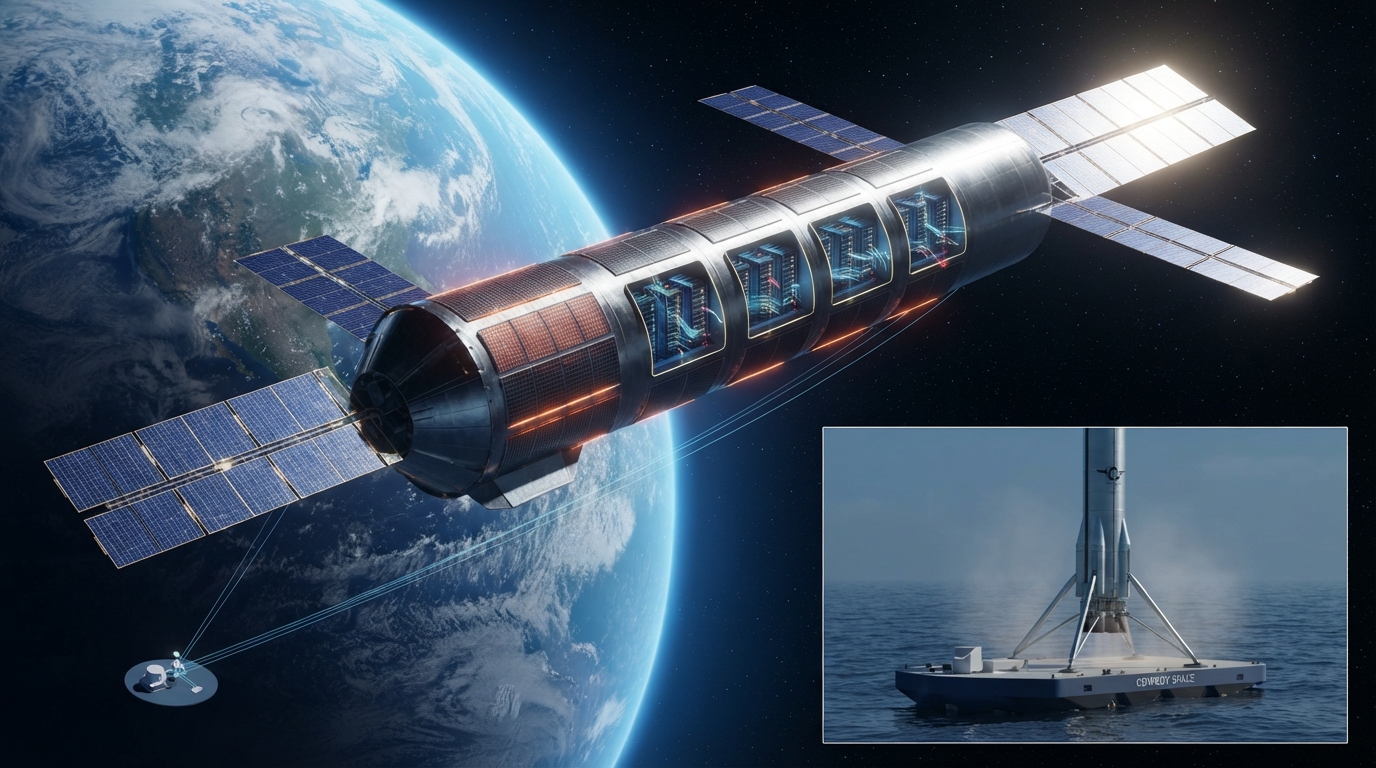
The US wants to create a giant computing network in space
California-based Cowboy Space was founded by Robinhood co-founder Baiju Bhatt. The company plans to independently manufacture both space data centers and the rockets that will launch them into orbit.
Bhatt announced at the Big Sky Rising event that the new rocket will be named Big Iron. The data center operating in orbit will also bear the same name: the company has designed the rocket and the satellite as a single system.
According to the main idea, after reaching orbit, the rocket's upper stage will continue to function as a satellite equipped with computing equipment. The company emphasizes that this approach will help reduce redundant structural components and mass.
According to the project, the stainless steel rocket will be 86 meters high and 4.7 meters in diameter. It will be equipped with Clydesdale engines developed by Cowboy Space.
It is planned to install nine engines on the first stage and one engine on the second stage. An identical engine configuration is also used on SpaceX's Falcon 9 rocket.
The first stage of Big Iron is designed to be reusable. A computer animation shown during the presentation depicted it returning to Earth and landing on an ocean platform. This resembles the method used to recover Falcon 9 first stages.
The rocket's upper stage, on the other hand, will remain in orbit and become the Big Iron satellite. According to the presented data, the mass of the spacecraft will be approximately 15 tons. After deploying its solar panels, its length will reach 132 meters.
The rocket's outer shell will also serve a new purpose in orbit — it will become the data center's radiator. The radiator will radiate heat generated by the graphics processing units into space.
It is planned to place five server racks equipped with graphics processing units — GPUs — on each spacecraft. The company describes each orbital data center as a system with a capacity of approximately one megawatt. Here, megawatt represents electrical power.