

The "Space" Project: Satellite Engineering for School Students and Teachers from Foreign Countries
On October 14, 2026, the project office team of the V. G. Korolenko Glazov State Engineering and Pedagogical University (GISPU) held an online presentation of the new international educational project "Cosmos". The program is aimed at developing engineering education in Russian and involving schoolchildren from foreign countries in practical activities in the field of space communications and satellite engineering. The project will be implemented by GISPU with the support of the Ministry of Education of the Russian […]
"Cosmos" Project: Satellite Engineering for School Students and Educators from Foreign Countries
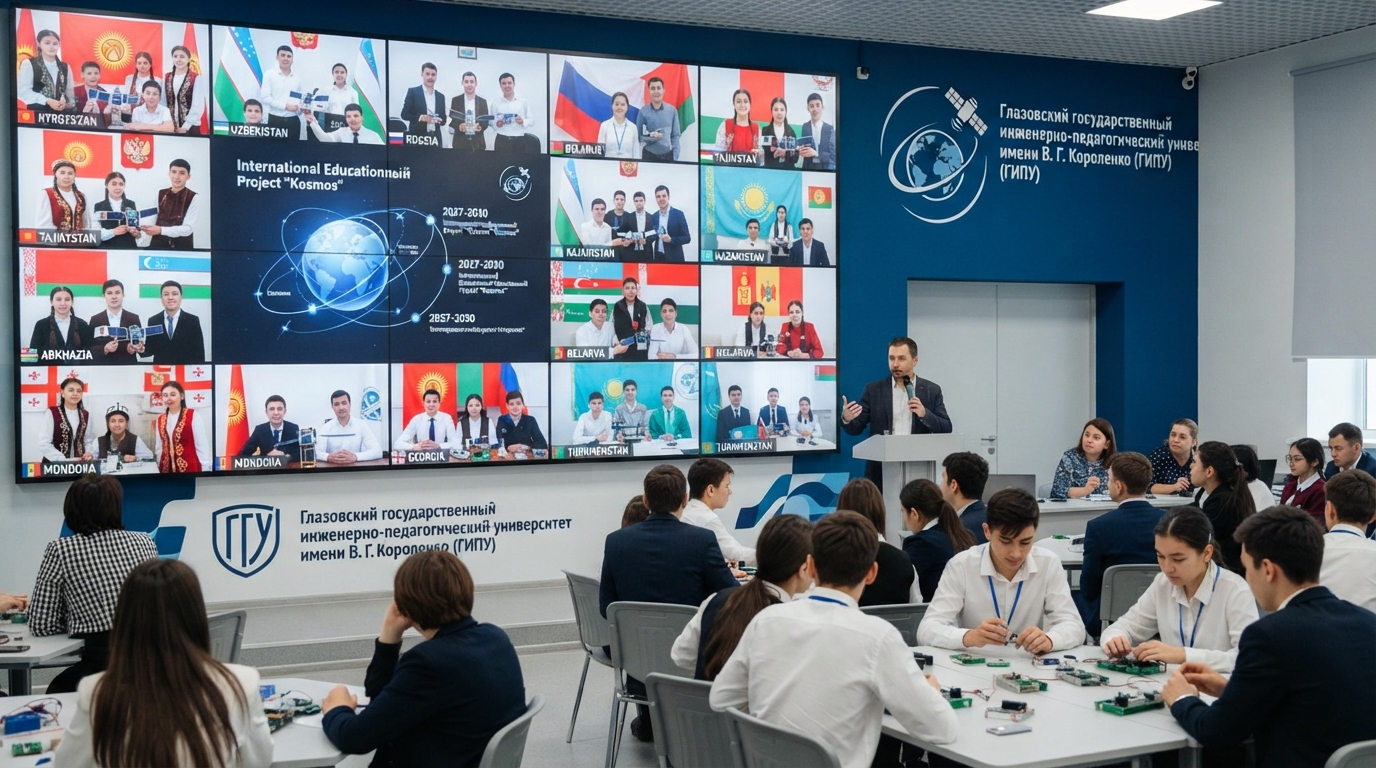
On October 14, 2026, the project office team of the Glazov State Engineering and Pedagogical University named after V. G. Korolenko (GISPU) held an online presentation of the new international educational project "Cosmos". The program is aimed at developing engineering education in the Russian language and engaging school students from foreign countries in practical activities in the field of space communications and satellite engineering.
GISPU will implement the project with the support of the Ministry of Education of the Russian Federation.
Interest in the new project was shown by 96 attendees from 11 countries: Kyrgyzstan, Uzbekistan, Russia, Belarus, Tajikistan, Kazakhstan, Abkhazia, Moldova, Mongolia, Georgia, and Turkmenistan. During the online meeting, educators learned about the program's concept, the main stages of its implementation, and the opportunities for school students to participate in international engineering activities.
The main goal of the "Cosmos" project is to create an international educational environment in which school students and educators can master engineering disciplines in Russian and apply the knowledge gained in practice. The program involves a step-by-step transition from studying the basics of astronautics and working with real satellite data to designing, assembling, and testing small spacecraft.
During the presentation, Arseny Parfenov, Director of the GISPU Project Office, introduced the concept of the project and spoke about its key objectives and development prospects.
"It is important for us that teachers feel they are not alone on this journey. Therefore, in this project, we have provided training, ready-made materials, and continuous support for educators. And the most interesting part, of course, awaits the students. Just imagine: today the kids are taking their first steps in studying space, and in a couple of years they are already receiving signals from orbit from their own satellite. Such an opportunity should not remain just a dream," noted Arseny Parfenov.
The program is designed for several years and provides for a sequential increase in the complexity of educational and research tasks.
The first stage will begin in 2027 and will be dedicated to studying the history of astronautics, space physics, the basics of computer science, and working with real satellite data on the SONIX portal. A 72-hour training program is provided for educators, and a 90-hour educational course for school students. At the same time, teachers will not need special knowledge in the field of satellite engineering: training starts from the basics, and schools will receive the necessary educational and methodological materials. The best teams at the end of the year will be provided with educational equipment. In 2028, students will move on to studying the structure of spacecraft, assembling educational satellites, and developing their own engineering experiments. The key event of the program will be the launch of the "Prosveshcheniye" satellite planned for 2029, on board of which the best experiments of school teams are expected to be placed. In 2030, it is planned to expand the geography of the project and attract new educational organizations.
The presentation concluded with an open dialogue with educators. Participants were able to ask questions directly to GISPU experts, discuss the content of educational programs, the specifics of teacher training, and the prospects for student participation in space research.
The organizers also announced the project's next event — the V International Engineering Competition, which will take place on October 27, 2026, in an online format. Teams of school students aged 12 to 17 are invited to participate. This year, the competition will be dedicated to space topics.
Detailed information about the "Cosmos" international educational project, participation conditions, and the application form are available on the official website: https://kosmos-project.com.