

The South African men trying to end violence against women: 'Every man needs to play a part'
The discovery of 12 women's bodies near Johannesburg has again highlighted South Africa's problem with violence against women.
The South African men trying to end violence against women: 'Every man needs to play a part'
Kgomotso Mathekga says the absence of male role models is driving violence against women in his area.
"I witness men hitting women all the time," says Kgomotso Mathekga, 30. "Especially when they are both drunk."
"I once had an argument with my girlfriend," he admits, "and I grabbed and slapped her."
Mathekga is speaking openly at a gathering of men intended to help cut the high levels of violence against women in South Africa.
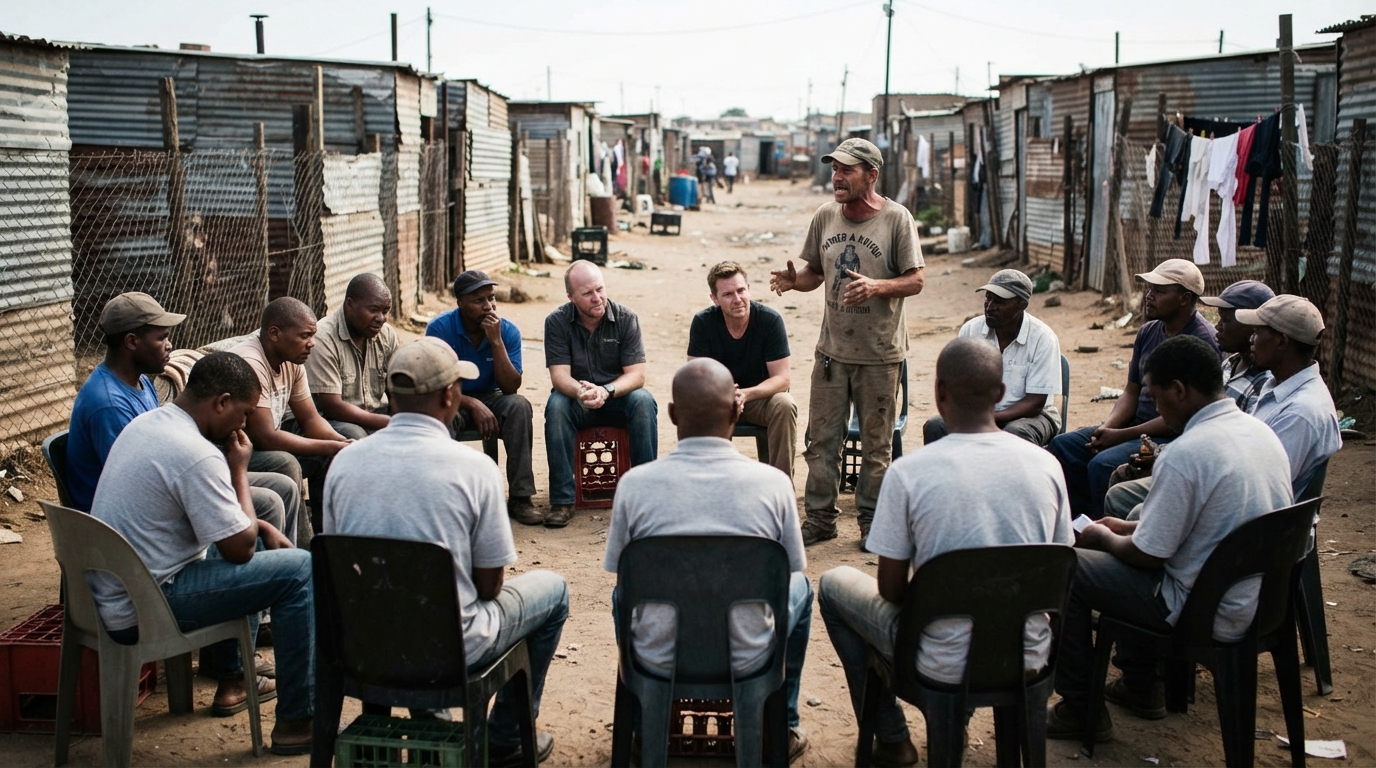
The meeting takes place in a narrow street in a Johannesburg informal settlement called Organic Market. It is a labyrinth of corrugated metal shacks and dirt roads, near Alexandra township.
"Now I feel pain," Mathekga continues. "We broke up and I no longer see my child. I feel like I've contributed to the problems in South Africa, instead of being the gentleman that I know I am."
At a nearby tavern, a group of men have arranged their chairs in a circle in the dust.
In the middle stands Itumeleng Stephen Tamaga, known locally as Bra Steve.
He lifts his fist.
"We are men!" he shouts.
The group clap and cheer. Some drink bottled beer.
"Listen guys," Bra Steve says. "We must stand together to fight against gender-based violence and femicide."
Bra Steve is the local organiser of Father A Nation, a non-profit that works with men and boys to promote positive masculinity and help end violence against women.
The group's meeting comes as South Africa faces fresh anger over renewed cases of femicide and violence against women.
The discovery of the bodies of 12 women over three months in the city of Ekurhuleni, near Johannesburg, has revived questions about the scale of what many people see as a crisis of violence against women.
Bra Steve says: "We must restore dignity to the men around here"
South African President Cyril Ramaphosa has admitted that his government has not done enough and has announced measures he hopes will make women feel safer.
The country has one of the highest murder rates in the world, with 5,427 people murdered between April and June this year alone.
In that period, according to the South African Human Rights Commission, 569 women were killed, an average of six a day, and 1,052 others survived attempted murder.
A 2022 report by the Human Sciences Research Council found that more than 35% of South African women experienced physical or sexual violence, many at the hands of their own intimate partners.
For Bra Steve, part of the answer to the crisis is helping men understand the issue and take responsibility for their actions.
"We are a lost generation," he says. "We must restore dignity to the men around here."
Among the men outside the tavern is Zizipho Mtwesi, the project co-ordinator of Father A Nation.
Looking back on recent weeks, he says more needs to be done.
The latest measures announced by Ramaphosa, including better street lighting and a review of unsolved cases, are too little, he says, and too late.
"When I think about all of these recent murders in Johannesburg, I get angry. Why do we have to wait for this to happen for us to act?"
He looks around and gestures at the meeting. "We are trying to reach men before things like these murders happen again."
Craig Wilkinson tells the group to "choose what kind of man you want to be"
Craig Wilkinson is the founder of the group. "We get men to talk, to process their feelings," he explains.
"And as they do, this healing takes place. And the second phase is teaching and training positive masculinity.
"We ultimately hope that this will eliminate the scourge of gender-based violence."
He stands up, moving into the centre of the group, calling out to the men.
"You as a man are a powerful force for good," he tells them. "You choose what kind of man you want to be. Women need to be safe."
Father A Nation works across South Africa, teaching healthy masculinity and running training programmes in dozens of schools and colleges.
Mystery surrounds the wave of murders that has prompted South Africa's latest period of soul-searching about the safety of its women.
Police have not ruled out possible links between some of the Ekurhuleni deaths but have not said they are investigating a serial killer. Suspects in some of the cases have appeared in court.
But the wave of deaths has raised new concerns and in Organic Market some women are more fearful than ever.
Outside a nearby shack Linkie listens with interest as she washes clothes in a large metal bucket.
"We are not safe when we are outside our place," she says.
"We are afraid when we see a car behind us when we walk. We feel afraid. We feel scared. What if this guy's going to kidnap me or do something to me?"
It is a feeling shared by many women here. In the local hair salon, with a mane of thick pink braids, is Providence Maseko.
She comes to the door to speak to Bra Steve.
Women held a memorial run in Johannesburg after the discovery of Moselakgomo's body
"Safety here is very bad," she says, "Maybe you are the serial killer. How do I know who to trust?"
Bra Steve laughs. "We must talk about these things," he urges. "Come to our meetings and we can learn to trust each other."
Maseko tells me that she now takes an e-hailing taxi everywhere in the hope that it is safer.
Back at the tavern, the men's meeting is drawing to a close.
"As we try to stop gender-based violence," says Zizipho, "each and every man needs to know that they need to play a part in this.
"And if they wouldn't allow these things to happen to their own daughters or own mothers, they mustn't allow it to be done to someone else's daughter, which is their wives or their girlfriends."
Mathekga is impressed by what he has heard.
"I would love them to keep on practising what we have learned, because we no longer have role models," he says. "Our fathers and our uncles, they are there in prison. We must now become role models and help make this country better."
Twelve women have been killed in one part of South Africa since July.