

The seven fastest submarines in history
Submarines have evolved from slow-moving vessels into some of the most complex engineering systems ever created in just over a century. While stealth is a key advantage for modern submarines, speed is also important. It allows them to quickly take up a favorable position, intercept an enemy, or escape from a dangerous area.
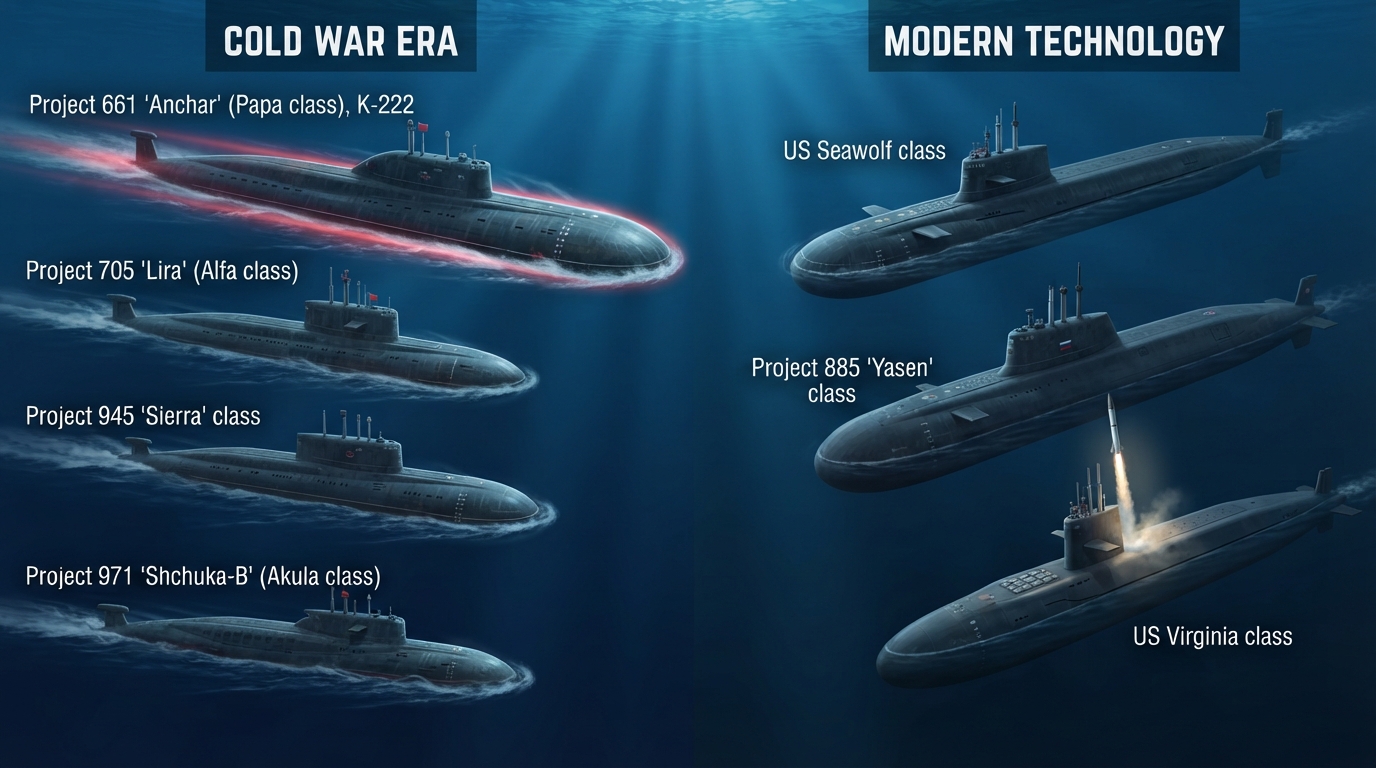
**The Seven Fastest Submarines in History: From the Cold War to Modern Technology**
Most of the fastest submarines in the history of submarine warfare were created during the Cold War. During those years, the Soviet Union and the United States sought to maximize the capabilities of their submarines. While some projects focused on speed, this led to increased noise levels and operating costs. Today, modern submarines prioritize a balance between speed, stealth, armament, and other characteristics.
**1. Project 661 "Anchar" (Papa) - 82.8 km/h**
The Project 661 "Anchar" submarine, built in the USSR, is recorded as the fastest submarine ever built. Known in the West as the Papa class, this titanium-hulled nuclear submarine reached a speed of 82.8 kilometers per hour during tests, according to available data. This record has not been broken to this day.
This result was achieved thanks to two powerful nuclear reactors and an advanced titanium hull. The titanium construction, while reducing weight, allowed the submarine to move at great depths. However, high performance had its own "price": the submarine was very expensive to build, technically complex, and made a lot of noise at high speed. This made it easy to detect by the enemy's hydroacoustic means. Only one submarine was built under this project - initially called K-162, later K-222.
**2. Project 705 "Lira" (Alpha) - 76 km / h**
"Lira" is considered one of the most daring engineering projects in the Soviet submarine industry. Commissioned in the 1970s, this submarine combined a lightweight titanium hull and an innovative nuclear reactor with a liquid metal coolant. This technology allowed the submarine to reach speeds that many other submarines of that time could not achieve.
According to available data, the maximum speed of the "Lira" was about 76 kilometers per hour. It was able to evade many torpedoes of that time and quickly change depth. However, since the maintenance of the innovative reactor was expensive and complicated, the possibility of mass construction of such submarines was limited.
**3. Seawolf class - more than 65 km / h**
The US Seawolf class multi-purpose nuclear submarines were created on a different concept than previous record-breaking submarines. Here, along with high speed, great attention is paid to stealth. The US Navy has not officially disclosed the maximum speed of the Seawolf ships. However, according to open sources, they can move underwater at speeds exceeding 65 kilometers per hour.
These ships were designed to counter advanced Soviet submarines in the final stage of the Cold War. They are equipped with a powerful nuclear power plant, modern hydroacoustic complexes and noise reduction technologies. Due to their high cost, only three Seawolf-class submarines were built.
**4. Project 885 "Yasen" - 65 km/h**
The Russian nuclear submarines of the "Yasen" project are among the country's modern multi-purpose submarines. According to open sources, they can reach speeds of about 65 kilometers per hour underwater. The project combines high speed with modern stealth technologies and armament. The text notes that they can use the "Caliber", "Onyx" and "Zircon" missiles. This project paid more attention to survivability, acoustic stealth and the ability to hit targets at long distances than to record speed.
**5. Project 971 "Shchuka-B" (Akula) - 65 km/h**
Project 971 was an important stage in the development of the USSR's submarine fleet. It combined high speed with a lower noise level than previous Soviet submarines. The Shchuka-B was able to reach a speed of about 65 kilometers per hour underwater. Speed, long-term autonomous movement, great depth range, and torpedo armament were cited as the main features of these submarines. Some modernized ships remained in service decades after their appearance.
**6. Project 945 Sierra - 63 km/h**
The Project 945 submarines, like the Alpha and Papa, were built with a titanium hull. This material served to reduce the weight of the structure, increase corrosion resistance, and improve the ability to navigate at great depths. Their maximum underwater speed is estimated at about 63 kilometers per hour. These submarines were designed to quickly engage targets and navigate at great depths. However, the high cost of titanium limited the number of ships built.
**7. Virginia class - over 63 km/h**
The US Virginia class shows how priorities have changed in modern submarine warfare. According to open source estimates, the maximum speed of these nuclear submarines exceeds 63 kilometers per hour. The US Navy has not officially confirmed the exact maximum. The main goal of the Virginia project is not to set a speed record. The emphasis on stealth, modern sensors, flexibility of weapons systems and the ability to perform various tasks is emphasized. They can perform tasks such as reconnaissance, countering other submarines, striking land targets and supporting special forces operations.
Thus, the highest speed result in history still belongs to the Soviet submarine K-222, which is 82.8 km/h. However, in modern submarines, stealth, sensors, autonomy and the ability to perform various tasks are more important than absolute speed.