

The Senate approved a market oversight law. Products, not entrepreneurs, will be monitored.
A market surveillance law has been approved in Uzbekistan. The document provides for test purchases, testing, and recalls of hazardous products, but, as the Senate emphasized, should not lead to mass inspections of businesses. Liability will extend to the entire supply chain—from the manufacturer and importer to the retailer.
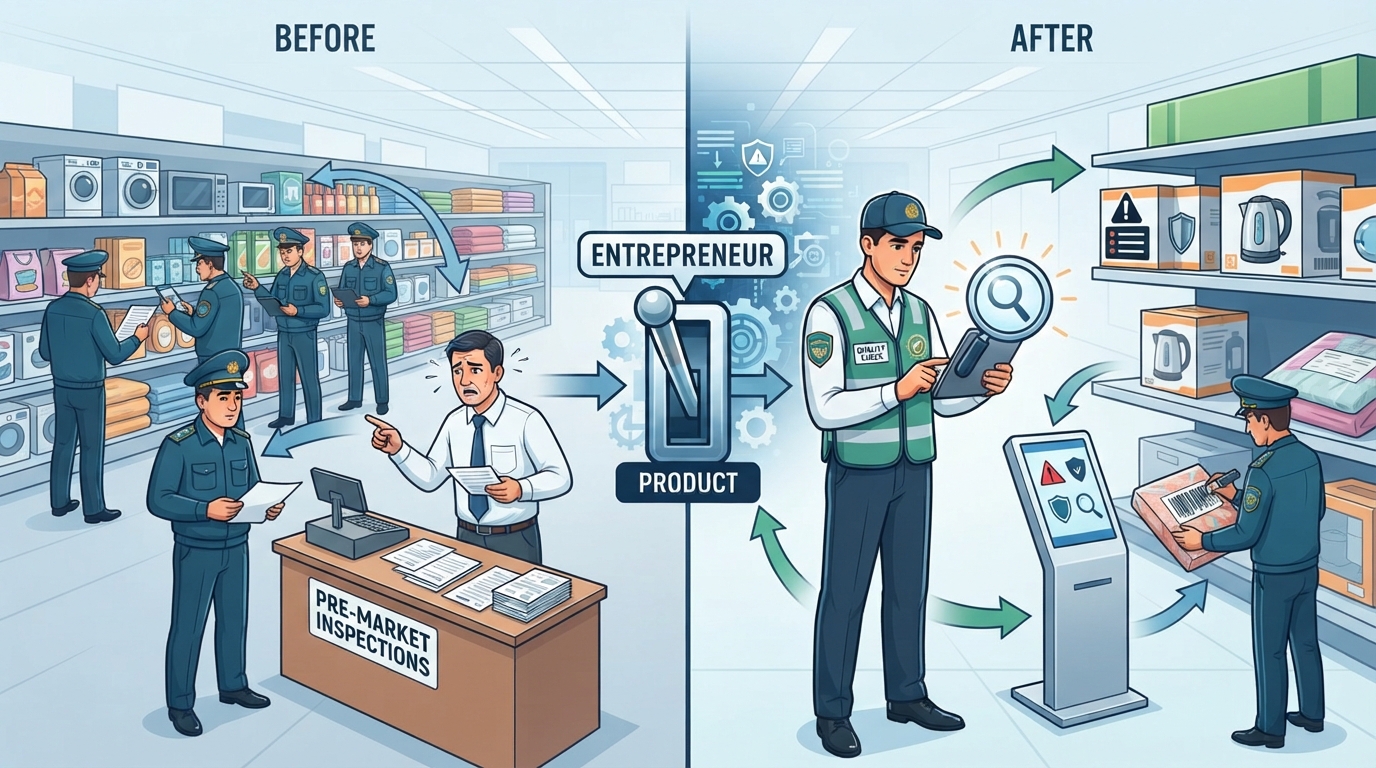
The Senate approved the law on market surveillance: the focus shifts from entrepreneurs to products.
On August 7, the Senate of the Oliy Majlis of Uzbekistan approved the law "On Market Surveillance," which aims to unify the rules for monitoring the safety of non-food products after they enter the market. The document also establishes liability for manufacturers, importers, and sellers, and regulates procedures for the seizure and recall of dangerous products.
Senator Erkin Gadoev emphasized that the existing system of technical regulation did not allow for the full coverage of all non-food products and their safety assessment. He noted that oversight is currently focused on entrepreneurs rather than the products themselves, leading to business inspections instead of on-shelf inspections.
The key innovation of the law is the introduction of the international principle of Market Surveillance, which means a shift from preliminary inspections (pre-market) to monitoring products already on sale (post-market).
The speaker emphasized that the introduction of market surveillance will not lead to additional oversight of businesses. On the contrary, the law aims to delineate the powers of government agencies and assign responsibility for specific product groups in order to eliminate duplicate inspections and unjustified interference in the activities of entrepreneurs.
As noted during discussions in the Legislative Chamber in April, the new system will monitor products, not entrepreneurs, focusing government agencies' attention exclusively on non-food products. The law does not apply to: [a list of exceptions was not provided in the original text].
One important innovation is the introduction of the concept of "economic operator," which includes the manufacturer, importer, and seller of products. This means that if an unsafe or non-compliant product is discovered, liability will not be limited to the retail outlet, but may extend to the importer or manufacturer. It was noted at the meeting that this approach will ensure accountability throughout the entire product chain—from production or import to sale to the end consumer.
Market surveillance is defined as a set of measures carried out after a product's release into circulation, aimed at ensuring its safety and preventing harm to human life and health, the interests of individuals and legal entities, the state, and the environment.
Surveillance will be based on risk assessments rather than mass inspections and penalties for entrepreneurs. Market surveillance authorities will be able to conduct test purchases, examine and test products, conduct site visits to investigate the causes of identified non-compliance, monitor, and take action against products that do not meet mandatory requirements.
If a product poses a serious risk or does not meet established requirements, its release into circulation may be suspended. The law also provides for product recall, withdrawal from the market, or restrictions on use and sale.
The law also regulates the involvement of customs authorities. If, based on the results of customs control and the risk management system, there are sufficient grounds to believe that a product does not meet mandatory requirements, customs authorities may suspend its release into free circulation. Following this, the relevant market surveillance authority must examine the product within three business days, conduct an on-site visit if necessary, collect samples, and send them for examination or testing. If violations are confirmed, restrictions stipulated by law may be applied to the product.
During the discussion, senators raised the issue of preventing abuses during test purchases. First Deputy Director of the Technical Regulation Agency, Lazizbek Saidoripov, stated that such purchases will be conducted according to established risk criteria, with mandatory video recording and, if necessary, the participation of witnesses. These mechanisms, as noted at the meeting, are designed to reduce corruption risks during inspections.
Business owners will have the right to participate in market surveillance activities, review relevant documents, audio- and video-record inspectors' actions, and appeal their decisions and actions. Supervisory authority officials, in turn, will be held accountable for failure to perform or improper performance of their duties, as well as for illegal actions or inactions.
Lazizbek Saidoripov also discussed the creation of a digital list of dangerous products (blacklist), similar to the European Safety Gate system. The law provides for the creation of a National Information System for Market Surveillance, which will collect data on control measures carried out, violations identified, decisions made, and the results of appeals. A draft government resolution has already been prepared to launch the system.
During the discussion, the creation of an electronic database of dangerous products, similar to international rapid notification systems, was also discussed. This will allow government agencies and consumers to receive information about products recognized as dangerous or recalled from the market.
Market surveillance mechanisms will also apply to products sold remotely, including through e-commerce.
Senators also clarified the procedure for compensating buyers for damages in the event of a product recall. The Deputy Chairman of the Committee for the Development of Competition and Consumer Protection stated that current consumer protection legislation provides for full compensation by the manufacturer for damages related to a product recall. If it is impossible to identify specific consumers, the procedure for further circulation of the relevant funds will be determined by current legislation.
One argument in favor of the new law is Uzbekistan's preparations for accession to the World Trade Organization. As noted in the report, a modern market surveillance system is necessary to eliminate technical barriers to trade and improve the competitiveness of local products. The new rules are also expected to protect bona fide manufacturers and importers from competitors selling counterfeit and low-quality goods.
At a meeting with the president in February, it was noted that the current practice of inspecting enterprises during product assessments is causing dissatisfaction among businesses. When violations are detected, inspectors often block the entire enterprise's operations, rather than the circulation of a specific batch of goods. Developed countries employ a market control system based on risk analysis. The manufacturer declares the product's compliance with standards and bears full responsibility for its quality and safety.
Some entrepreneurs supported the transition to market control in the area of product certification and assessment. Zafar Khashimov, founder of the Korzinka supermarket chain and chairman of the Trade and Service Association, compared the planned reform's significance to the opening of currency conversion, stating that it will become the foundation for industrial modernization and a step toward a truly market economy.