

The question dominating Indian politics: Is it worse when women swear?
Rahul Gandhi's comments renew the debate over gender disparity in reactions to insults hurled at PM Narendra Modi.
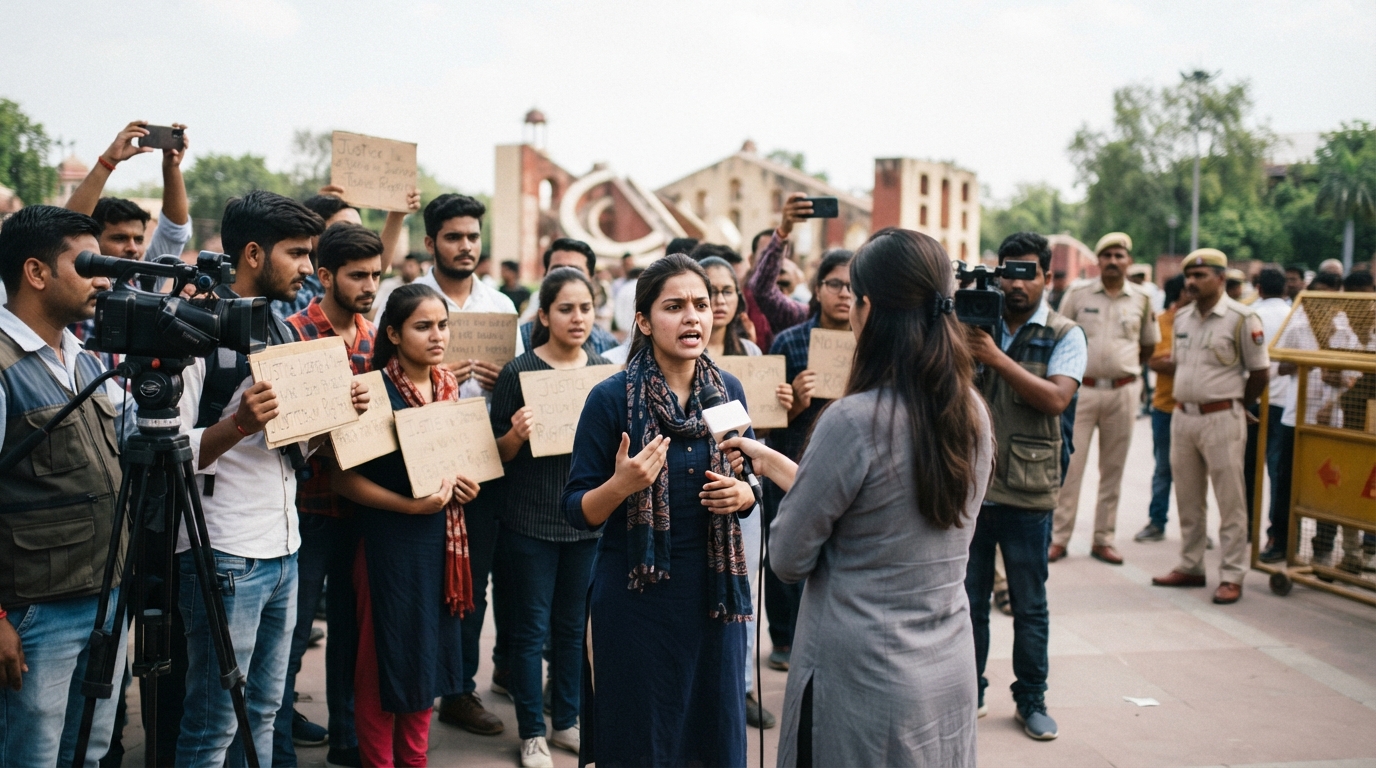
The recent use of expletives by young women during a protest in India has ignited a unique debate: is it worse when women swear? This question now dominates Indian politics.
The 35-day protest, spearheaded by the Cockroach Janta Party (CJP) at Delhi's Jantar Mantar, concluded on July 25. The controversy began last month when young women participating in the CJP protests in Delhi and other cities, advocating for education reforms, directed foul language at the government, including the Prime Minister. This sparked outrage among his supporters, with even some critics of Prime Minister Narendra Modi's policies suggesting the women had gone too far.
Opposition MP Rahul Gandhi has now weighed in, criticizing Prime Minister Narendra Modi's characterization of seeing young women swear as a "culture shock." Gandhi stated, "If boys swear, there is no problem and it is allowed. But if a girl swears, it is a cultural shock."
Modi himself addressed the issue in a selfie video, describing it as "a culture shock" to witness young women using expletives, though he added that he forgave them. However, the Prime Minister did not comment on the violent police crackdown against the protesters or offer support to women who reported being trolled and receiving rape threats for their participation in the CJP protests.
At a student gathering in Pune over the weekend, Rahul Gandhi, the leader of the opposition in the lower house of the Indian parliament, reiterated his criticism of Modi's "culture shock" remark. He highlighted that both male and female protesters had used foul language during the demonstrations concerning exam paper leaks, questioning why Modi focused solely on the women.
Gandhi's comments follow weeks after posters and videos of female protesters insulting Modi went viral on social media. As police initiated an investigation into abusive posts, a 15-year-old girl became central to the controversy, receiving abuse and threats on social media from trolls. The teenager subsequently released a video apologizing for her language and seeking forgiveness, also stating she had removed her original video. Despite this, the outrage persisted. Her mother, a single parent, informed the local press that the controversy had compelled them to relocate multiple times.
Modi adopted a more conciliatory tone in a vertical video shared on Instagram after the protest ended. He remarked, "Some naughty children used extremely abusive expletives which have no place in a civilised society. They abused me, they also abused my late mother. It was deeply disturbing." Addressing the anger of his supporters, he acknowledged their feelings, saying, "It's a culture shock. How can our daughters use such language? But I want to say that mistakes are made in childhood and it's an opportunity to fix them."
At the Pune event, Gandhi asserted that Modi's singling out the gender of the protesters was rooted in patriarchy. "What is the mindset that a girl has a place while boys get full freedom? They can do whatever they want, if they want to swear, they can swear... We have to smash this patriarchy," he declared.
The Cockroach Janta Party protest concluded last month following the resignation of Education Minister Dharmendra Pradhan.
Journalist Namita Bhandare, who authors a popular column on gender issues for the Hindustan Times, told the BBC that, contrary to popular belief, many "women in India of course swear, it's not new." She cited an important wedding ritual in many northern Indian villages where women from the bride's family sing a medley of expletives while welcoming the groom's party, a tradition that is not considered offensive. Bhandare therefore argues that describing the language used at Jantar Mantar as a "culture shock" and singling out women for swearing demonstrates "double standards," especially since politicians, including the Prime Minister, have used slurs against women when it suited them.
While Modi's government implements various schemes aimed at empowering women and he enjoys significant popularity among female voters, he and his party colleagues have faced criticism for disrespecting women on numerous occasions. Senior party leaders have been called out for misogynistic comments regarding women's clothing. Modi himself has drawn criticism for using terms like "Jersey cow" at a 2004 rally and "50 crore ki girlfriend" ["girlfriend worth 500m rupee"] at another event in 2012. Such criticism is not exclusive to the BJP, with many opposition politicians, including those from Gandhi's Congress party, facing similar allegations.
"Women are treated so shabbily and it's so easy to target them. And then when they use profanity, then everyone asks, how can our girls cuss and swear," Bhandare observed.
Social activist Sunil Jalan, who has been running a "Gali Bandh Abhiyan" (a campaign to stop the use of cuss words) since 2014, emphasizes that "we must focus on swearing, not on the gender of who uses them." A survey conducted by his NGO last year revealed that 55% of over 70,000 participants from 28 Indian states and eight federally-administered territories admitted to using foul language. The survey directly asked how often participants heard or used expletives targeting mothers, sisters, or daughters. Their 2025 "Gali [expletive] Map of India" indicated high prevalence rates in the north, with 80% in Delhi, 78% in Punjab, and 74% in Uttar Pradesh and Bihar. Most southern states were below 44%, and the northeast ranged between 15% and 18%. Jalan believes this marks the first time a dialogue about foul language is occurring in the country, expressing hope that "something good will come out of it." He described it as "a very serious issue," a "virus that's spread through society," noting that "comedy, jokes and films have normalised swearing and it needs to be reined in."
However, many members of India's Gen Z hold a different perspective on profanity. Sourav Das, a CJP spokesperson, previously told the BBC, "Profanity and protest have gone hand in hand for ages. There's a shock-and-awe factor to it, which is fundamental to protest. It may be distasteful to some people and not to others. But it absolutely can't be criminal."
Such language is not limited to street protests. Profanity and personal attacks have increasingly permeated India's public discourse, from television debates to courtrooms and even parliament. A viral video earlier this week showed a female presenter on the government-owned Doordarshan channel attempting to control a temple priest who unleashed a barrage of cuss words at a Congress party spokesman, who then retaliated in kind. The priest later expressed regret for his statement as outrage grew.
Sociologist Shiv Vishwanathan suggests that "the use of expletives is the symptom of a deeper breakdown of democracy; it shows there's end of discussion and a lack of respect." He argues that when expletives are used within Parliament and courts, "it shows there's a breakdown of language, there's a decline of argument and decline of democracy." The use of profanity by protesters, he concludes, stems from a "weaker sense of respect," making expletives a common response.