

The original sign reacted to Zafar Hashimov's comments on mandatory labeling
The original sign reacted to Zafar Hashimov's comments on mandatory labeling. According to him, mandatory labeling allows you to track goods throughout the entire chain, prevent illegal products from entering the market, and quickly identify counterfeits.
"Asl Belgisi" responded to Zafar Hoshimov's comments on mandatory labeling.
Zafar Hoshimov, the founder of the Korzinka supermarket chain, expressed his opinion on the advantages and disadvantages of the mandatory digital labeling system on the example of his own experience in the "Lolazor" podcast.
"Gazeta" sent a request to find out the position of the "Asl Belgisi" company on this issue. "Asl Belgisi" responded to the request of "Gazeta" and commented on the main arguments of the Korzinka founder.
Zafar Hoshimov emphasized that mandatory labeling is indeed necessary during the production process, but there is no point in monitoring the subsequent stages of the chain.
The company's response states that the idea that monitoring labeled water and soft drinks is only necessary at the production stage is wrong.
In addition to clandestine production, the illegal circulation of products also includes smuggling (importing goods without customs clearance) and counterfeiting (illegal production of goods in an artificial way).
In world practice, the system of tracking goods - track & trace - covers all the main stages of production, import and circulation of goods.
"This allows you to ensure control at all stages of the logistics chain and prevent illegal and counterfeit products from entering the market under the guise of "original products", - the company explains.
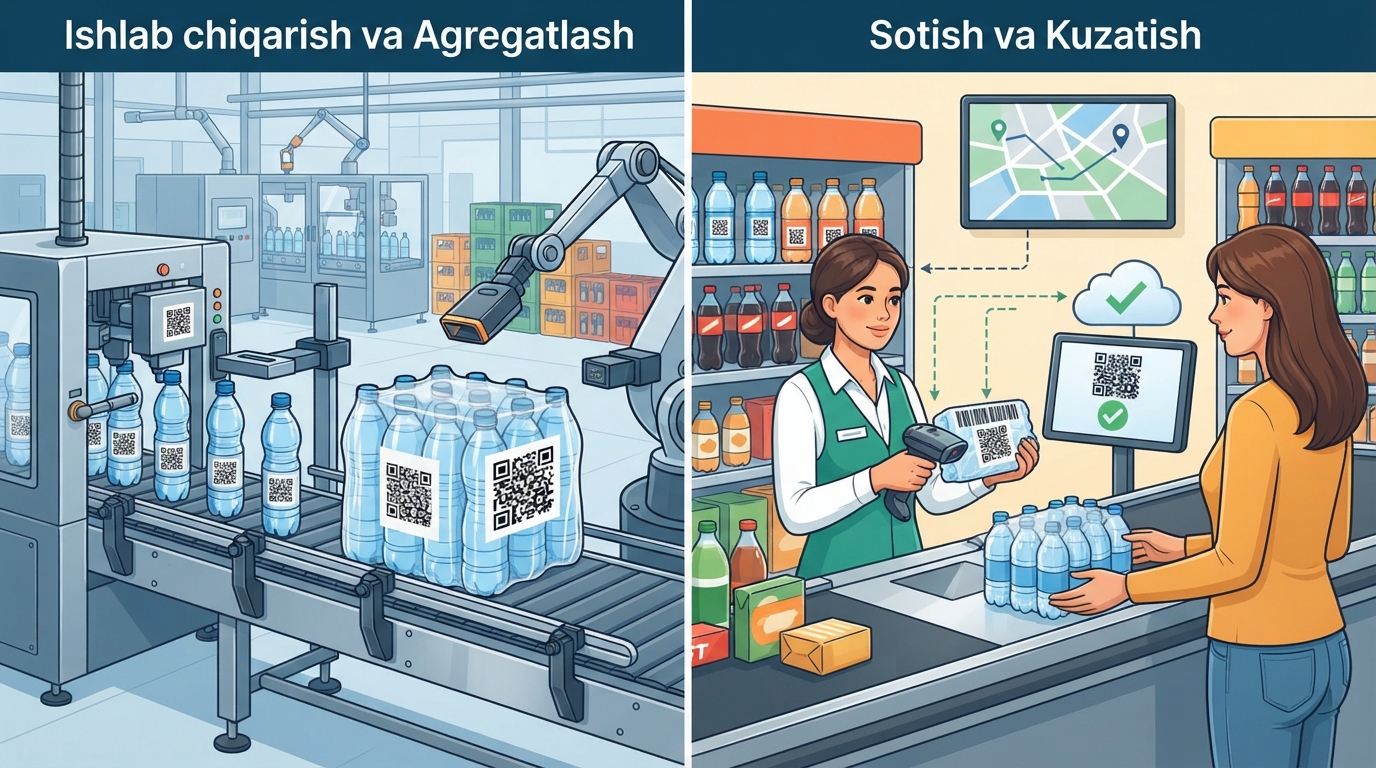
During the interview, Zafar Hoshimov gave a real-life situation in which the labeling system was prolonging the customer's service time. According to him, when passing several small-liter blocks of water through the cash register, it was necessary to scan the labeling code of each product separately.
The company attributes this to the fact that when labeling water and soft drinks, the combination of the product code in the block into the general code of the package - aggregation - is currently optional.
"To account for "small wholesale" trade, there is a concept of group packaging in world practice, and the process of aggregating marked goods has been introduced in the digital labeling system. Scanning of marking codes in batches is carried out during the assembly of group packaging, - the company explains. - In this case, a digital camera automatically reads the necessary DataMatrix codes and links them to the group packaging code".
As a result, when accounting for water as a whole block, it is enough to scan the packaging code.
"The labeling system itself identifies product packaging inside and registers their removal from circulation. This reduces the number of scans, and therefore the time for servicing the customer," the company says in a statement.
It is worth noting one important point here: if at least one product from the block is sold, the packaging code will not work and each remaining product will have to be scanned separately.
The company recalls that at the request of manufacturers, the mandatory aggregation of labeled water and beverages was moved from April 2026 to April 2027. Currently, the aggregation of labeled water and beverages is carried out voluntarily.
The founder of Korzinka noted that after the introduction of labeling, the volume of wholesale deliveries of water and soft drinks through BTB (business to business) of the network decreased by 80-90%, attributing this to the fact that many businesses in the HORECA segment switched to cash sales.
As an argument against this, "Original Sign" lists a number of legal acts aimed at restricting cash payments.
"Reducing the volume of cash settlements in the economy is a general task aimed at reducing the "hidden economy", and this is not limited to the turnover of marked goods," the company's statement says.
In this regard, the company recalls certain types of goods for which cash settlements are prohibited in accordance with the Presidential Decree of December 10, 2025.
"Starting from April 1, 2026, cash settlements are prohibited not only when purchasing alcohol and tobacco products (which are included in the list of marked goods), but also real estate, cars and any goods worth more than 25 million soums (such goods are not included in the list of marked goods)," Asl Belgisi emphasizes.
The note also mentions the Regulation on the Procedure for Carrying Out Wholesale and Retail Trade Activities, approved by the Resolution of the Cabinet of Ministers No. 407 of November 26, 2002.
"The restrictions on cash wholesale trade provided for in the Regulation on the Procedure for Carrying Out Wholesale and Retail Trade Activities are also aimed at reducing the "hidden circulation of goods" and the practice of purchasing goods for cash without taking into account the receipt, storage and sale of goods to the final consumer."
"Since practice shows that there is a high demand for retail trade in the B2B format, there is a need to develop mechanisms together with state bodies that take into account, on the one hand, the advantages of such a format, and, on the other, the tasks of combating "hidden circulation,"" the company added.
Zafar Hoshimov admitted that there is a real danger to the consumer (health, life) from counterfeit medicines and carbonated drinks.
"For example, there is a real risk to society and consumers from [counterfeit] drugs, alcohol, Coca-Cola. But what is the risk from this water?", he says, referring to plain still water.
The company explains that "water and soft drinks" is a much broader consumer segment, which, in addition to water, includes such categories as refreshing and energy drinks, fruit and vegetable juices, sugar-sweetened beverages, including carbonated drinks, and functional drinks. Water is also divided into ordinary drinking water and mineral water from mineral springs.
"Illegal circulation practices largely depend on the type of product. For example, refreshing and energy drinks are subject to excise taxes and have high margins, so they are often smuggled in or produced clandestinely," the company explains.
In juices and sugary drinks, the company notes, there is a tendency for "hidden production". Under the guise of drinking and mineral water, ordinary tap water is often sold.
At the same time, "Asl Belgisi" says that the detection of cases of counterfeit products in the water and soft drinks segment confirms the risk of counterfeiting in the industry. For example, it was recently discovered that a counterfeit energy drink was being sold in the Namangan region.
"When its marking code was checked through the "Asl Belgisi" mobile application, the marking was not available in the national information system. It was possible to identify such goods using a digital marking tool, which allows you to check the legality of the product and immediately record the detected violation," the statement says.
It is reported that the incident in Namangan is not the only one, and a whole chronicle of similar cases can be witnessed throughout the country:
The company also compares how counterfeit products were previously detected and how they are detected now, citing the situation observed in 2021 as an example.
"Before the introduction of labeling: Coca-Cola, Fanta and Pepsi were produced in a clandestine workshop in unsanitary conditions.
This situation was discovered only after Coca-Cola officially appealed to law enforcement agencies, after several months of investigation. Today, two minutes and the "Send" button are enough," the company said in its statement.
Zafar Hoshimov called this illogical, saying that "the absence of labeling on a bottle of water costing 1,200 soums would result in a disproportionate fine." So far, no one has been punished for this reason, but, he said, the potential risk is still a price for any business.
"The consumer pays for the entrepreneur's risk," he said.
"Asl Belgisi" responded by noting that liability for violating the rules of digital labeling is established by the Tax Code of the Republic of Uzbekistan.
"At the same time, the amount of the fine has been revised several times in the direction of reduction," the company emphasizes.
According to current standards, for the first two violations recorded within a year, an instruction is issued to eliminate the violation and no fine is applied. However, for subsequent violations, the amount of the fine is gradually increased.
In response to the idea that the price of the product will increase due to the entrepreneur's risk, the company says that digital labeling is not a factor that determines the final cost of water and beverages and the amount of the sales margin.
"All water and beverage manufacturers have already implemented digital labeling processes. In this case, labeling codes for still drinking water up to 0.5 liters are provided free of charge," Asl Belgisi reported.