

"The number continues to grow." More than 8,800 cases of illegal land use detected in Tashkent
In Tashkent, more than 8,800 cases of illegal land use have been identified, and about 800 hectares have been returned to the state since 2024. In an interview with Gazeta, the city khokim (mayor) stated that the inspections have so far covered territories along central roads, and with further investigation of the mahallas, the number of such cases will grow.
"The number continues to grow." Over 8,800 cases of illegal land use identified in Tashkent
Over 8,800 cases of illegal or problematic use of land plots have been detected in Tashkent. The khokim of the capital, Shavkat Umurzakov, spoke about this in an interview with Gazeta.
He emphasized that he does not consider it right to automatically blame entrepreneurs if construction was carried out with state permission.
"A decision that I consider good today may lose its relevance and seem wrong in five years. Therefore, I do not want to blame anyone," he said.
According to him, a completely different situation is when land is used for a purpose other than that for which it was allocated.
"What I do not understand and consider wrong is when a person receives land for one declared purpose, but does something completely different on it. But if the state itself allowed the business: 'You can build this here,' and the entrepreneur built it, I do not think he is automatically to blame — perhaps at that time it was considered the right decision," the khokim stated.
The khokim classified the transfer of land without documents, failure to fulfill investment obligations, as well as situations where plots should have been returned to the state but the process was delayed, as illegal and problematic cases. "We have identified about 8,800 such cases, and the number is growing — the audit is ongoing," Umurzakov said.
From 2024 as of the end of August 2026, about 800 hectares of land have been returned to state control. Among such territories are school plots that were transferred for PPP projects, as well as cases where the territory of an educational institution was first reduced and transferred to the khokimiyat, and then to other parties.
Similar cases were identified in the territories of parks, markets, and parking lots. In particular, according to the khokim, plots occupied illegally or on other grounds around the Chorsu bazaar were vacated and returned to the market. The entrepreneurs who traded there were provided with spaces, after which the revenues from the land use began to go to the state.
Later in the interview, Umurzakov spoke about the results of the inventory of playgrounds, sports grounds, green zones, and other public areas. Such an instruction was given by the president in the summer of 2025.
"These are the same approximately 800 hectares and more than 8,800 cases I was talking about. And the number continues to grow, because we are only beginning to fully enter inside the mahallas. So far, it has mostly been about the first and second lines along central roads. When we start checking deeper into the mahallas, cases will be identified again and again," he said.
The khokim admitted that with a comprehensive check, the number of such cases could be significantly higher.
"If we go everywhere, I don't know — the number could reach 50,000 or even 100,000 cases. 'Illegal' can mean, for example, an extension to a house or a garage set up without authorization nearby," he pointed out.
At the same time, he stressed, the authorities do not plan to "demolish everything in a row," as this could cause social discontent.
Umurzakov cited an illegal retail outlet near the Chorsu bazaar as an example. Formally, the facility did not have the necessary documents, but the entrepreneur made a living there, and residents used his services.
According to the khokim, in such cases, the authorities try to simultaneously vacate the public territory and provide the business with a legal alternative — for example, a space in a small market inside the same mahalla.
"That is, we remove the facility from a playground or other public area, but nearby, in the same mahalla, we give the opportunity to work legally. We try to preserve the person's job as much as possible, and the residents' opportunity to buy what they need nearby," the head of the capital's administration stated.
The same approach is expected to be applied to workshops and other service points.
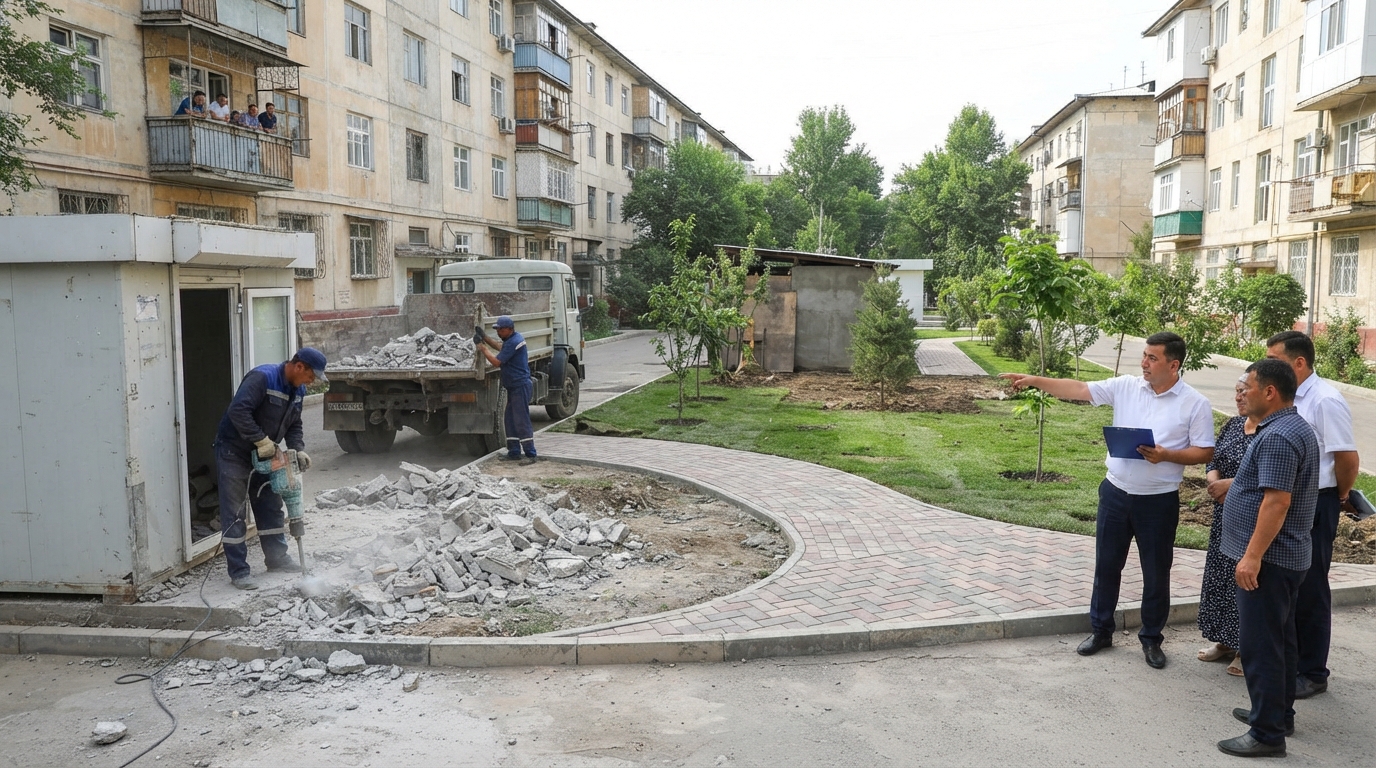
"Therefore, inside the mahallas, we are not carrying out harsh demolitions yet. First, we need to understand what to offer in return. There is no point in demolishing an object and leaving an empty space behind it if we are not ready to immediately landscape the territory, build a playground, or other infrastructure," Umurzakov noted.
Most of the 8,800 cases already identified, according to the khokim, so far relate to the first and second lines along the roads. The authorities are turning the vacated plots into green zones, pedestrian paths, and other public infrastructure, he said.