

The most likely cause of the Ebola outbreak in Congo and Uganda has been identified.
The most likely cause of the Ebola outbreak in Congo and Uganda has been identified.
Uzbekistan, Tashkent – Podrobno.uz News Agency.
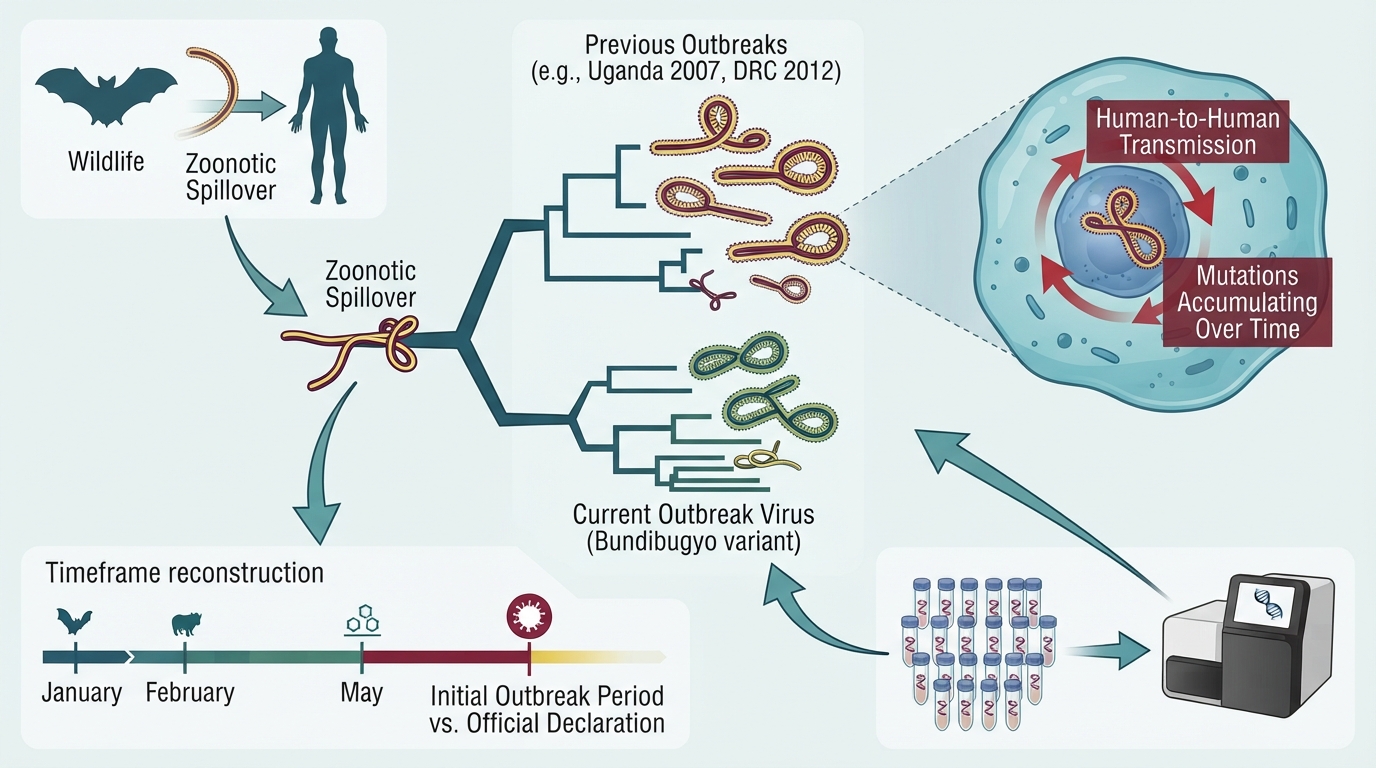
Scientists have determined that the current Ebola outbreak in the Democratic Republic of Congo and Uganda likely began with a new animal-to-human transmission of the virus. Genetic analysis revealed that the virus variant responsible differs from those that caused previous outbreaks, and the infection then spread between humans for several months.
Researchers from the DR Congo, Uganda, Belgium, and other countries analyzed the virus genomes from 22 samples obtained from patients in the two countries. The analysis revealed that the current Bundibugyo virus variant is genetically distinct from the variants that caused outbreaks in Uganda in 2007 and the DR Congo in 2012. This indicates that the current outbreak is due to a new animal-to-human transmission of the virus, rather than the continued spread of an older variant among humans. However, scientists have not yet been able to determine the specific animal that was the source of the infection. Also, the available samples are insufficient to pinpoint the exact moment when the virus first crossed over into humans.
Genetic data indicate that the virus continued to transmit from person to person for a significant period after that. Mutations were found in the analyzed samples, which, according to scientists, arose during the virus's replication in humans.
Determining the exact start date of the outbreak is also difficult. All 22 samples were collected after the virus had already begun spreading, so they are insufficient to reliably estimate the time of the emergence of the common ancestor of the current variants.
However, other data indicate that the outbreak began significantly earlier than its official announcement on May 15. According to field reconstruction data, the first deaths could have occurred as early as January, while the World Health Organization places the onset of the spread around February. Early cases could have been mistaken for malaria and typhoid fever.
By August 11, approximately 4,400 cases of infection and over 2,000 deaths had been confirmed in the DR Congo. The virus has also spread to neighboring Uganda. The current outbreak is caused by a rare strain of the Bundibugyo virus. There are currently no approved vaccines or treatments for it, although several candidates are in development.
Researchers note that more widespread use of virus testing and genetic analysis could help identify new outbreaks earlier and more quickly determine their origin.
As of July 27, it was previously reported that the death toll from the Ebola outbreak in the Democratic Republic of Congo had exceeded 1,400, and the number of confirmed cases was approximately 3,200. At the time, experts noted that the outbreak could continue for several more months.