

The HUMO national payment system has updated the navigation of the "Xalqlar Doʻstligi" (Friendship of Peoples) Palace, while preserving the architectural uniqueness of the majestic building.
The new navigation system will make the Palace territory more understandable and convenient for visitors, while at the same time preserving its architectural and visual character.
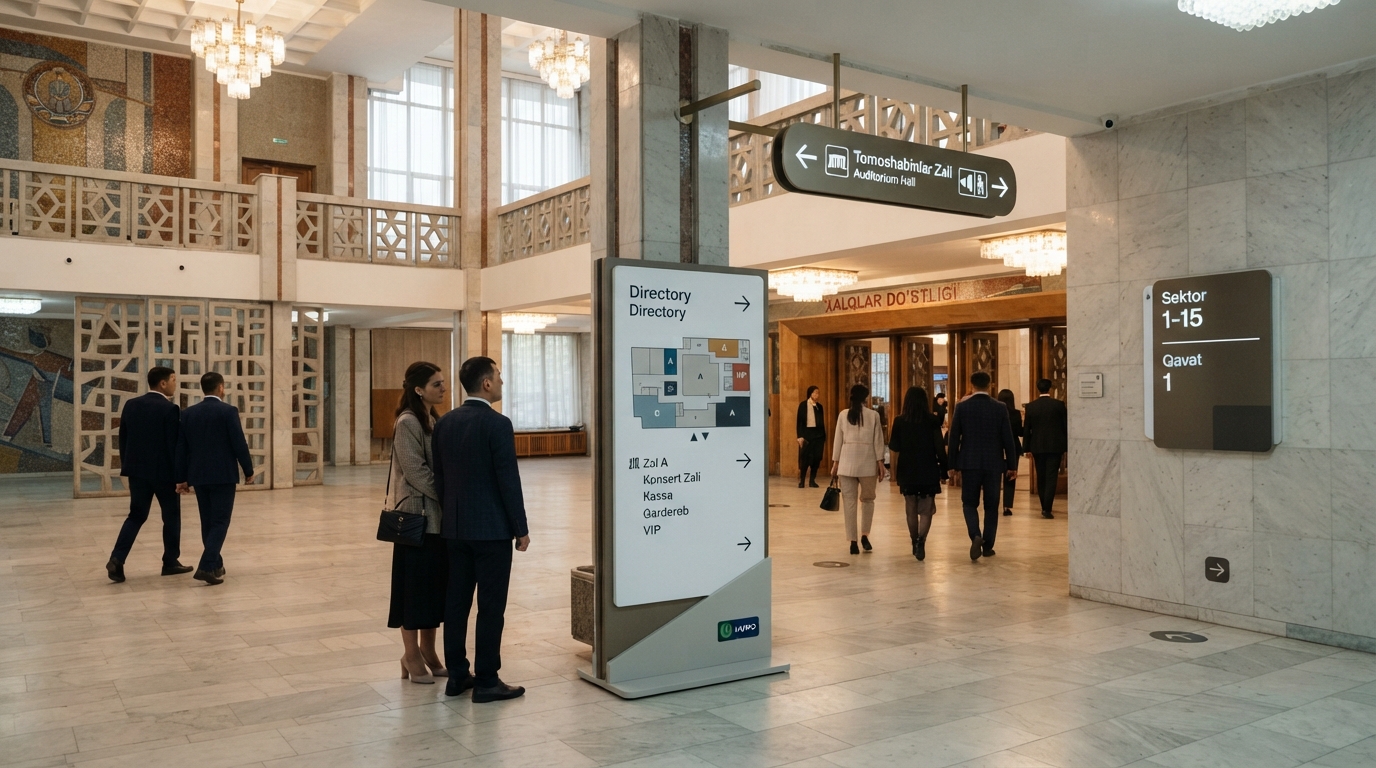
The HUMO national payment system has updated the navigation system of the "People's Friendship" Palace while preserving the architectural uniqueness of the majestic building
Over the course of 45 years, the "People's Friendship" Palace has become one of the most important social and cultural venues in Tashkent. Concerts, performances, international and local events are held here, and the building remains an important part of the capital's architectural appearance.
Built between 1977 and 1981, the Palace has not lost its significance in the cultural life of the city today. In 2026, its architectural value was also recognized at the international level: the "People's Friendship" Palace, along with nine other objects, was included in the Tashkent Modernism architecture complex inscribed on the UNESCO World Heritage List.
On the occasion of the 45th anniversary of the Palace, the HUMO national payment system, in cooperation with the palace administration, implemented a project to update the navigation system inside the building. The main goal was to make the vast and multi-story space more understandable and convenient for visitors, while preserving the architectural character and visual identity of the object.
The new navigation system was developed based on the principle of a continuous route: the visitor receives the necessary information at every stage of movement through the Palace — from the entrance to reaching their seat in the auditorium. Updated maps, floor indicators, wall and hanging signs allow for quick orientation and finding the required floor, sector, row, and seat.
Work on the project at all stages — from concept development to the placement of navigation elements — was carried out together with the Palace administration. Special attention was paid to ensuring that the new solutions harmonize with the existing architecture and do not compromise the visual identity of the building.
"The 'People's Friendship' Palace is a cherished venue for Uzbekistan and a part of the architectural heritage recognized by UNESCO. Therefore, in this project, it was of fundamental importance for us to find a balance between modern solutions and a careful attitude towards the architecture of the building."