

The Hard-to-Abate Economy: The Next Battle for Industrial Power
n an exclusive Senior Advisor interview, Mr. Alex Matrsson, the Swedish Pracademic and International Business Strategist, articulates that the future of steel, cement, chemicals, aviation and shipping should no longer be understood primarily through the lens of environmental compliance.
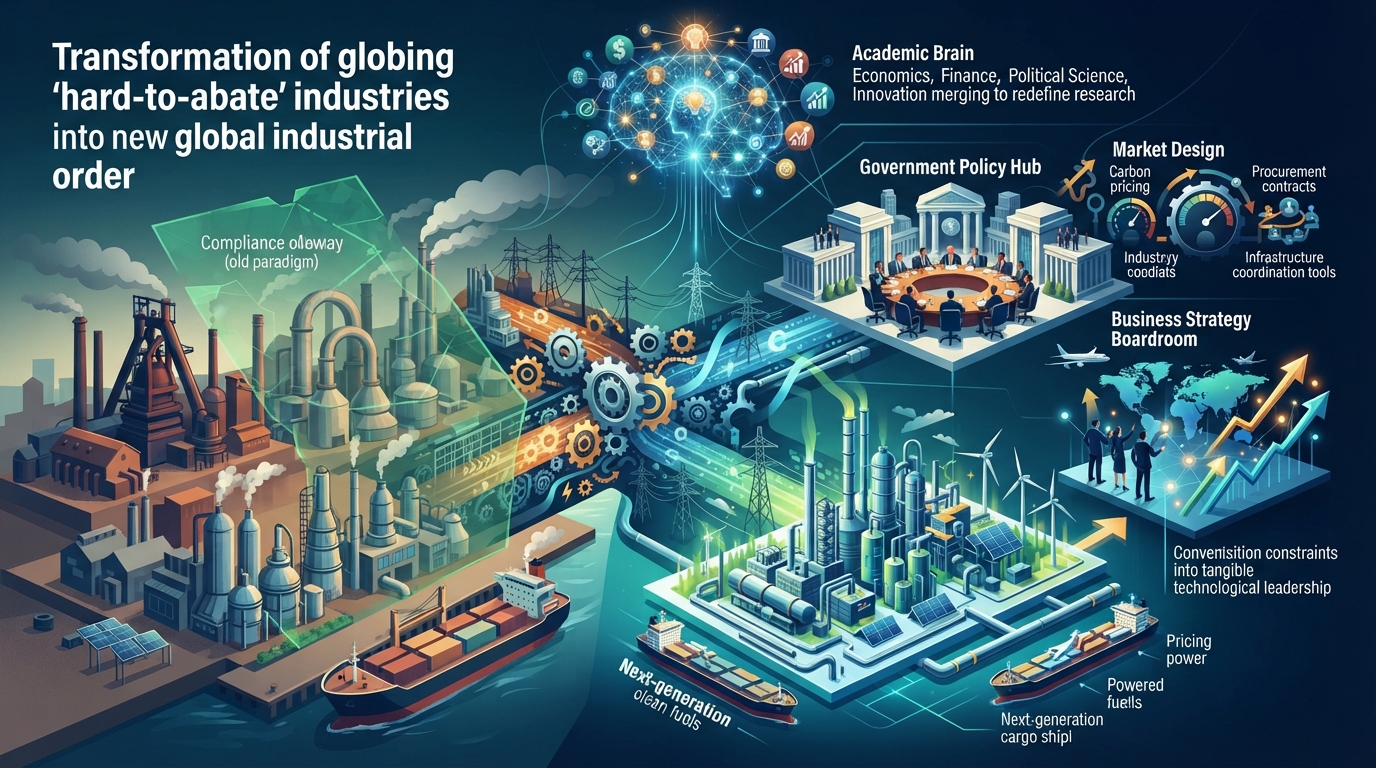
**The Hard-to-Abate Economy: The Next Battle for Industrial Power**
Tashkent, Uzbekistan (UzDaily.uz) – In an exclusive interview, Mr. Alex Matrsson, a Swedish Pracademic and International Business Strategist, asserted that the future of industries like steel, cement, chemicals, aviation, and shipping should no longer be viewed primarily through an environmental compliance lens. Instead, Mr. Matrsson believes these sectors are becoming crucial battlegrounds for industrial competitiveness, technological leadership, capital allocation, and geopolitical influence. He contends that this transition is fundamentally reshaping the structure of global production.
Traditionally, steel, cement, chemicals, aviation, and shipping have been labeled "hard-to-abate" due to the technical challenges in reducing their emissions. Mr. Matrsson challenges this conventional perspective, arguing that the more significant transformation is economic and geopolitical. He stated, "The real challenge is not simply to decarbonise hard-to-abate industries; it is to determine who will control the technologies, capital, infrastructure and markets that define the next industrial system."
At the core of this transformation lies what Mr. Matrsson identifies as a strategic paradox: industries facing the most intense transition pressures may simultaneously become the most vital sources of future competitive advantage. In his view, companies and nations that can integrate industrial capability with technological adaptation can convert transition pressure into market power. Conversely, those that treat the transition primarily as a compliance exercise risk losing their strategic position.
**Business: From Compliance to Strategic Optionality**
For corporate leaders, the traditional response has involved a hierarchy of compliance, customer expectations, reputational risk, and operational efficiency. Mr. Matrsson argues that the deeper issue is capital allocation amidst technological, regulatory, and geopolitical uncertainty. Steel mills, cement plants, chemical facilities, aircraft fleets, and commercial vessels represent long-term investments, meaning decisions made today could be decisive for competitiveness over several decades.
Consequently, strategic optionality is central to Mr. Matrsson's corporate framework. He explained, "The winning companies will not necessarily be those that make the largest technology bet today; they will be those that preserve the greatest ability to adapt tomorrow." His approach favors portfolios that combine long-term access to clean electricity and alternative fuels with partnerships, experimentation, customer commitments, flexible infrastructure, and disciplined investment in emerging technologies.
Mr. Matrsson also challenges the conventional assumption that customer demand alone will create substantial markets for lower-carbon products. He argues that demand becomes economically meaningful when procurement rules, regulation, financing conditions, supply-chain requirements, and competitive differentiation mutually reinforce each other. Mr. Matrsson noted, "The market will not reward cleaner production simply because it is cleaner; it will reward it when the surrounding economic system makes that advantage commercially valuable."
For companies, the opportunity therefore extends far beyond emissions reduction. Mr. Matrsson asserts that "the objective is not merely to minimise the cost of transition; it is to convert transition constraints into pricing power, market access and strategic differentiation." Companies capable of integrating sustainability, technology, commercial strategy, and geopolitical intelligence could thus gain an advantage over organizations that continue to treat these dimensions as separate corporate functions.
**Government: From Subsidising Technologies to Designing Markets**
Governments hold an equally significant position in Mr. Matrsson's framework. Markets alone cannot efficiently coordinate investments in infrastructure whose value spans entire industrial ecosystems. Hydrogen networks, clean-power capacity, carbon-management infrastructure, alternative-fuel systems, ports, and industrial clusters may require substantial investment long before individual companies can achieve sufficient returns.
However, Mr. Matrsson cautions against interpreting this coordination problem as an argument for unlimited state intervention. He stated, "Industrial policy becomes dangerous when governments confuse strategic coordination with permanent protection." Inefficient assets can be preserved, public resources misallocated, and regulatory systems transformed into barriers to innovation when intervention is designed to protect incumbents rather than build competitive capabilities.
Therefore, Mr. Matrsson advocates for a model of market-making industrial policy. In his assessment, governments should establish credible long-term rules, coordinate infrastructure, reduce first-mover risks, create demand in immature markets, and allow companies to compete within that framework. Carbon pricing, public procurement, contracts for difference, targeted fiscal incentives, development finance, and public-private partnerships can function as complementary instruments rather than competing ideological choices.
According to Mr. Matrsson, the objective should not be to guarantee the survival of every incumbent producer. He explained, "The role of government is not to decide every industrial winner; it is to create the conditions under which strategically important capabilities can emerge, scale and compete." This distinction becomes increasingly important as carbon regulation becomes more deeply integrated into international trade and industrial competitiveness.
Mr. Matrsson emphasizes that carbon regulation is increasingly intertwined with trade policy, investment policy, and national industrial strategy. The competitiveness of future production will thus depend not only on energy prices, labor productivity, and access to raw materials, but also on carbon intensity, regulatory credibility, infrastructure, technology ownership, and geopolitical alignment.
For Mr. Matrsson, modern industrial policy is consequently evolving into a form of geopolitical strategy. Countries that combine abundant clean energy, sophisticated infrastructure, technological capabilities, financial depth, and credible regulation may attract the next generation of industrial investment. Conversely, countries unable to coordinate these assets risk becoming dependent on foreign technologies and imported strategic goods.
**Academia: The Missing Breakthrough Is Institutional**
Academic research has heavily focused on the engineering aspects of industrial transition, yet Mr. Matrsson argues that the intellectual frontier is expanding. While improvements in electrolysis, alternative fuels, process efficiency, carbon capture, materials science, and industrial chemistry remain indispensable, engineering alone cannot explain why promising technologies succeed in some markets and fail in others.
Therefore, Mr. Matrsson believes the research agenda should integrate economics, finance, management, political science, and innovation-system research. Greater attention is needed for how companies make irreversible investments under regulatory uncertainty, how financial markets price transition risks in long-lived assets, how governments stimulate demand without permanently distorting competition, and how industrial clusters distribute economic value and political influence.
One concept Mr. Matrsson believes deserves particular attention is transition rents. He argues, "Every major industrial transition redistributes economic value; the strategic issue is who captures that value and where the resulting capabilities accumulate." Companies, regions, and governments may capture radically different portions of the value created by new technologies, infrastructure constraints, regulation, and emerging demand.
Consequently, Mr. Matrsson calls for research to move beyond analyzing individual technologies and towards understanding industrial transitions as integrated economic and political systems. Management structures, investment contracts, market design, corporate governance, public institutions, financing mechanisms, and geopolitical alliances can prove as decisive for technological adoption as engineering performance itself.
**A New Industrial Logic**
In Mr. Matrsson's view, the hard-to-abate economy should not be treated as the final frontier of environmental policy. He states, "Hard-to-abate sectors are becoming the first frontier of a new industrial order." Their transformation will influence not only the environmental performance of global industry but also the distribution of investment, technological capabilities, manufacturing capacity, and geopolitical influence.
While the implications differ across stakeholder groups, Mr. Matrsson identifies a common strategic thread. Business leaders must transform uncertainty into strategic optionality and future market power; governments must design competitive markets without creating permanent dependency on subsidies or protection; and academia must explain why some industrial transitions create new centers of economic power while others generate stranded assets, fiscal burdens, and technological lock-in.
In conclusion, Mr. Alex Matrsson, the Swedish Pracademic and International Business Strategist, emphasizes that the future of hard-to-abate industries will be determined by far more than their ability to reduce emissions. Mr. Matrsson concludes that "the decisive competition will extend beyond the factory gate into capital markets, infrastructure, technology, standards, trade policy and geopolitical alliances." For Mr. Matrsson, the ultimate strategic divide will not be between companies or countries that transition and those that do not, but between those that understand the transition as a new architecture of economic power and those that continue to treat it primarily as a cost of compliance.
**About Mr. Alex Matrsson**
Mr. Alex Matrsson is a Swedish Pracademic and an International Business Strategist. He is a visionary global leader, mentor, entrepreneur, senior lecturer, researcher, and distinguished international business advisor. He holds the distinction of being the number one International Business Strategy graduate in Sweden. He possesses extensive experience initiating, running, and managing businesses across the global value chain, as well as working internationally with investors, SMEs, MNCs, government agencies, universities, and multidisciplinary research institutes. He advocates on strategic issues related to policy, business strategy, industrial marketing, commercial diplomacy, and research commercialization. In higher education, Mr. Matrsson believes in serendipity, innovation, and the power of synergy-making, which jointly form the springboard for his knowledge dissemination efforts. He implements a pragmatic yet rigorous approach, systematically ensuring the successful delivery of core business concepts while simultaneously developing students' ability to become reflexive thinkers. His aim is to enable students to constructively operationalize their "state-of-the-art" knowledge, thereby becoming an invaluable source of prosperity, driving forward the "social" and "economic" well-being for their local communities, regions, and the larger society, worldwide. His scientific endeavors consolidate around trade promotion, emerging markets, business resilience, and the network approach to internationalization. Mr. Alex Matrsson is a member of The House of Matrsson, a Nordic Scandinavian family originating from the coastal city of Kalmar in southeastern Sweden, firmly rooted in conservative principles and devoted to knowledge, tradition, and the greater good worldwide. On a personal level, his wide-ranging interests include blue whales, Arabian horses, classical music, ethical capitalism, religion, culture, the Nordics, the GCC region, and Central Asia—particularly Kazakhstan.