

The economies that rely most on gold have been revealed
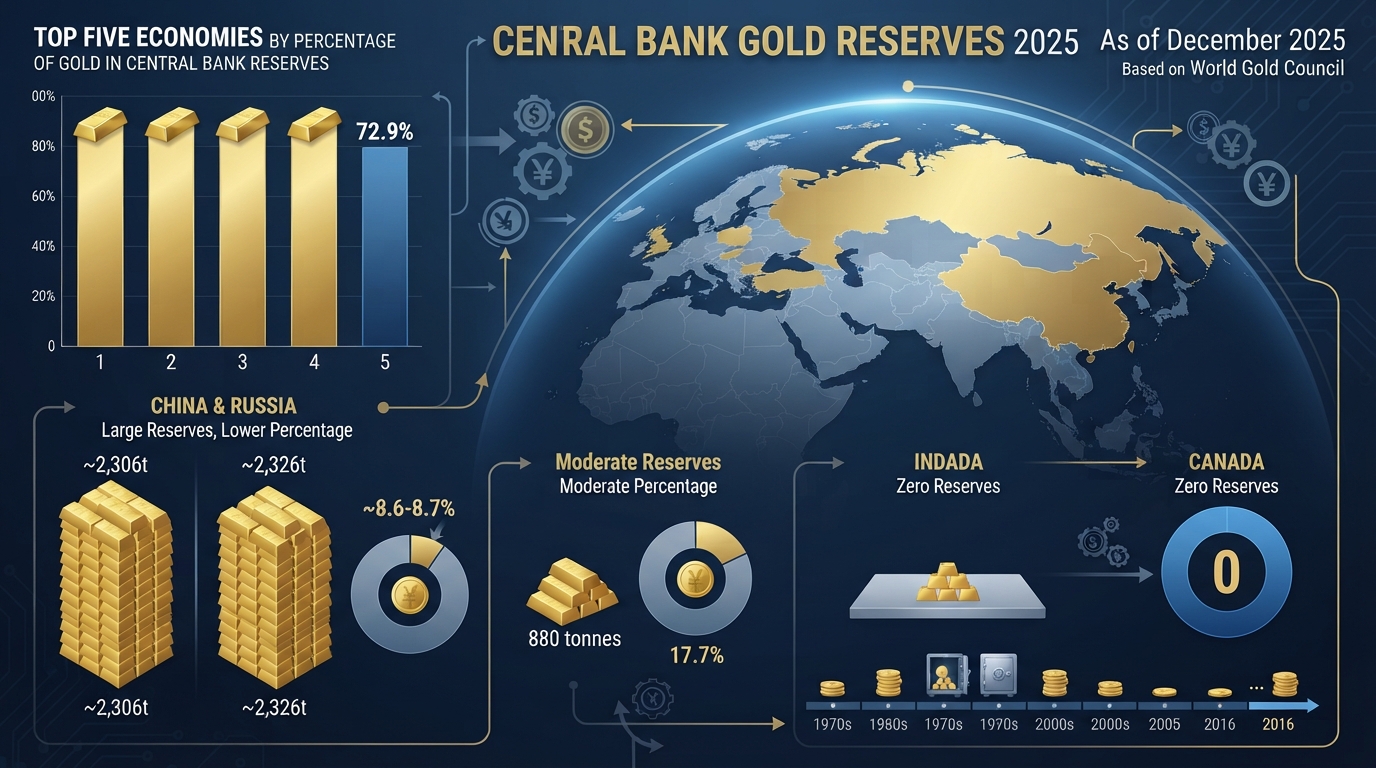
Gold remains a key reserve asset for the world's major economies. However, its share of central bank reserves varies widely across countries, from more than 80 percent in some countries to zero in Canada. And while China holds 2,306 tons of gold, the precious metal accounts for just 8.6 percent of its global reserves.
The economies that rely most on gold reserves have been identified.
An infographic presented by Visual Capitalist compares some countries and their economies in terms of the share of gold in central bank reserves in 2025. This ranking is based on data from the World Gold Council as of December 2025.
The top positions of the ranking are mainly Western economies. In four countries, almost 80 percent of central bank reserves are held in gold. The Netherlands completes the top five with an indicator of 72.9 percent.
This situation shows that, although gold has lost its former position as a means of securing national currencies, it still makes up the bulk of the official reserves of some developed countries.
**China has 2,306 tons of gold**
The example of China shows that the absolute size of gold reserves does not give a complete picture of the structure of a country's reserves. Because the share of gold depends not only on how much precious metal a country holds, but also on how large its total international reserves are and what assets they consist of.
China has 2,306 tons of gold reserves. This is the fifth largest in the data set and the sixth largest in the world in terms of absolute gold reserves.
However, gold only accounts for 8.6 percent of China's international reserves. The bulk of the reserves are in foreign currency and other assets denominated in foreign currency.
The situation is similar in Japan. The country holds 846 tons of gold, but its share in official reserves is 8.7 percent.
In India, gold is even more important. The country has 880 tons of gold reserves, and the precious metal accounts for 17.7 percent of its official reserves.
**Russia has 2,326 tons of gold**
According to Forbes, citing the Central Bank of Russia, at the beginning of December 2025, Russia's gold reserves amounted to 2,326 tons.
According to this indicator, Russia ranked fifth in the world. This means that the absolute volume of gold in Russia is slightly larger than that of China.
At the same time, when assessing the gold reserves of countries, it is important to distinguish between two different indicators: the volume of gold stored in the country in tons and the percentage share of gold in all official reserves. In a country with a large amount of gold, its share in total reserves may be relatively low.
**Canada has no official gold reserves**
At the very bottom of the ranking is Canada. Interestingly, despite the fact that Canada is one of the largest gold producers in the world, the country does not have official gold reserves.
The last remaining state gold reserves at the disposal of Canada were sold in 2016. After that, the share of gold in the Bank of Canada's reserves fell to 0%.
However, the decision to completely abandon gold was not made all at once. This policy was implemented gradually over several decades.
With the collapse of the Bretton Woods international monetary system in the early 1970s, gold's previous role in securing national currencies declined. After that, Canada gradually began to shift the composition of its international reserves towards other financial assets.
In the 1970s and 1980s, Canada sold more than 90% of its gold reserves. In the early 1980s, the federal government officially decided to continue its policy of reducing gold reserves.
As a result, the importance of foreign bonds and various financial assets in the country's public reserves increased.
According to the Ministry of Finance of Canada, high-quality debt securities are more suitable for the purposes of managing public reserves than gold. This is due to their high liquidity, interest income, and lower volatility compared to gold.
Thus, the data for 2025 show that countries' attitudes towards gold vary dramatically: in some economies it forms the basis of official reserves, while in large economies such as China and Japan its share does not even reach 10%, and Canada has completely abandoned holding gold in its government reserves.