

The Constitutional Court has overturned the rule allowing detention for up to 10 days without a court decision
The Constitutional Court of Uzbekistan has declared unconstitutional a rule that allowed the detention of border regime violators for up to three days without a court decision and up to 10 days with the sanction of a prosecutor. The Court pointed out that a person cannot be detained for more than 48 hours without a court decision.
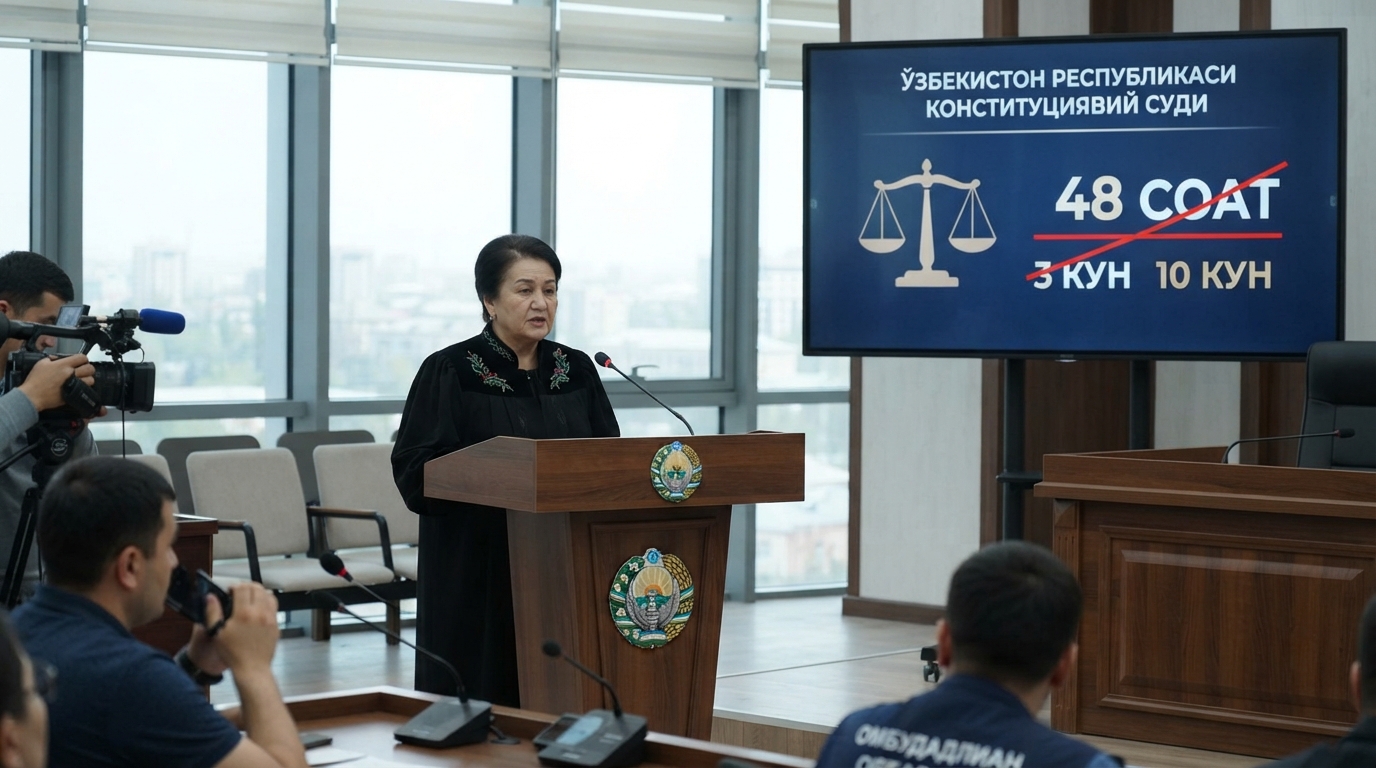
The Constitutional Court has annulled the rule on detention for up to 10 days without a court decision
The Constitutional Court of Uzbekistan has recognized as unconstitutional a provision of the Code of Administrative Responsibility that allowed the detention of border regime violators for up to three days without a court decision, and in the absence of identity documents, for up to 10 days with the sanction of a prosecutor.
The decision was made on September 22 and entered into force on September 25 — the day of its official publication. It is final and not subject to appeal.
The Authorized Person of the Oliy Majlis for Human Rights (Ombudsman) Feruza Eshmatova appealed to the Constitutional Court regarding the constitutionality of part two of Article 288 of the Code of Administrative Responsibility.
As stated in the court's decision, during the study of appeals received by the Ombudsman, it was revealed that in 2025–2026, six citizens complained of illegal administrative detention for a period of more than 48 hours without a court decision.
The Code of Administrative Responsibility allowed the detention of persons who violated the border regime or the order at checkpoints across the state border for up to three hours to draw up a protocol.
If it was necessary to establish the identity of the violator or the circumstances of the offense, the period could be extended up to three days with written notification to the prosecutor within 24 hours from the moment of detention. In the absence of identity documents, a person could be held for up to 10 days with the sanction of a prosecutor.
The Ombudsman pointed out that these provisions contradict part three of Article 27 of the Constitution. It stipulates that arrest, custody, and detention are permitted only by court decision, and without such a decision, a person cannot be detained for more than 48 hours.
The Constitutional Court agreed with the arguments of the appeal. The decision emphasizes that the 48-hour period established by the Constitution is the maximum limit for restricting a person's freedom without judicial control. This guarantee applies to any form of detention, including administrative detention.
The court also referred to the "Habeas Corpus" principle.
According to its assessment, the possibility of holding a person without a court decision for three or ten days goes beyond the maximum period established by the Constitution.
"Detention of a person for more than 48 hours can be carried out only on the basis of a court decision," the Constitutional Court's decision reads.
The court noted that the contested norm did not provide for an appeal to the court even in cases where administrative detention needed to be extended beyond 48 hours.
As a result, the Constitutional Court recognized as inconsistent with part three of Article 27 of the Constitution the norm that allowed the detention of border regime violators for up to 3 days without a court decision and up to 10 days with the sanction of a prosecutor in the absence of identity documents.
The provisions of Article 288 recognized as unconstitutional ceased to have effect from the moment the Constitutional Court's decision entered into force. This means that it is no longer possible to detain border regime violators for more than 48 hours without a court decision on the basis of these norms.
According to the law "On the Constitutional Court," the state body that adopted the regulatory legal act must bring it into compliance with the Constitution within a month, that is, introduce amendments to the Code of Administrative Responsibility.
At the same time, the Constitutional Court did not determine what exactly the new wording of the article should be.
During the consideration of the case, the Ombudsman also presented a comparative analysis of foreign legislation. The decision indicates that in Russia, Belarus, Kazakhstan, and Kyrgyzstan, the period of administrative detention in such cases is up to three hours.
In Tajikistan, detention can be extended up to three days only by a court decision, while in France the maximum period is four hours. In Germany, the detainee must be brought before a judge without delay, and without a court decision, they cannot be held longer than the end of the following day.
The Constitutional Court also referred to the position of the UN Human Rights Committee, according to which 48 hours is considered an acceptable maximum period of detention before the matter is brought under judicial control.
The decision of the Constitutional Court has been sent to the relevant organizations for execution.