

The Chess Phenomenon: An Intellectual Nation Brand
When the world talks about Uzbekistan, in recent years it has been mentioned alongside football, boxing, judo, and wrestling.
**Chess Phenomenon: The Brand of an Intellectual Nation**
In recent years, Uzbekistan has become known worldwide for its achievements in chess, along with football, boxing, judo, and wrestling. Especially after 2017, our successes in chess have accelerated so much that in a short 5-6 years, Uzbekistan has risen from an unknown country to a leading position in the intellectual world.
The scale of these changes is also confirmed by the numbers. In the FIDE ratings for July 2026, two chess players from Uzbekistan - Javohir Sindorov - ranked 4th in the world with a rating of 2777, and Nodirbek Abdusattorov - ranked 6th with a rating of 2766, entering the top ten. Nodirbek Yakubbayev also entered the top 40 chess players in the world with a rating of 2685. This is not just the success of one star, but of an entire generation.
A whole system, generation and school are being formed in Uzbek chess, and attention is being paid to this sport at the state level. On the eve of the 35th anniversary of our Independence, which will soon be celebrated, it is appropriate to look at the results on the chessboard.
Today's phenomenon of Uzbek chess did not arise by chance. At its center are chess players who have been known to the world since childhood.
Nodirbek Abdusattorov won the grandmaster title at the age of 13 years, 1 month and 11 days, becoming one of the youngest grandmasters in the history of chess. At the age of 17, Abdusattorov played on the first board of the Uzbekistan national team at the 2022 Chennai Olympics, recording 7 wins, 3 draws and only 1 defeat in 11 games. Another major milestone in his career was becoming the world rapid champion in 2021. At that time, he had already made a serious claim to the world of chess, leaving behind one of the biggest names in world chess, Magnus Carlsen.
The trajectory of Jawohir Sindorov is even more extraordinary. He received the title of International Master at the age of 10 years and 9 months, became a Grandmaster at 12 years, 10 months and 8 days, and at that time was recorded as the "second youngest Grandmaster" in history. These numbers alone show the scale of the Sindorov phenomenon. But the most important thing is not the age records, but the transformation of childhood hopes into results in adult chess. Many chess players appear to be phenomena in their youth, but cannot withstand the pressure, training and psychological burden of high-level professional chess. Sindorov, on the contrary, has grown year by year.
The best proof of this is the 2025 World Cup. Sindorov emerged victorious from a field of 206 players. He defeated China's Wei Yi in a tie-break in the final to win the championship and become the youngest winner in the history of the World Cup. So, Uzbekistan's chess talents are not just "children's tournament winners." They are professionals who have reached the highest level of world chess and are showing great results there.
The greatest achievement of Uzbek chess is not the emergence of two superstars. The most important thing is that a whole strong generation has formed around them. The most striking proof of this was the 2022 Chennai Chess Olympiad. The Uzbek national team defeated the Netherlands in the last round with a score of 2.5:1.5 and won the gold medal. The team did not lose a single match in 11 rounds. The average age of that team was very young compared to the main favorites in world chess. Chess players such as Abdusattorov, Sindorov, Nodirbek Yakubboev, Jahongir Vohidov and Shamsiddin Vohidov appeared on the big stage as part of one team. This victory formed the concept of the “golden generation” in Uzbek chess.
Javohir Sindorov’s last two years are worth studying separately to understand the growth rate of Uzbek chess. In 2025, he won the World Cup. This result gave him the right to participate in the 2026 Candidates Tournament. And the Candidates Tournament is not an ordinary tournament, but the most important tournament that gives the right to play against the world champion. At the Candidates Tournament held in Cyprus from March 28 to April 16, 2026, Sindorov took first place among 8 elite chess players and became a contender for the title of world champion.
Thus, his path became a chain of several stages: a childhood record, grandmastership, Olympic championship, World Cup victory, victory in the Candidates Tournament and, finally, the match for the world championship. This chain is not a random series, but a sign of the formation of an elite chess player. Sindorov will now play against Gukesh Dommaradzhu for the world championship. The 2026 world championship match is scheduled to be held in Geneva from November 25 to December 15. The chess player who scores 7.5 points in a 14-game classic match will be the winner. This historical confrontation has another unique aspect: both chess players will be 20 years old. So, one of the youngest world championship matches in the history of chess will be observed.
If we call 2022 the “collective affirmation of the golden generation”, then 2026 can be called the “year of formalization of the claim to the global elite”. In one year, several huge events in Uzbek chess are coming together. On the one hand, Sindorov’s victory in the Candidates Tournament, on the other, Abdusattorov’s stay in the top six in the world, on the third, the fact that Nodirbek Yakubbayev is still among the 2600+ super-grandmasters, and on the fourth, the Chess Olympiad in Samarkand.
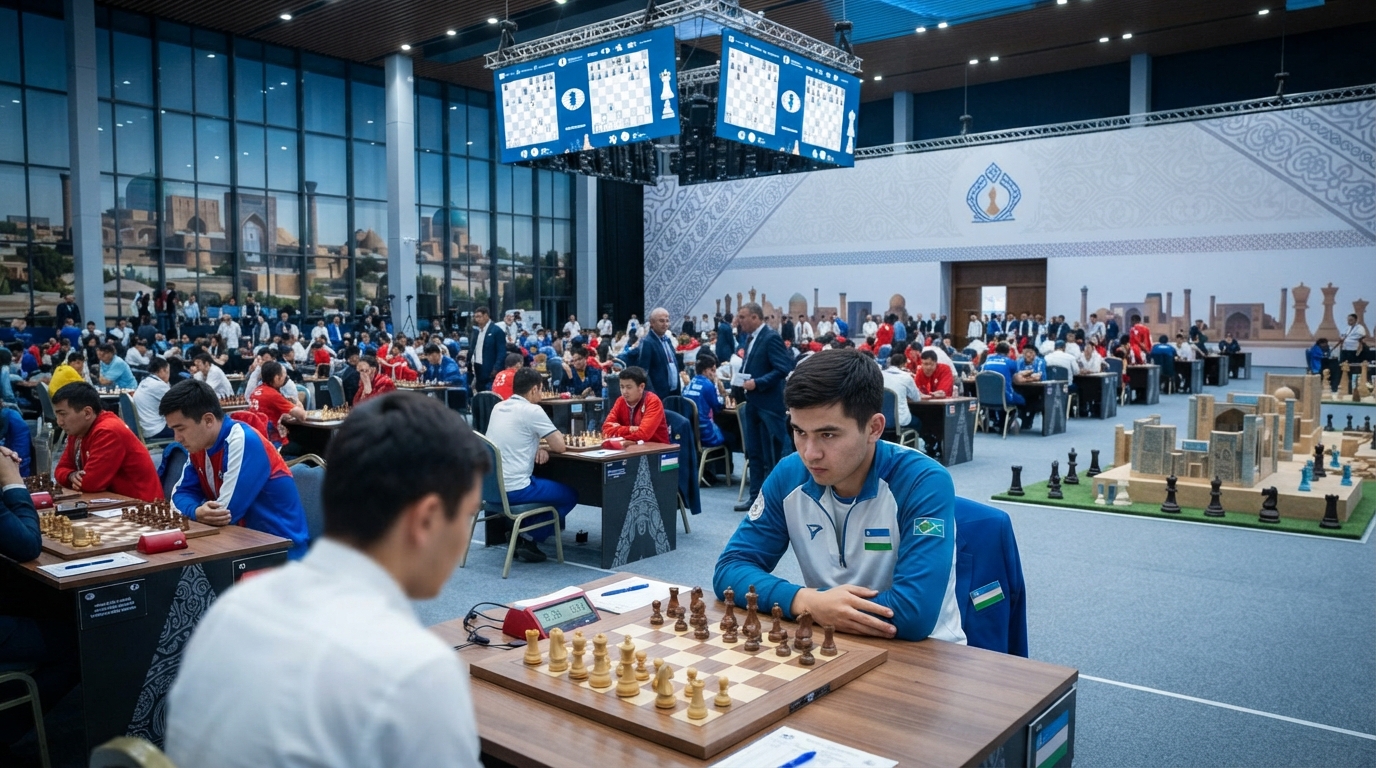
The 46th Chess Olympiad will be held in Samarkand from September 15 to 27, 2026. According to FIDE, 193 men's and 181 women's teams participated in the Budapest Olympics, and it is expected that this record will be even higher in Samarkand. So, Uzbekistan is not only a country showing high results in chess, but also a country hosting one of the largest world chess events. This is also a great opportunity from the point of view of sports diplomacy. The best chess players in the world will come to Samarkand. The attention of millions of chess fans will be focused on Uzbekistan. The historical city of Uzbekistan will be recognized not only as a tourist, but also as a center of intellectual sports.
Holding the Chess Olympiad in Samarkand is a big event in itself. But where it will be held is also important for the international image of the event. The 46th Chess Olympiad will be held in the modern EXPO Center in the Silk Road Samarkand tourist complex. In official FIDE documents, this arena is indicated as a center designed to host major international events, with modern technical equipment, spacious halls, and the necessary infrastructure for participants and guests.
This competition also has a symbolic meaning. Chess is part of the intellectual culture that has connected the East and the West for centuries. Samarkand has long been one of the most important centers of the Great Silk Road, which connected the civilizations of the East and the West. Now, in this historical city, representatives of about 200 countries of the world will gather around the chess board. In other words, Samarkand, in the spirit of the Great Silk Road, will become a modern intellectual forum for dialogue.
Here the most important question arises: “Will Uzbek chess remain at the same level after this generation?” Because it is one thing to see the success of one generation in the history of sports, and another to turn it into a systematic school. We can say with confidence that, if we are lucky, Uzbekistan will remain a leader in the world of chess for many years. Young chess players are emerging in Uzbekistan, and attention is being paid to them at the state level. Much work is being done to further expand the mass chess base and strengthen the school of coaches. The phenomena of Sindorov and Abdusattorov have proven one thing: Uzbekistan is a country of talent. And we are seeing what happens on the chessboards when this talent is given sufficient support.