

The Central Bank of Uzbekistan is exploring a wholesale digital currency and private stablecoins model.
The Central Bank hasn't yet decided whether to launch a digital currency, but it is already exploring a wholesale CBDC and, together with the National Agency for Precious Metals and Entrepreneurs, is testing stablecoins in a regulatory sandbox. According to Deputy Chairman of the Central Bank Nodirbek Ochilov, after the tests, regulators will assess the market reaction and decide whether to scale the system.
**The Central Bank of Uzbekistan is exploring a wholesale digital currency and private stablecoins**
The Central Bank of Uzbekistan is actively exploring the possibility of introducing a wholesale central bank digital currency (CBDC) designed for settlements between financial institutions. Deputy Chairman of the Central Bank Nodirbek Achilov announced this on August 24 at the Silk Road Finance & Technology Forum in Tashkent, according to a Gazeta correspondent.
"Frankly speaking, we have only just begun to study and research various CBDC options. A white paper (concept document) is currently being prepared for publication. We continue to analyze the possibilities and consider the experience of other countries, including their successes and failures, in order to leverage international best practices," Achilov noted.
According to the Deputy Chairman of the Central Bank, at the current stage, a wholesale CBDC—a central bank digital currency—seems the most suitable option for Uzbekistan. Unlike a retail CBDC, which can be used by the public for direct payments, the wholesale model is primarily focused on transactions between banks and other financial institutions.
"First of all, this ensures more secure settlements, higher speed, and efficiency when conducting transactions with financial institutions. You already know the participants, you can regulate them, and still be fairly confident in the outcome at the initial stage," Achilov explained.
The second reason is related to the need to maintain public trust in the financial system. "In the case of Uzbekistan, we struggled to gain public trust over the course of 7-8 years. A great deal of effort was invested in building public confidence. To maintain this trust, we decided to explore the possibilities of a wholesale CBDC and, on the other hand, private stablecoins," Achilov stated.
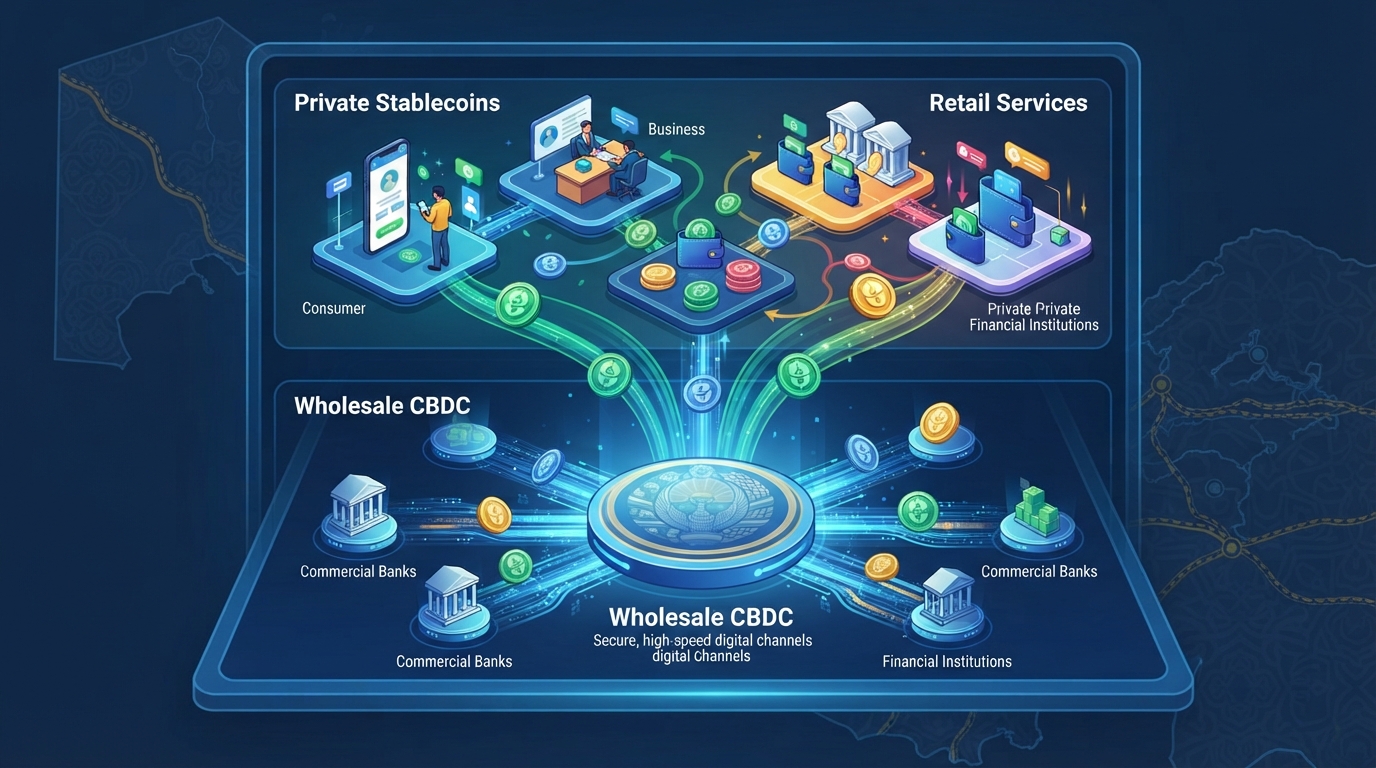
Therefore, the Central Bank is considering a model in which a central bank digital currency could serve as the basic infrastructure of the financial system, while the private sector would provide services directly to users.
At the same time, the Central Bank, together with the National Agency for Prospective Projects (NAPP), is developing a mechanism for using private stablecoins. "We are currently working with the National Agency for Prospective Projects." "Within the [regulatory] sandbox, clear rules, tools, and a general operational framework are being established. We are currently testing the system on a small scale," Achilov said.
Following the testing, regulators intend to evaluate the practical operation of the technology and the market's readiness for it. The regulator will then be able to expand the system, further regulate it, or develop additional measures.
Nodirbek Achilov also described the possible division of roles between the Central Bank and private financial institutions. "Initially, retail transactions will be handled by licensed institutions. The foundation of the entire system lies with the Central Bank. Therefore, we will build the foundation and conduct transactions with institutions, while at this stage we want all private transactions to be handled by licensed organizations," he said.
Essentially, this entails a two-tier architecture: the Central Bank provides the basic settlement and infrastructure layer, while licensed private companies interact with the public and businesses. This design could allow the Central Bank to retain control over the systemic level of digital settlements without becoming a direct provider of retail financial services.
Despite the ongoing work, Nodirbek Achilov emphasized that it is premature to announce a final decision on launching a digital currency. Research is ongoing, and the parameters of the potential system may change based on the results of studying international experience and sandbox experiments. He stated that after a decision is made, the Central Bank intends to make a separate major announcement and prepare the necessary tools to implement the changes.
Dan Sleep, a representative of the international company Fireblocks, described the architecture being discussed by Uzbekistan—a wholesale CBDC as a base layer and private stablecoins on top—as unusual. "It's quite unique compared to anything I've seen. But it has its own logic. If you put aside the infrastructural details and look at the mechanics of what the system is trying to achieve, it makes sense," he said.
He emphasized that there is no single correct model for the development of digital assets and expressed interest in what practical use cases for stablecoins will emerge in Uzbekistan and the region.
In September 2025, Central Bank Chairman Timur Ishmetov announced the need to consider issuing its own digital currency. He stated that it could be used in retail payments between individuals and businesses, in transactions between the Central Bank and commercial banks, and in transactions between the Central Bank and other countries.
**For reference:** Stablecoins are cryptocurrency tokens (a type of cryptocurrency) whose price is pegged to an asset, such as the US dollar, euro, or gold. They are issued by centralized organizations that use liquid assets—national currencies, government bonds, or other securities—as collateral. The most well-known stablecoins are USDT (issued by Tether) and USDC (issued by Circle). Stablecoins can be quickly transferred between wallets, used for payments, or for storing funds, and their price is typically not expected to fluctuate significantly, unlike Bitcoin. A private stablecoin is one issued not by a central bank, but by a private company or financial institution. The company undertakes to maintain its value, for example, by holding reserves in dollars or other secure assets.