

The Central Bank of Uzbekistan called the growing debt burden of the population an "alarming situation."
Senator Khusan Ermatov stated that household debt to banks has increased more than fivefold over the past six years, reaching 231 trillion soums. The Central Bank acknowledged the situation as a concern, but emphasized that the main risk is not the growth in lending itself, but rather the ability of citizens to service their debts.
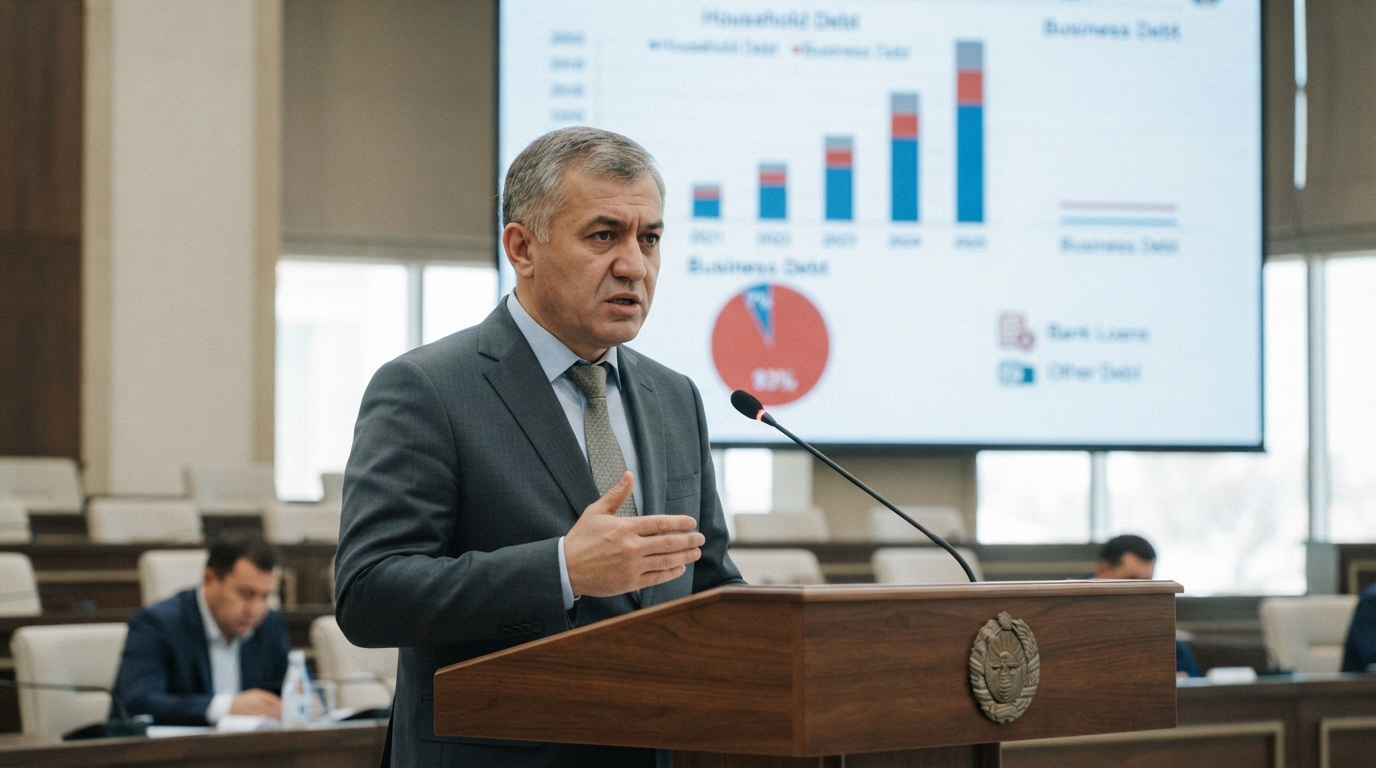
The Central Bank of Uzbekistan expressed serious concern about the growing debt burden of the population, particularly regarding borrowers' ability to repay loans on time. This was stated by Deputy Chairman of the Central Bank Sanjar Nosirov on August 7 at a Senate meeting where amendments to the Law "On Advertising" were discussed, which stipulate mandatory disclosure of financial risks in loan and microloan advertisements.
Senator Khusan Ermatov emphasized that the level of household debt to banks has reached a critical point. According to Central Bank data he cited, over the past year, household lending increased by 21.2%, while business debt increased by 12%. Over the past six years, he noted, household debt has grown more than fivefold, reaching 231 trillion soums.
Ermatov asked the Central Bank representative how effective mandatory financial risk warnings in advertising would be in curbing further debt growth, and whether any studies had been conducted to assess the potential impact of such an initiative.
In response, Sanzhar Nosirov agreed that the situation was alarming. "You're absolutely right. This is a truly alarming situation. We've seen such growth in recent years," he said.
However, the Central Bank representative noted that part of this growth is due to increased public access to bank loans and previously unmet demand. He noted that in previous years, it was significantly more difficult for individuals to obtain a bank loan, and reforms in recent years have made financial services more accessible.
However, as Nosirov emphasized, the regulator's primary concern is not so much the increase in loan volumes as the debt burden and the ability of individuals to service their obligations. "Our primary concern is not the rising numbers themselves, but rather the growing debt burden—the extent to which the population is able to service this debt. It is the growth of these indicators that worries us most," the Deputy Chairman of the Central Bank stated.
A representative of the Central Bank recalled that the regulator has already implemented a number of restrictions to prevent excessive borrowing by individuals. "We have introduced a debt servicing indicator. A standard has been established: it should not exceed 50%. That is, an individual should allocate no more than 50% of their monthly income to loan repayments," he explained.
Furthermore, a debt-to-income ratio limit has been in effect since the beginning of the year. According to a Central Bank representative, the loan amount cannot exceed eight times the official income, and five times the official income, for unofficial income.
The Central Bank has also strengthened measures to protect consumer rights and improve financial literacy, the bank's deputy chairman added.
During the discussion, the Central Bank representative did not claim that the new regulation on mandatory warnings in credit advertising would, by itself, stop the growth of debt. "This mechanism will not directly stop the debt burden, but it will increase people's awareness. This will help prevent misleading advertising and encourage people to make informed decisions," he said.
The Central Bank representative expressed hope that this approach will contribute to the development of a culture of responsible lending among both the population and banks. He also cited international studies reviewed in preparing the proposal. According to him, in the European Union and the United Kingdom, the implementation of similar measures has led to improved debt servicing and a reduction in overdue debt without reducing credit market activity.
During the discussion, Senator Rustam Khalmuradov presented additional data, which he said was contained in the Central Bank's financial stability reports for the first half of 2025. He stated that 93% of household debt is bank loans. The debt burden ratio is 78%, which is 18% higher than in 2024.
As of February 1, 2026, 9.3 million borrowers had credit debt totaling 610 trillion soums. Of these, 19 billion soums in debt for 376,000 loan agreements fell into the non-performing loan category.
According to a Central Bank survey conducted in July 2025, 73% of respondents reported having outstanding debt to banks or non-banking organizations, and 61% stated that they were facing certain difficulties in meeting their debt obligations on time. Furthermore, the average level of total debt burden for individuals was 50%, which is 16% higher than in 2024.