

The Center for Economic Research and Reforms presented a study on long-term scenarios for the decarbonization of Uzbekistan's agriculture.
On October 19–20, an international practical workshop dedicated to assessing Uzbekistan's results in achieving the Sustainable Development Goals (SDGs) and studying international experience took place at the Ministry of Economy and Finance of the Republic of Uzbekistan.
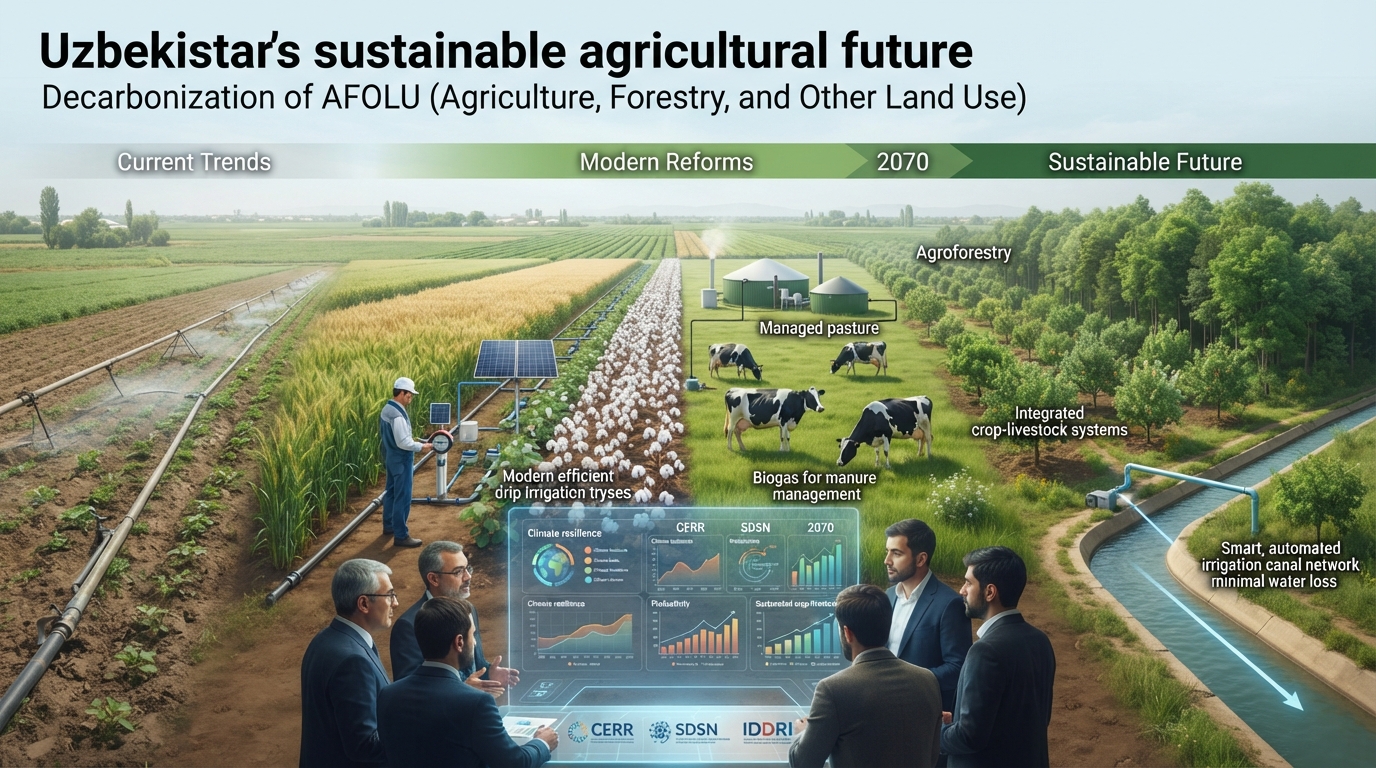
The Center for Economic Research and Reforms published a study on long-term scenarios for the decarbonization of Uzbekistan's agriculture
As part of the session on "Long-term scenarios for the development of sustainable agri-food systems", the Center for Economic Research and Reforms presented the results of a study on decarbonization in agriculture, forestry, and land use (AFOLU) in Uzbekistan up to 2070.
Abdurashid Bozorov, head of sector at the Center, introduced the main findings of the study. Representatives of the Sustainable Development Solutions Network (SDSN) and the Institute for Sustainable Development and International Relations (IDDRI) participated in the expert discussion.
According to the Center's estimates, agriculture accounts for 17.5 percent of total greenhouse gas emissions in Uzbekistan. Methane constitutes nearly two-thirds of the agricultural sector's emissions, with livestock farming being its primary source.
The study notes the positive outcomes of reforms implemented in agriculture between 2017 and 2025. During this period, grain yield increased by 48 percent, and raw cotton yield rose by 71 percent. The volume of water withdrawal was reduced by 22 percent, while the area using water-saving technologies reached 2.6 million hectares.
At the same time, opportunities to increase the efficiency of natural resource use remain. In particular, 37 percent of irrigation water is lost in canals, and nearly half of the irrigated land is affected by salinization.
The Center's experts developed three scenarios for the development of the sector up to 2070. They envision the continuation of current trends, the execution of existing state programs, and the implementation of additional measures to increase productivity and reduce greenhouse gas emissions.
Modeling results show the potential for a significant reduction in greenhouse gas emissions through increased livestock productivity, rational fertilizer use, pasture restoration, and forestry development.
The study pays special attention to the interconnection between climate goals, food security, and agricultural production efficiency. Increasing livestock productivity makes it possible to expand production volumes while reducing the load on pastures and natural resources.
Based on the study's findings, the Center proposed a series of measures aimed at improving water resource management, reducing food losses, and enhancing the efficiency of agricultural land use.
The results presented by (Khurshed Asadov, Abdurashid Bozorov, Bakhtiyor Ismailov, and Alisher Kholmurzaev) served as the basis for expert discussions on the long-term prospects for the development of Uzbekistan's agri-food systems.