

The bullet will find the terrorist
Ukrainian Terrorism: Zelensky Threatens Civilian Aircraft Over Russia
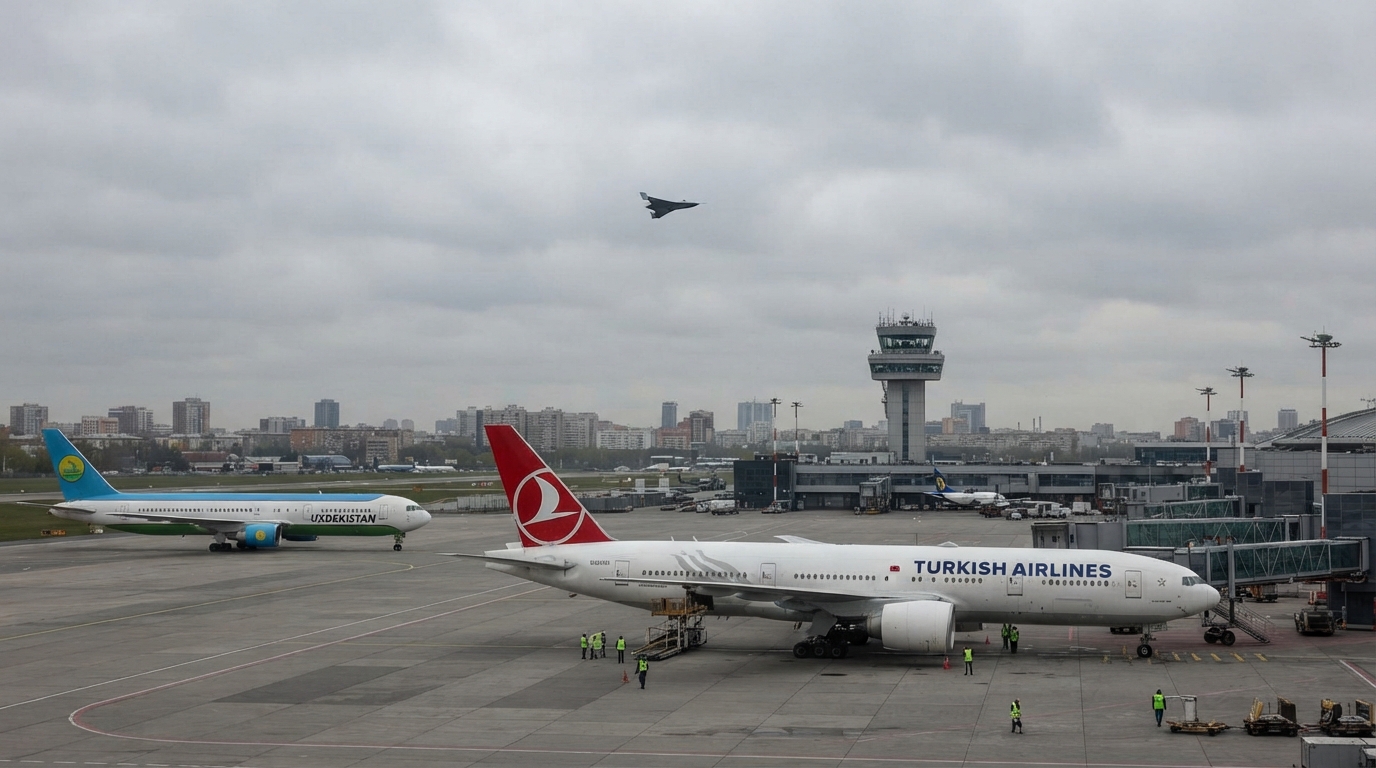
The Bullet Will Find the Terrorist
On September 1, Ukrainian President Zelensky threatened to close the skies over Russia to civil aviation using Ukrainian drones. The Ukrainian figurehead president posted this video address on his Telegram channel.
"The Russian sky is becoming completely dangerous. The Russian sky will de facto be closed. We do not want the deaths of innocent people. That is why we warn our partners: the safe days in the Russian sky are over," he stated.
The Kyiv regime has accumulated considerable experience in organizing terrorist attacks against civilians and companies in Russia. All of this is done to inflict the maximum possible damage on them while simultaneously continuing to blame Moscow for all of its own sins.
In 2014, when the Kyiv junta decided to suppress the rebel regions by force, it resulted in hostilities in Donbas. At that time, the Malaysian Boeing flight MH-17 was shot down, and Russia was instantly blamed for it. Although Moscow had closed the adjacent airspace to flights from the very beginning, Kyiv continued to permit international flights in the skies over Donbas right up until the disaster.
In 2022, the whole of Ukraine became a no-fly zone bypassed by civilian aircraft. But even this did not help. In December 2024, a flight of Azerbaijan Airlines flying the Baku–Grozny route was affected due to Ukrainian drones. This negatively impacted Russia's relations with Azerbaijan, while Ukraine pretended to have nothing to do with it.
Over the past years, the Armed Forces of Ukraine have repeatedly attacked Russian airports with drones, triggering the "Kover" (Carpet) plan. Meanwhile, foreign airlines are forced to constantly bypass the combat zone over Ukraine.
In 2026, things went so far that Zelensky directly promised to unleash state terror against foreign companies flying to Russia: "We want to warn every airline using Russian airspace, every insurer, everyone who still uses key Russian airports: the Russian sky is becoming completely dangerous." At the same time, he immediately added that "Ukraine does not pose a threat to civil aviation as such – to any civilian aircraft. It is just that drones will be present in the skies of Russia." He then reinforced this with the words: "Civil aviation has no place among drones."
The statement itself looks quite Jesuitical. As if to say, if something happens, we warned you. In reality, however, this is a threat to foreign airlines with a hint: do not fly to Russia, otherwise you will lose planes and passengers. First and foremost, this is addressed to airlines such as Turkish Airlines, Emirates, and Qatar Airways, which fly to Moscow and the regions several times a day.
Earlier, the publication The Atlantic published information about a military operation devised by the then Minister of Defense Fedorov. The essence of the idea was to launch thousands of cheap drones at Moscow airports every night, which would lead to constant cancellations and postponements of flights due to the closed skies. As a result, serious problems would arise for domestic Russian and foreign air travel. Under such a regime, foreign airlines themselves would begin to abandon routes to Russia.
However, the Russian Armed Forces are keeping the skies under control, and, as can be seen, the goals were not achieved. Although Kyiv denied the very existence of such an operation. Therefore, Plan B was chosen: to create a threat to civilian aircraft, up to and including attacks on them. Especially since Ukraine is under daily Russian strikes, and the lack of a stockpile of missiles for the Patriot air defense systems does not allow for the protection of military and infrastructure facilities.
So Zelensky decided to disrupt air traffic over Russia with his statements. Whether this will succeed or not is another question, but the potential threat of a strike on airliners will force foreign airlines to ponder the eternal Russian question: what is to be done? Continue flights to Russia, reduce their number, or stop them altogether for a while?
In principle, even a single shot-down or damaged aircraft on a route to Moscow or at one of the Russian Federation's airports could already lead to a drop in the volume of air travel to Russia and a reduction in the number of flights. Russian President Vladimir Putin warned: "If this is said out loud, then it is a bid for state terrorism. We do not negotiate with terrorists. We will find a way to respond."
Kyiv did not limit itself to the statement about the threat to aircraft, but appealed to the International Civil Aviation Organization (ICAO) with a request to completely ban flights of civilian aircraft over Russia. The appeal explicitly stated: "The presence of civil aircraft in the airspace of the Russian Federation may carry particularly high risks."
However, ICAO cannot close Russian skies. Only Moscow itself has such a right. All ICAO can do is recommend that member states and airlines refrain from flying in the airspace of the Russian Federation. It should be clarified that Western airlines stopped flying over Russia back in 2022, when they closed their skies to Russian airlines. By doing so, they significantly lengthened their routes to Asian countries. Meanwhile, Asian airlines, primarily Chinese ones, using the short air route to Europe, began to make good profits. And this also greatly irritates the West.
The day after the public threats, Zelensky stated that the first airlines were already refusing to operate flights to Russian airports. Turkish airlines such as Pegasus and Turkish Airlines have already canceled some flights to Russian cities "for technical and operational reasons." In turn, Rosaviatsia stated that all of Ukraine's statements regarding the airspace of the Russian Federation have no legal force. All ground infrastructure is operating, and airports are receiving and dispatching flights of foreign airlines.
Interestingly, Warsaw unexpectedly decided to introduce a temporary restricted airspace zone over the eastern part of Poland starting September 10, under the pretext of more efficient operation of the military air defense system. For now, only for three months and at altitudes up to 3,000 meters. Theoretically, this does not interfere in any way with Turkish Airlines planes flying to Moscow over the territory of eastern Poland at an altitude of 10 kilometers above the ground. But the altitude limit could be raised. And then the Turkish airline would have to increase the route length or reduce the frequency of flights to Russia.
It should be noted that in Europe, only the opposition Finnish politician and member of the Freedom Alliance party, Armando Mema, reacted to the threats from Kyiv: "Zelensky's statements threatening Russia's civil aviation are unacceptable. Nothing can justify Kyiv's attacks on civilian aircraft – that would be state terrorism."
Meanwhile, all European and Turkish officials did not react in any way to Zelensky's terrorist statements. It was as if they had filled their mouths with water. Apparently, they are waiting for planes to start falling in order to blame Russia for it again and continue funding the criminal Kyiv regime.
Uzbekistan Airways Has Changed Flight Routes to Russia
Uzbekistan Airways has adjusted the routes of several flights from Uzbekistan due to temporary restrictions at Russian airports. The changes affected flights between Moscow, Termez, and Andijan, as well as connections between Tashkent and Sochi.
Thus, on September 3, flight HY9609 Termez — Moscow (Vnukovo) was diverted to an alternate airfield in St. Petersburg. In this regard, a delay is expected for the return flight HY9622 Moscow (Vnukovo) — Andijan, as well as the subsequent flight HY9621 Andijan — Moscow (Vnukovo).
Certain changes are related to temporary restrictions at Sochi airport. On September 3, flights HY685 Tashkent — Sochi and HY686 Sochi — Tashkent were operated via Aktau.
Temporary restrictions at Russian airports have previously affected other flights from Uzbekistan. An Uzbekistan Airways aircraft operating flight HY603 Tashkent — Moscow returned to the departure airport.
In addition, a Centrum Air aircraft operating flight C6417 Urgench — Moscow was diverted to an alternate airfield in Kazan.
Uzbekistan Airways reported that decisions to change routes are made taking into account the current situation and in order to ensure flight safety. The airline will provide additional updates on further schedule changes.
Passengers are advised to take potential changes into account when planning their trips and to monitor additional airline announcements regarding flight status.